
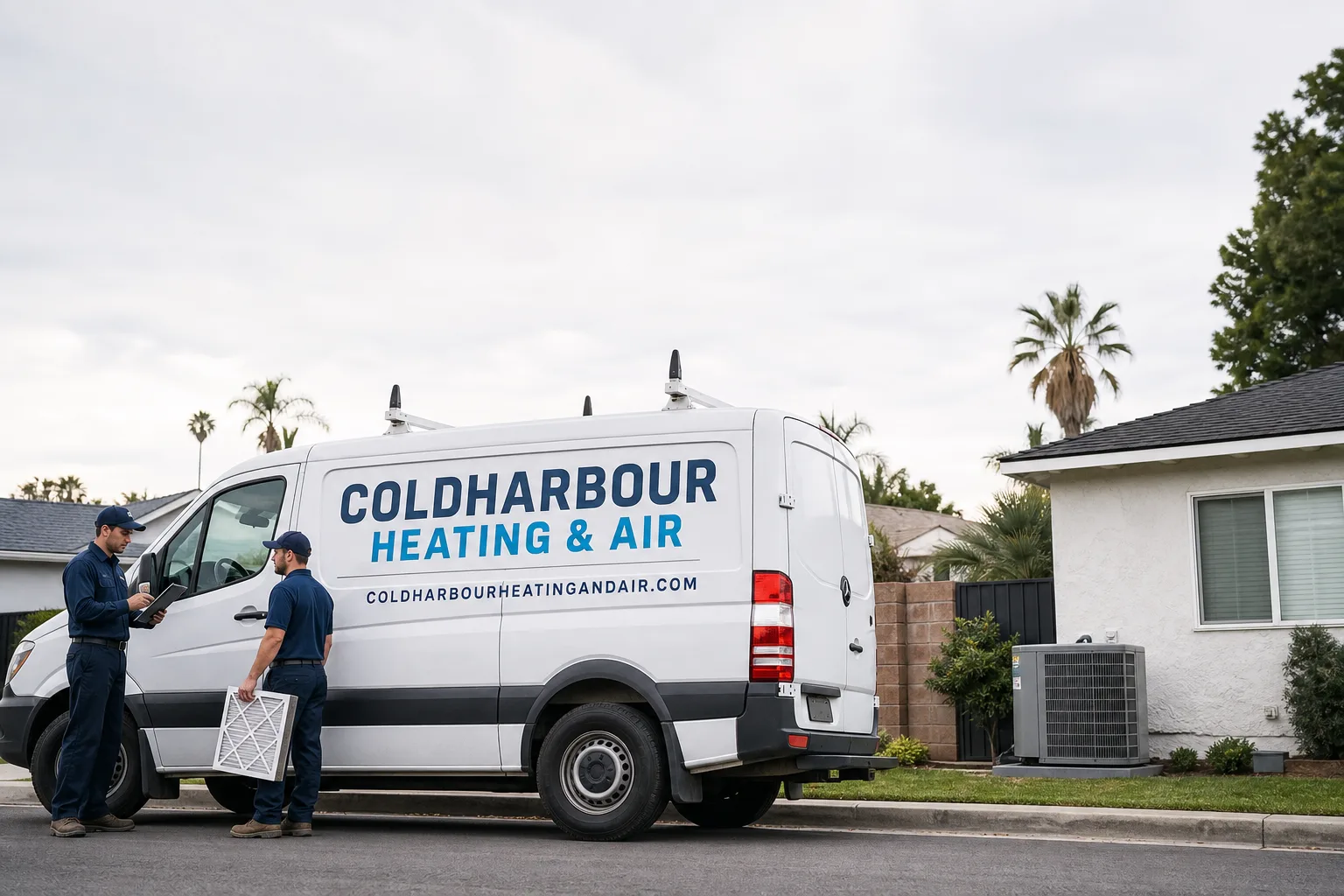
Seasonal tune-up and full diagnostic on your Carrier, Trane, or Goodman system - readings shown to you before any repair is proposed
Diagnosis first, numbers second - you approve the repair price before a single part goes in.







 Before
 After
After Before
 After
After Before
 After
AfterFurnace Won’t Turn On
What’s Happening
A furnace that won’t turn on is almost always caused by one of four things: a tripped circuit breaker, a dirty or clogged filter that triggered a safety shutoff, a failed igniter, or a fault with the thermostat signal. In most cases, the system itself is intact – it has simply stopped itself to prevent damage, or one small component has failed.
The frustrating part is that none of these look the same from the outside. The furnace just sits there, quiet, while your house gets colder. What you’re dealing with is almost certainly a solvable repair, not a full system failure. The key is figuring out which of those four causes is actually at work, because the fix is different for each one. The sections below walk through what to look for and what to leave alone until a technician arrives.
Why It Happens
The Filter Is Choked and the Safety Shutoff Tripped
A clogged air filter is the single most common reason a furnace stops dead. When airflow is blocked, heat builds up inside the heat exchanger faster than the system can move it. At a certain point, a component called the high-limit switch cuts power to the burners – not as a malfunction, but as designed. Pull the filter out and hold it up to a light source. If you can’t see light through it, that filter has been doing too much for too long.
The Igniter Has Failed
On most furnaces made in the last twenty years, a hot surface igniter – a small, brittle ceramic element – is responsible for lighting the burners. When it fails, the gas valve opens, the burner doesn’t light, and the furnace locks out after a few tries. You’ll often hear the furnace click on, run its startup sequence, and then go quiet without ever producing heat. A cracked or burned-out igniter is one of the more common cold-weather repairs we see, particularly on systems that have been running hard for several seasons.
A Tripped Breaker or Blown Fuse Cut the Power
Furnaces have dedicated electrical circuits, and those circuits can trip. Go to your electrical panel and look for a breaker labeled “furnace” or “air handler” that’s flipped to the middle position. A single tripped breaker can be reset once – if it trips again immediately, stop and call us, because a breaker that keeps tripping is telling you there’s a wiring or component fault that needs a technician, not a homeowner. There’s also a low-voltage fuse on the control board itself, usually a standard automotive-style blade fuse, that blows when there’s a wiring short.
The Thermostat Isn’t Sending the Right Signal
A thermostat that looks fine might not be communicating with the furnace correctly. Dead batteries are the overlooked culprit more often than you’d expect – a thermostat with a weak battery can display normally while failing to send a reliable call-for-heat signal. Check that the thermostat is set to “Heat,” that the temperature setpoint is actually above the room temperature, and that fresh batteries are installed if it uses them. If you have a smart thermostat that updated its firmware recently, a reset to factory settings sometimes resolves a communication glitch.
What to Do Right Now
- Check the thermostat first. Set it to Heat, raise the setpoint 5 degrees above room temperature, and replace the batteries if it takes them. Wait two minutes to see if the furnace responds before moving on.
- Find the furnace switch and the breaker. There’s usually a wall switch near the unit that looks like a light switch – confirm it’s on. Check your electrical panel for a tripped breaker and reset it once. If it trips again, leave it and call.
- Pull and inspect the filter. If it’s visibly gray and packed with debris, replace it with a clean one, reset the system by switching the furnace power off for 30 seconds and back on, and wait to see if it restarts. Do not run the system with no filter installed.
- Look at the furnace’s status light. Most modern furnaces have a small LED on the control board that flashes a diagnostic code. Count the flashes and compare them to the chart usually printed on the inside of the access panel door. Write down or photograph that code before you call – it tells a technician a great deal before they even arrive.
- Do not attempt to access the burner compartment, gas valve, or heat exchanger yourself. These components carry combustion gas and operate under conditions that can cause serious injury. If you smell gas, leave the house immediately, leave the door open, and call your gas utility from outside before calling anyone else. Once you’re clear and safe, call us at (817) 402-2972.
How We Fix It
When your local Coldharbour Heating & Air technician arrives, the first thing that happens is a written price. Not an estimate that changes when the panel comes off – a real number, on paper, handed to you before a single tool comes out. That’s not a policy we apply sometimes; it’s core to The Kingswell Way.
The technician will pull the diagnostic fault code, test the igniter resistance, check the flame sensor, measure voltage at the control board, and inspect the heat exchanger for cracks or blockages. Most no-start calls resolve under furnace repair – a failed igniter swap, a control board fuse, or a thermostat recalibration. Straightforward igniter replacements typically take under an hour once the right part is confirmed. More involved control board diagnostics run a bit longer.
Whatever the repair is, it’s covered by our 365-Day Done Right Promise: if the repair fails within a full year, we come back and correct it at no charge. That guarantee is written down before the technician leaves – not verbal, not conditional.
Frequently Asked Questions
It depends on what’s causing it. Most no-start situations are not immediately dangerous – a failed igniter or tripped breaker is a comfort problem, not a hazard. However, if you smell gas anywhere in the home, that is an emergency: leave immediately and call your gas utility from outside. A cracked heat exchanger can also allow combustion gases including carbon monoxide to enter your living space without any visible sign, which is why we always inspect the heat exchanger during a furnace repair call. If you have any doubt at all, call (817) 402-2972 and let us assess it – that’s a faster and safer answer than guessing.
In mild weather, a furnace that’s not starting is inconvenient but not urgent. In cold weather, it becomes a health risk quickly – especially for households with young children, elderly residents, or anyone with a respiratory condition. Don’t wait overnight if temperatures inside are dropping. Your local Coldharbour Heating & Air team answers live, around the clock, every day of the year – call (817) 402-2972 and tell us what you’re seeing.
Call (817) 402-2972 and ask. A live person answers that call right now – not a voicemail, not a callback request form, not an after-hours answering service that relays a message in the morning. We’ll tell you exactly what’s available and give you a real arrival window. We work on Carrier, Trane, Lennox, Goodman, Rheem, York, Daikin, Bryant, and American Standard systems, so whatever’s installed in your home, the technician who shows up can work on it.
The honest answer is that it depends on what’s actually wrong, and we won’t know that until the technician has run a proper diagnostic. What we can tell you is that you’ll have the exact price in writing before any work begins – the written price is included on every job, not something you have to ask for. There’s no figure that changes once the panel comes off. If you’d like a starting point, call (817) 402-2972 and describe what the furnace is doing; we can often give you a useful range before we even arrive.
Get It Fixed
Call (817) 402-2972 – a live person answers right now. Your local Coldharbour Heating & Air team will give you a real arrival window, show up in it, hand you a written price before touching anything, and back the repair with our 365-Day Done Right Promise. You can also book online if that’s easier.
Written by Victor Mancini, Owner & Lead HVAC Technician, Coldharbour Heating & Air, a member of the Kingswell network of independently owned and operated HVAC businesses, founded in 2003.
What Our Customers Say
"Furnace was short cycling all winter. They diagnosed a bad sensor instead of condemning the whole unit like I feared. Cheap fix, honest call."
- Russ Tiedemann"Thermostat and a weak blower. Fixed both in one visit, explained the guarantee, and didn't leave a mess. I've already recommended them to my neighbor."
- Natalie Esposito"Honest to a fault. Two companies told me I needed a whole new unit. Coldharbour said mine had years left and just needed a cleaning and a part. Saved me thousands."
- Marcus Reilly