
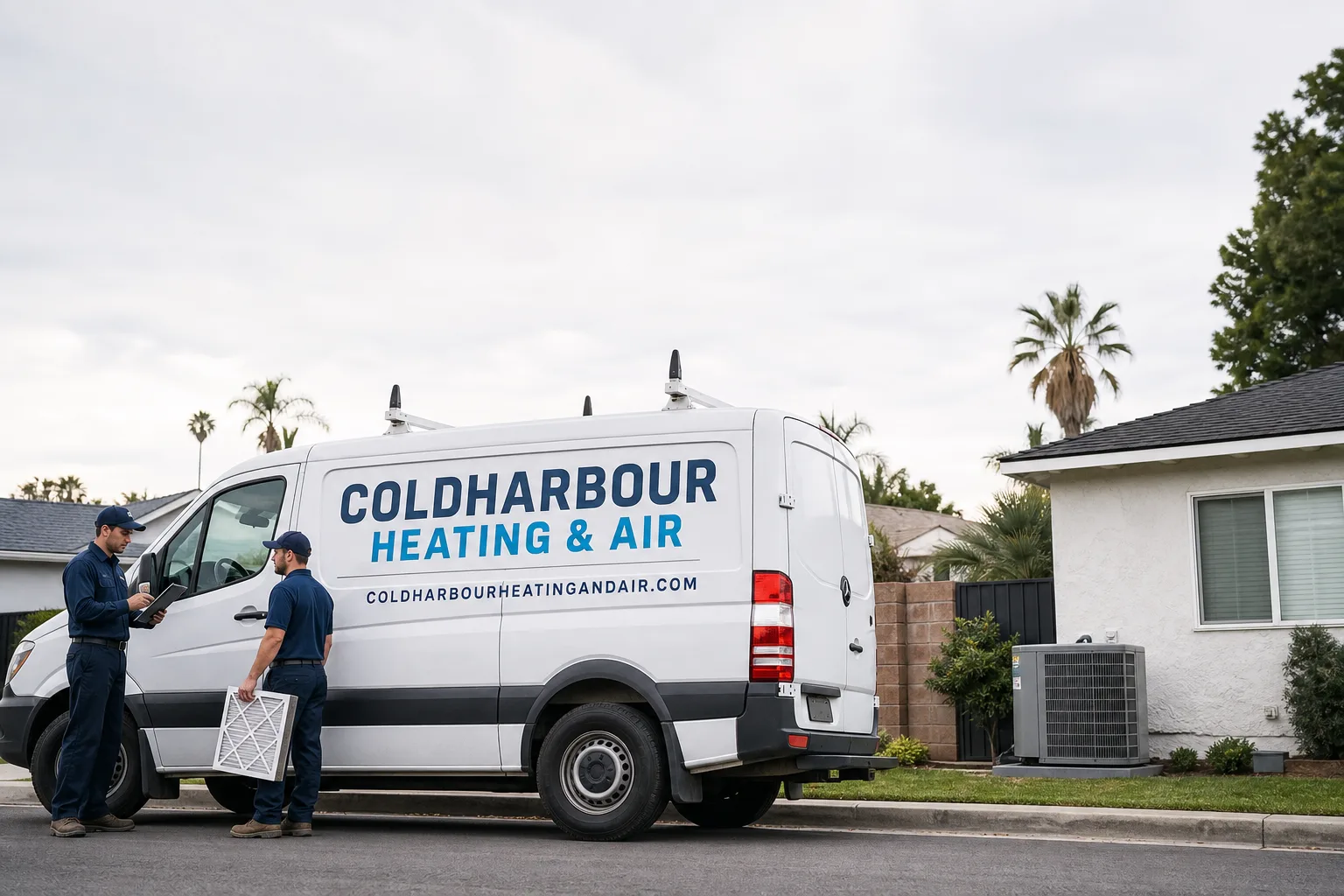
Seasonal tune-up and full diagnostic on your Carrier, Trane, or Goodman system - readings shown to you before any repair is proposed
Diagnosis first, numbers second - you approve the repair price before a single part goes in.







 Before
 After
After Before
 After
After Before
 After
AfterA/C Won’t Turn On at All
What’s Happening
When your A/C won’t turn on at all, the most common causes are a tripped circuit breaker, a blown fuse at the disconnect box near the outdoor unit, a failed capacitor, or a thermostat that has lost power or settings. In most cases, a trained technician can pinpoint the exact cause on the first visit and have the system running the same day.
A completely dead A/C – no fan, no compressor hum, no display on the thermostat – is different from a system that runs but doesn’t cool. When nothing happens at all, the problem is almost always electrical or control-related. That’s actually good news in a way: these failures tend to be clean and diagnosable. The system isn’t slowly dying; something specific stopped it, and something specific will bring it back. The steps below will help you understand which failure you’re looking at before anyone arrives.
Why It Happens
Tripped Circuit Breaker or Blown Fuse
Your A/C runs on a dedicated circuit, and that circuit has a breaker in your main electrical panel sized specifically for the load. If the system drew too much current – during a hard start on a hot afternoon, for example – the breaker trips as a safety measure. You’ll see it in the “tripped” position in your panel, sitting between ON and OFF rather than all the way to either side. There may also be a separate disconnect box mounted on the wall next to the outdoor condenser unit; that box contains its own fuses, and those can blow independently of the main panel.
Failed Capacitor
The capacitor is a small cylindrical component inside the outdoor unit that gives the compressor and fan motors the jolt of voltage they need to start. When a capacitor fails, the motor it serves simply won’t spin – the system tries to start, draws too much current, and shuts off before you hear anything meaningful. Sometimes you’ll hear a single click or a faint hum that stops immediately. Capacitors degrade from heat and age, and a failed one is one of the most common reasons a system that worked fine yesterday won’t respond at all today.
Thermostat Has Lost Power or Settings
If your thermostat screen is blank or dim, the problem may start there rather than at the equipment. Battery-powered thermostats lose their settings when batteries die; hardwired thermostats can lose power if a wire connection loosens at the terminal block or if a short in the low-voltage control wiring trips a small fuse on the furnace or air handler control board. Check whether the thermostat display is fully lit and whether the fan setting reads AUTO, not OFF. A blank screen means the A/C isn’t receiving any signal to start – and it won’t until the thermostat does.
Contactor or Control Board Failure
The contactor is a relay inside the outdoor unit that physically connects high-voltage power to the compressor and condenser fan when the thermostat calls for cooling. When it fails – stuck open, burned contacts, coil gone bad – the outdoor unit receives no power even if everything upstream is working. Control board failures on the indoor air handler produce a similar result: the system gets a call for cooling, can’t execute it, and does nothing. These are less common than the first two causes, but they’re worth knowing about because the symptoms look identical from the outside.
What to Do Right Now
- Check your thermostat first. Make sure it’s set to COOL, the target temperature is below the current room temperature, and the fan is set to AUTO. If the screen is blank, replace the batteries if it uses them, or check whether the indoor air handler’s power switch – it looks like a light switch and is usually mounted on or near the unit – has been turned off accidentally.
- Look at your electrical panel. Find the breaker labeled for the air conditioner or HVAC. If it’s in the tripped position, switch it fully to OFF and then back to ON once. If it trips again immediately or within a few minutes of the system starting, stop there. A breaker that keeps tripping is telling you something is wrong with the circuit or the equipment – resetting it repeatedly can cause damage or create a fire hazard. Call for a technician at that point.
- Check the outdoor disconnect box. There’s usually a metal box mounted near the condenser unit on the exterior wall. Open the cover (you can do this safely with the breaker off) and look for a pull-out block or fuses inside. A visibly burned or discolored fuse is a clear sign. Do not attempt to replace fuses yourself if you’re not certain the power is fully off – the voltage inside that box is high enough to cause serious injury.
- Do not repeatedly reset the breaker or thermostat trying to force the system on. If the first reset doesn’t hold, continued attempts can stress components that might otherwise be salvageable. Note what you saw and heard – one click, a brief hum, nothing at all – and pass that information to the technician. It genuinely helps narrow the diagnosis before they open anything up.
- Photograph what you find. A photo of the tripped breaker, the thermostat screen, or anything visibly burned near the disconnect saves time on the service call and gives the technician a head start.
How We Fix It
When your local Coldharbour Heating & Air technician arrives, the first thing they do is a full electrical and controls diagnostic – thermostat signal, low-voltage wiring, panel, disconnect, and the unit itself. We carry capacitors, contactors, and fuses for Carrier, Trane, Lennox, Goodman, Rheem, York, Daikin, Bryant, and American Standard systems, so the most common repairs can be completed on the same visit without a parts run.
Before anything comes out of the service bag, you’ll receive a written price. That’s not a formality – it’s one of the four commitments that make up The Kingswell Way: say the price before the work. The number on that sheet is the number on your invoice.
If we find the fault and fix it, the repair is covered by our 365-Day Done Right Promise. That guarantee is written down before the technician leaves. If the same repair fails within the year, we come back and correct it at no charge – no debate, no fine print. Most electrical and capacitor repairs on a dead A/C take one to two hours once we’re on-site.
This work falls under our AC Repair service. If the diagnostic reveals the system itself is beyond repair, we’ll walk you through AC Installation options with the same upfront written pricing, no pressure.
Frequently Asked Questions
In mild weather, a dead A/C is uncomfortable but not immediately dangerous for most adults. In a heat wave, it’s a different situation – prolonged indoor heat can become a genuine health risk, especially for young children, older adults, or anyone with a heart or respiratory condition. Don’t assume it can wait until the temperature climbs. If you’re unsure, call (817) 402-2972 and a live person will help you assess how urgent your situation is.
Yes – your local Coldharbour Heating & Air team takes calls around the clock, every day of the year, and a live person answers every time. We’ll get a technician to you as quickly as our schedule allows and give you a real arrival window, not a six-hour range. Call (817) 402-2972 to get on the schedule right now.
Not always. A failed capacitor or a blown disconnect fuse are among the more affordable A/C repairs, and they’re two of the most common reasons a system won’t turn on at all. A failed contactor or control board costs more, but is still typically far less than a full system replacement. The only way to know is to have a technician diagnose the specific failure – and that written estimate is yours before any work starts, at no obligation. Call (817) 402-2972 to schedule.
No – stop resetting it. A breaker that trips repeatedly is protecting you from a real electrical fault, whether that’s a short in the wiring, a failing compressor drawing too much current, or a damaged capacitor. Forcing it back on repeatedly risks damaging otherwise repairable components or creating a hazard at the panel. Leave the breaker off, note how many times it tripped and how quickly, and call (817) 402-2972 so a technician can trace the fault safely.
Get It Fixed
Your local Coldharbour Heating & Air team is available right now – call (817) 402-2972 and a live person answers, any hour, any day. Or book online and we’ll confirm your arrival window. A written price comes before any work starts, and every repair is covered by the 365-Day Done Right Promise.
Written by Victor Mancini, Owner & Lead HVAC Technician, Coldharbour Heating & Air, a member of the Kingswell network of independently owned and operated HVAC businesses since 2003.
What Our Customers Say
"AC died overnight with a newborn in the house. They bumped us up the list and had it running by noon. I about hugged the guy. Fair price even on a rush call."
- Celeste Ngo"The repair was done well and quickly. Scheduling over the phone was a little clunky and I got transferred twice, but the tech himself was great and on time."
- Brett Haygood"Furnace was short cycling all winter. They diagnosed a bad sensor instead of condemning the whole unit like I feared. Cheap fix, honest call."
- Russ Tiedemann