
5 Mistakes to Avoid With AC Repair
The most expensive AC repair mistakes happen before a single tool comes out of the truck. The biggest one we see in Los Angeles is accepting a verbal price over the phone, then finding a different number on the invoice when the job’s done. If you remember nothing else from this post: get the price in writing before any work begins. If you’d rather skip the reading and just talk to someone, call (817) 402-2972 and we’ll walk you through it.
Mistake #1: Accepting a Verbal Estimate Instead of a Written Price
Here’s how this plays out across Los Angeles every summer. A homeowner calls an AC company, describes the symptom, and hears “that sounds like it’ll run around $300.” Around $300. Two words that quietly leave room for a final invoice of $420, $480, or more. When you ask why, you get a list of parts and labor you never agreed to.
The fix is one sentence: “Can you put that in writing before you start?” A reputable company will hand you a written, itemized price before a single tool comes out. At Coldharbour Heating & Air, that’s not a special request. It’s how every job works, because it’s one of the written standards of the Kingswell network we’ve operated under. The price we write down is the price you pay. If it changes, that’s on us, not you.
If a company hesitates to hand you a written price, that hesitation tells you everything. It means they’re keeping room to move. And in our experience, the final number never moves down.
Mistake #2: Replacing Only the Failed Part When Its Neighbor Is About to Go
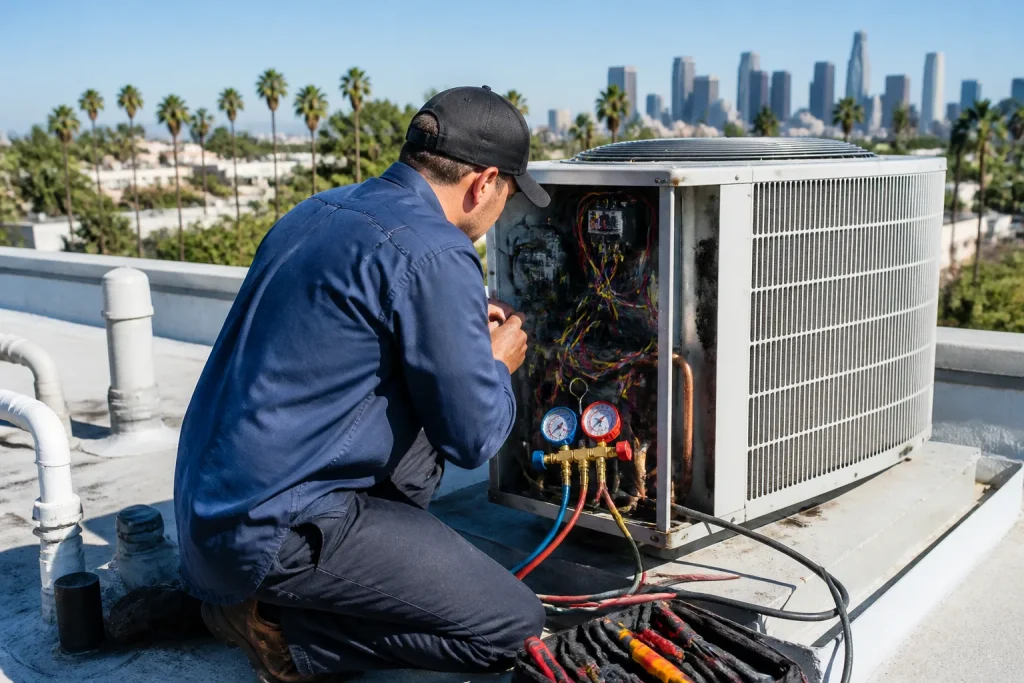
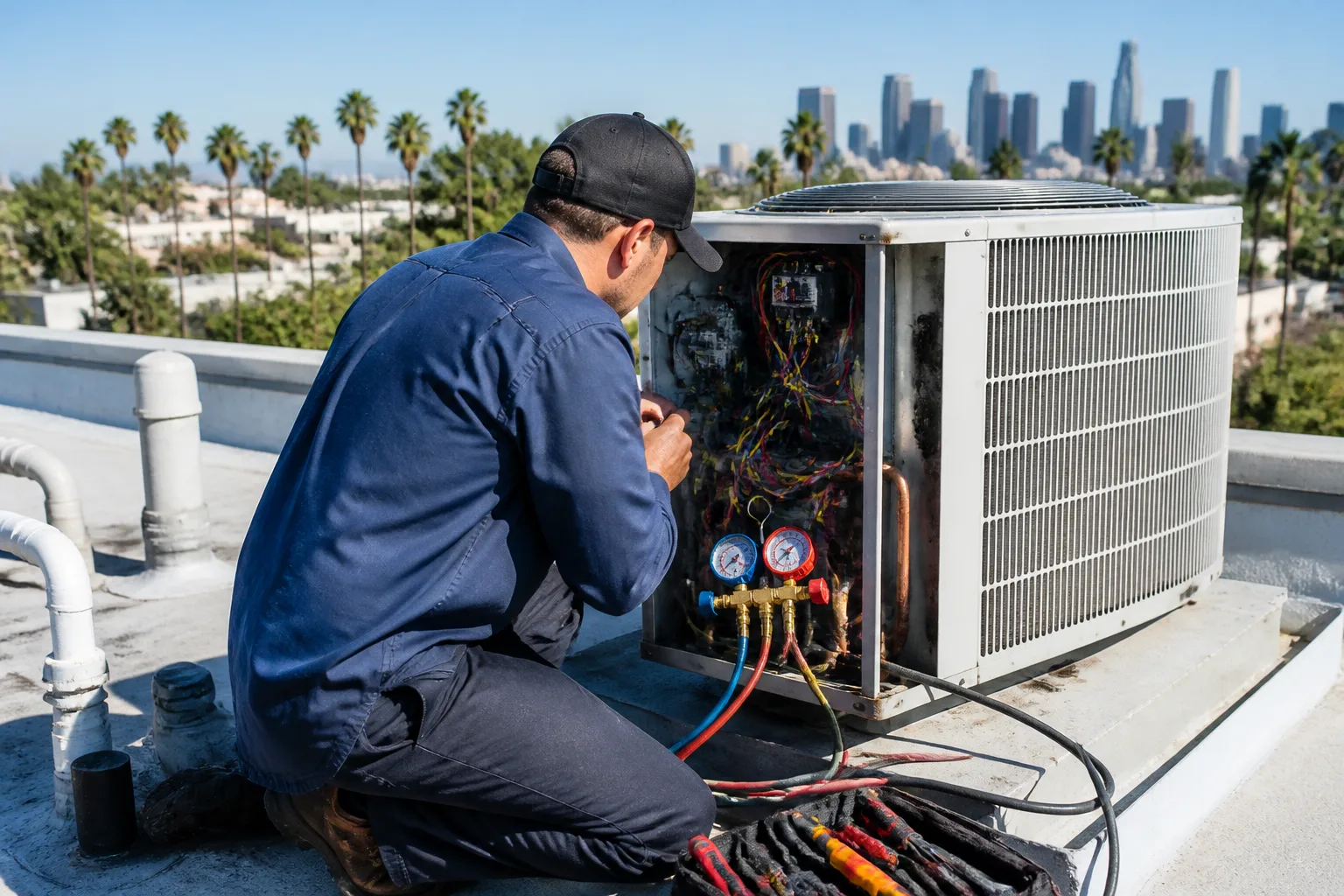
AC systems wear in pairs more often than homeowners realize. Two of the most common components that fail together are the capacitor and the contactor, both of which live in the outside condenser unit and work together to start the compressor and fan. When one fails, the other has usually been absorbing the same heat, the same cycling stress, and the same voltage fluctuation.
We’ve pulled capacitors out of units in the Valley that were visibly swollen, leaking, and running at half their rated microfarads, while the contactor next to it had pitted contacts that were a few weeks away from arcing. A technician who replaces only the capacitor has fixed today’s problem and scheduled next month’s service call. On your dime.
The mistake to avoid is agreeing to a repair that treats the symptom but ignores the surrounding wear. A good technician will show you the failing part, explain what it does (a capacitor stores the electrical charge that starts your compressor and fan; a contactor is the switch that sends power to those parts when the thermostat calls for cooling), and tell you honestly whether the neighboring component is also near the end. You should never feel pressured into replacing a healthy part, but if the part next door is showing measurable wear, replacing both in one visit is nearly always cheaper than two separate calls. You pay for one trip charge, one diagnosis, one window of waiting at home.
Mistake #3: Skipping the Post-Repair System Run With the Technician Present
When the technician says the repair is done, that’s not the end of the visit. That’s the beginning of the verification. Too many Los Angeles homeowners sign the invoice, wave goodbye, and only later discover the system is blowing warm air or short-cycling. By then the tech is across town and you’re waiting on a callback.
The two-minute test that saves you this headache: before you sign anything, ask the technician to run the system with you standing at the thermostat. You want to confirm three things. First, the air coming out of the registers is noticeably cooler than the room air. Second, the outside unit is running without unusual noise, vibration, or a hard start (that brief, harsh buzz or thump when the compressor tries to kick on). Third, the thermostat is reading the temperature you set and the system is responding normally.
This is not about mistrusting your technician. It’s about confirming the repair held under real running conditions, not just on a test bench. Any technician who’s been doing this for years will happily run the system with you. At Coldharbour Heating & Air, our technicians are background-checked and uniformed, and running the system with the homeowner before we leave is standard practice, not a favor you have to ask for.
Mistake #4: Hiring on the Lowest Price Without Asking About the Guarantee
A $220 repair with no warranty can cost more than a $300 repair backed by a 365-day callback commitment. That math only looks backwards if you assume the first repair will hold. In Los Angeles, where AC systems run hard from June through October, a cheap repair is often a bet against your own system’s age and condition. And it’s a bet with poor odds.
The question to ask before you agree to any repair: “What happens if this same problem comes back in the next few months?” Listen to the answer carefully. “We’ll be honest, we can’t warranty parts like that” is a company telling you they don’t trust their own work. “We cover our labor for 30 days” is a company telling you the parts warranty is on the manufacturer, and good luck with that.
Coldharbour Heating & Air puts a written guarantee on every repair. It’s called the Done Right Promise, and it’s exactly what it sounds like: if the repair fails within a full year, we come back and correct it at no charge. Not a discounted second visit. Not a prorated parts credit. A free visit to make the repair right, in writing, before our technician leaves your home. That piece of paper is the difference between “we fixed it” and “we fixed it, and we’ll stand behind it for a year.”
When you compare quotes, compare guarantees. One of those two numbers is the real price.
Mistake #5: Waiting Until Full Failure to Call
By the time an AC system stops blowing cold air entirely, the failure has usually been building for weeks. The compressor didn’t die that afternoon. It spent two weeks starting hard, drawing more amperage than it should, running hotter than it was designed to run. Every one of those days added wear that could have been avoided.
The symptoms worth calling about early, because they’re cheaper to fix at week one than at week six:
- Hard starts: you hear a thud, buzz, or hesitation when the outside unit kicks on. This often points to a failing capacitor or contactor, both inexpensive fixes compared to a compressor replacement.
- Warm air only on the hottest days: the system keeps up when it’s 85 degrees outside but falls behind at 100. This often signals low refrigerant (the cooling fluid your AC needs to run), a failing condenser fan motor, or restricted airflow across the coil.
- Unusual cycling: the system turns on and off more frequently than it used to, or runs constantly without satisfying the thermostat. Short cycling can be a thermostat issue, a refrigerant issue, or a compressor protection mechanism trying to save itself.
The pattern here is that all three symptoms point to components that are failing slowly, not suddenly. A capacitor replacement is a fraction of the cost of a compressor replacement. A refrigerant recharge (topping off the cooling fluid) caught early can stop a leak from becoming a compressor failure. Every week you wait, the repair bill tends to grow.
We service all major residential brands, including Goodman, Rheem, York, and Daikin, so if you’re in Los Angeles and hearing something unusual from your outside unit, our technicians can diagnose whatever system you have. The earlier you call, the less you typically pay.
Key Takeaways
- Always get a written, itemized price before work begins. “Around $300” is not a price.
- Ask whether any surrounding components are showing wear. Capacitors and contactors often fail in pairs.
- Run the AC with the technician before you sign the invoice. Two minutes confirms the repair held.
- Compare guarantees, not just prices. A written warranty can be the cheaper option.
- Call at the first sign of hard starts, warm air on hot days, or unusual cycling. Early repairs cost less.
The Bottom Line
The most expensive AC repair mistakes are almost always decision-layer mistakes. A verbal estimate. A skipped system run. A low price with no guarantee. A week of ignoring a hard start. None of these are mechanical failures. They’re information failures, and they’re all avoidable. You don’t need to become an HVAC expert. You need a company that hands you a written price before the work starts, backs the repair with a written guarantee, and runs the system with you before leaving. If you’re in Los Angeles and need an AC repair, Coldharbour Heating & Air offers free estimates. Call our AC repair team in Los Angeles at (817) 402-2972 and we’ll help you avoid the mistakes before they happen.
If your heating system is the one acting up, we handle that too. See our Furnace Repair in Los Angeles page for the same written-price, written-guarantee approach. And if your system is old enough that repairs are becoming a monthly event, an AC Installation in Los Angeles with a properly load-calculated system may save you more than another season of patch-and-hope. For everything else, start at the Coldharbour Heating & Air home page.
Frequently Asked Questions
Repair makes sense if the system is under 10 years old, the failed part is a wear-item like a capacitor, contactor, or condenser fan motor, and the rest of the system is in good condition. Replacement starts making sense when the compressor fails on an older system, the system uses R-22 refrigerant (which is no longer produced and gets more expensive every year), or repairs would total more than roughly half the cost of a new system. In Los Angeles, where cooling season runs long, a system that’s 12 to 15 years old and failing repeatedly is usually telling you it’s time. Call (817) 402-2972 if you want an honest read on which path makes sense for your setup.
Most common AC repairs in Los Angeles run $150 to $500, depending on the failed component. A capacitor replacement typically lands in the $150 to $280 range, a contactor replacement similar, and a condenser fan motor more like $300 to $550. Compressor replacements can run into the thousands. The key is that the price should be written down before the work starts, so you’re not surprised at the end. We hand you a written price on every job before a single tool comes out.
In most cases, yes. We answer the phone with a live person 24 hours a day, 7 days a week, and our technicians in Los Angeles carry common parts like capacitors, contactors, and fan motors on their trucks. That means many repairs are completed on the first visit. For less common parts, we’ll give you an honest arrival window and a written price before we order anything. Call (817) 402-2972 and we’ll tell you what’s realistic for your specific situation.
Every repair from Coldharbour Heating & Air comes with a written guarantee valid for 365 days. If the same repair fails within that year, we return and correct the work at no charge. No trip fee, no parts charge, no labor charge. The guarantee is printed and handed to you before our technician leaves, so you have it in writing, not just on a phone call. It’s part of the Kingswell standards we’ve worked to.
Written by the team at Coldharbour Heating & Air.
Need HVAC Help?
Call Coldharbour Heating & Air - licensed & insured, here with fast after-hours help in Los Angeles.
(817) 402-2972