
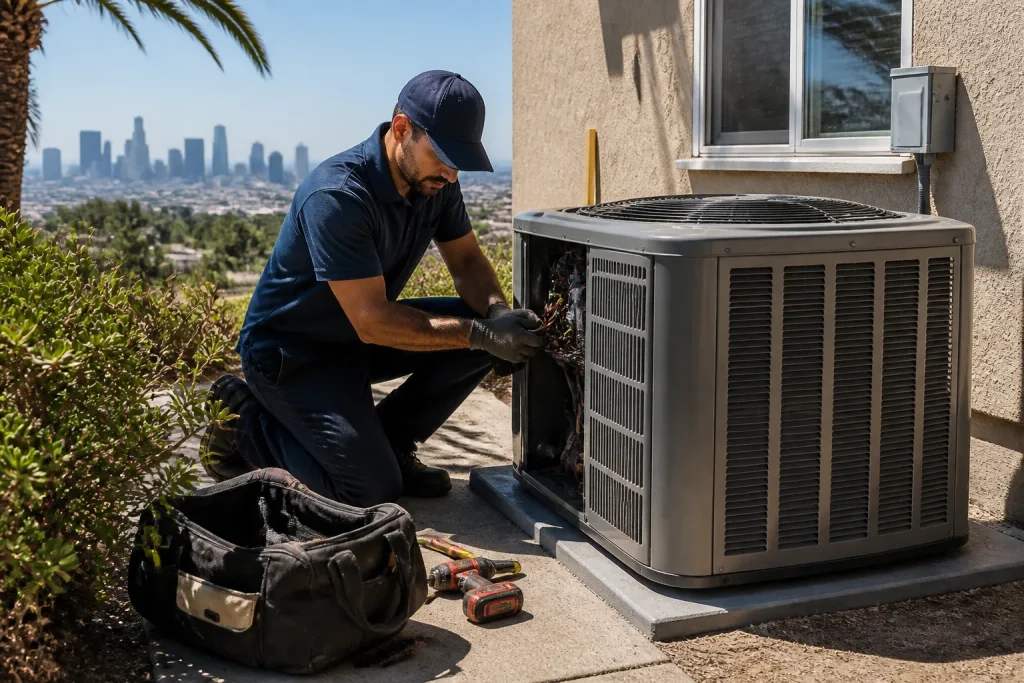
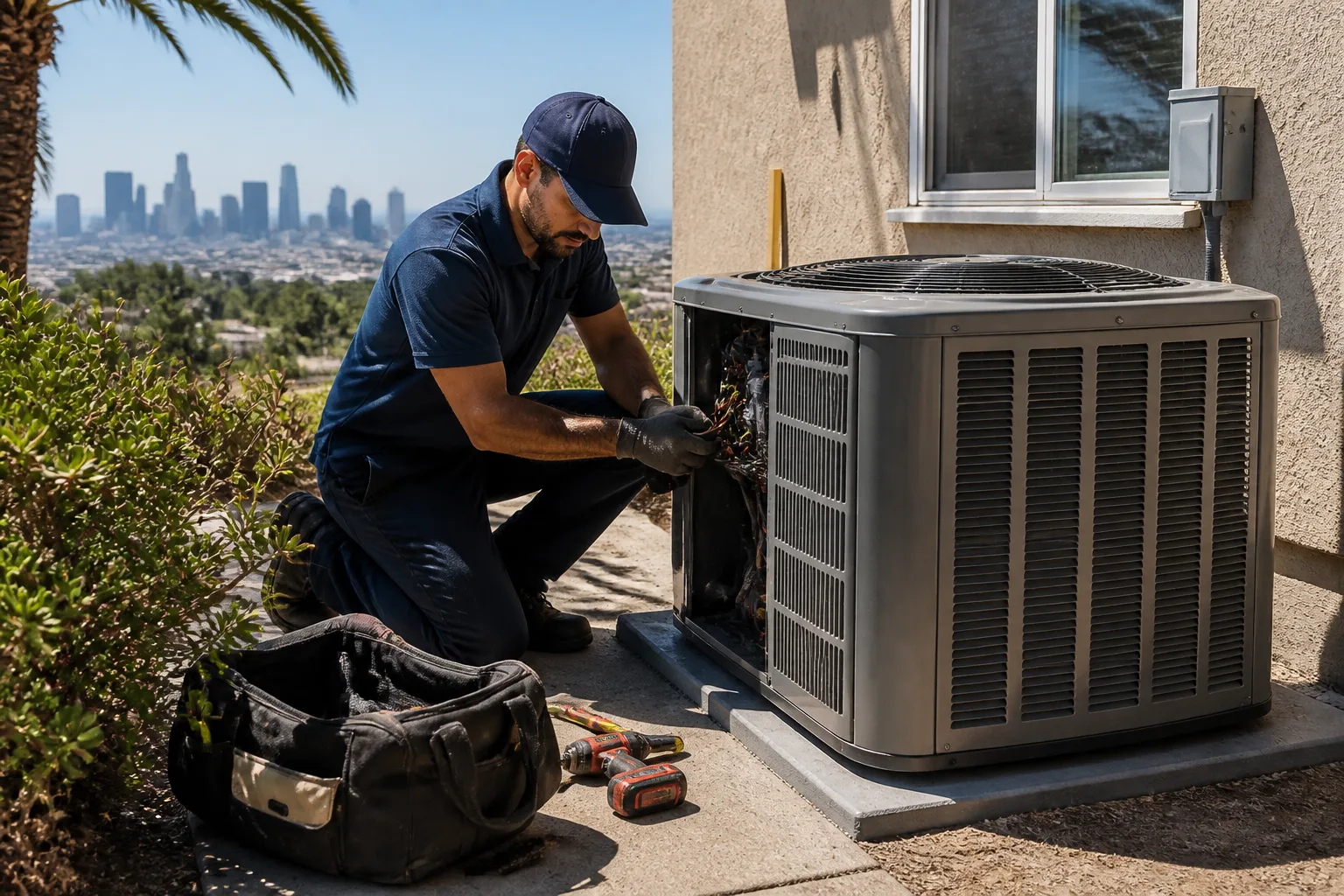
Rheem AC Repair in Los Angeles: A Homeowner’s Guide
Rheem AC repair in Los Angeles typically costs between $180 and $340 for common fixes like capacitor or contactor replacements, while refrigerant leak repairs run $250 to $900 depending on the leak location and refrigerant type. We complete most Rheem repairs the same day, and every repair carries our written Done Right Promise. If you’d rather not diagnose it yourself, call (817) 402-2972 and a live person will pick up, any hour, any day.
Why Rheem Systems Get Ignored Until It’s Too Late
Rheem builds a genuinely solid unit. We’ve installed and serviced hundreds of them across Los Angeles, from Chatsworth to San Pedro, and the build quality on their condenser cabinets and scroll compressors is consistently good. But that reputation has a downside: homeowners believe the unit will sort itself out. They hear a faint rattle or notice the system cycling a little longer than usual and figure, “It’s a Rheem, it’ll hold.”
A Rheem compressor replacement in Los Angeles runs $1,200 to $1,800, parts and labor. The refrigerant leak that causes most of those failures costs under $300 to fix when caught in the first season. The problem is knowing what to listen for. Here’s the thing: Rheem compressors are not quiet when they’re dying. They tell you. But you have to know the language.
The Three Sounds a Rheem Compressor Makes Before It Fails
In the 30 to 60 days before a Rheem compressor gives out, it makes three distinct sounds, in order. We’ve walked homeowners through this over the phone more times than we can count, usually after they call at 9pm on a July night in Reseda wondering why the house won’t cool below 82.
- A low rattle at startup. This sounds like a loose piece of metal shaking for the first two or three seconds after the condenser kicks on. It’s the internal mounts wearing out, and it’s the earliest warning. If you catch it here, you’re often looking at a $200 to $400 fix, not a replacement.
- A rhythmic buzzing while running. This is different from the normal hum. It pulses, almost like a cicada. That’s the compressor’s internal valves struggling against pressure. At this stage, the compressor is damaged but often still viable if the underlying cause is addressed quickly.
- A hard clank when the system shuts off. This is the one we dread. It means the compressor is slamming to a stop internally rather than winding down smoothly. Once you hear this, you’re usually days to weeks from total failure.
One of these sounds alone might mean several things. Hearing the first one on a list like this doesn’t mean your compressor is doomed tomorrow. But if you’re noticing any of them, especially combined with longer run times or rising electric bills, don’t wait. In our experience, Rheem compressors that fail almost always left clues for weeks. The homeowners who call early pay for a repair. The ones who wait pay for a compressor.
What Your Rheem EcoNet System Is Already Telling You
The smartest thing Rheem did in recent years is build EcoNet into their higher-end systems. It’s their proprietary smart control platform, and it logs error codes the same way your car’s computer does. Here’s what most Los Angeles homeowners don’t realize: you can read those codes yourself before you ever call a technician.
If you have a Rheem EcoNet-enabled thermostat or control board, navigate to the diagnostics or error code section on the screen. The codes you’ll see most often in Los Angeles are:
- FAULT: Low Pressure Trip (often shown as “LP” or “E2”) – This usually means low refrigerant. It’s often a leak. This one matters because running the system with low refrigerant is exactly how compressors die. Treat this as urgent.
- High Pressure Trip (“HP” or “E3”) – This typically means restricted airflow or a dirty condenser coil. Given how much dust and pollen blows around places like Northridge and Burbank in the spring, this is common. A coil cleaning often resolves it.
- Sensor Failure codes – These indicate a failing thermistor or sensor, which affects temperature accuracy and can cause short cycling. Less urgent, but worth addressing.
When you call a repair company with the specific code already in hand, you save a diagnostic trip. That saves you money and saves the technician time. We love it when homeowners read us a code over the phone. It means we can bring the right part on the first visit instead of making a second trip.
A note on those error codes: low pressure trips should not be ignored for more than a day or two. Every hour a refrigerant-starved system runs, the compressor runs hotter than it was designed to. Refrigerant is also the fluid that carries heat away from the compressor motor. Low refrigerant means a hot motor. A hot motor means a short life.
Rheem’s 10-Year Warranty: What It Actually Covers
Rheem’s warranty structure confuses people, and that confusion costs money. Here’s the plain version.
Rheem offers a 10-year limited parts warranty on most current-model condensers and air handlers when the system is registered within 60 days of installation. If it’s not registered, the warranty drops to 5 years. That registration step is critical, and a surprising number of Los Angeles homeowners never complete it because their installer didn’t mention it or the paperwork got lost. If you recently had a Rheem system installed and you’re not sure whether it was registered, you can check on Rheem’s site with your unit’s serial number.
What the warranty covers: the compressor, coils, and other major components. If a covered part fails due to a manufacturing defect, Rheem supplies the replacement part at no cost.
What the warranty does not cover: labor. This is the big one. The part may be free, but the 4 to 6 hours it takes to replace a compressor still costs labor, plus refrigerant, brazing materials, and filter-drier. That labor bill is usually $800 to $1,200 in Los Angeles. The warranty also doesn’t cover refrigerant, shipping costs, or anything related to improper maintenance. If a coil fails because the filter was never changed for three years, Rheem can deny the claim.
This matters when you’re deciding between repairing and replacing. A compressor under warranty is a much better deal than one that isn’t. But the labor is still yours. We tell homeowners to look at their warranty status before making any big repair decision. If you’re within the 10-year parts window and the compressor fails, the replacement makes financial sense. If you’re outside it, particularly on a system that’s 12 or 13 years old on the roof in Eagle Rock with original everything, replacement often wins.
Refrigerant Types and Why Your Rheem’s Age Determines Repair Cost
This is the detail that separates an informed homeowner from one who gets overcharged. The type of refrigerant in your Rheem system depends almost entirely on when it was manufactured, and that type directly affects repair cost.
R-22 (Freon): Rheem units built before January 2010 typically use R-22. Production of new R-22 was phased out in the United States in 2020. The only R-22 available now is reclaimed or recycled, and it’s expensive. A pound of R-22 now costs $90 to $150, versus $40 to $70 for modern refrigerants. If your older Rheem has a refrigerant leak and it needs several pounds, you could be looking at $500 to $900 just for the refrigerant itself, before labor and leak repair. At that price, many homeowners choose to put that money toward a new system instead.
R-410A: Rheem switched to R-410A around 2010 and used it through roughly 2024. It’s cheaper and easier to source. Leak repairs on R-410A systems are generally more economical.
R-454B and R-32: Rheem’s newest units, those manufactured from 2024 onward, use these lower-global-warming refrigerants. They’re readily available, and repair economics are reasonable.
How do you know what’s in your system? Look at the data plate on the outdoor condenser. It will list the refrigerant type in plain print. If it says R-22 and you’re facing a leak, that’s a conversation worth having carefully. The refrigerant alone might equal 40% of the repair cost.
One more note: topping off a leaking system is not a repair. It’s a temporary bandage. The leak will continue, the refrigerant will escape again, and you’ll pay again. Any technician who suggests “just topping it off” without locating and repairing the leak is not doing you a favor. In Los Angeles, where the system runs hard from May through October, a small leak can empty a system in a single season.
Finding the Leak: The EPA Section 608 Conversation
Here’s something most homeowners don’t know to check: any technician handling refrigerant in the United States must be EPA Section 608 certified. That’s federal law, not a nice-to-have. The Clean Air Act requires it. It’s the certification that proves a technician has been trained to handle refrigerant safely and legally, without venting it into the atmosphere.
Why should you care? Because uncertified or careless refrigerant work causes two problems. First, it’s illegal, and a homeowner who knowingly allows it can run into issues during a home sale if the system’s service history gets flagged. Second, and more practically, sloppy refrigerant work is exactly how compressors get killed. Overcharging, undercharging, failing to pull a proper vacuum, not replacing the filter-drier – these are the mistakes that turn a $300 repair into a $1,600 replacement.
How to verify: ask the technician directly. A licensed professional will say “yes, I’m Section 608 certified” without hesitation. Some carry their certification card. You can also ask for their EPA certification number. It’s a simple question, and it tells the technician you know what you’re talking about. We flash our certification at every job that involves refrigerant because we want homeowners to know the work is being done legally and correctly. That’s the floor, not a flex.
When to call a pro: If you’ve checked your EcoNet codes and you’re seeing low pressure, or you’ve heard the rattling or buzzing described above, call before the Los Angeles heat wave hits. We’ve been out to a house in Tarzana where the homeowner waited three weeks after hearing a rattle. By the time we arrived, the compressor had failed completely, and the repair went from $280 to $1,600. The unit was 11 years old, outside the parts warranty, and the homeowner ended up replacing the whole system. The earlier fix would have bought years.
Related services in Los Angeles: If this guide made you realize your system is past the point of economic repair, our AC Installation in Los Angeles page covers replacement costs and options. And if you’re reading this in winter with a different problem, our Furnace Repair in Los Angeles guide covers heating specifically. Our main AC Repair in Los Angeles page has service details and response times.
What a Rheem Repair Should Cost in Los Angeles
Here are the numbers we quote most often, parts and labor included, for common Rheem repairs in the Los Angeles market:
- Capacitor replacement: $150 to $280. This is the single most common repair on any AC brand. The capacitor is the small cylinder that gives the compressor and fan motor the electrical jolt to start. They fail in heat, and Los Angeles heat is exactly the environment they fail in.
- Contactor replacement: $120 to $250. This is the electrical switch that turns the condenser on and off. Pitting and burning on the contacts is common in older units.
- Refrigerant leak repair (minor): $250 to $600, depending on location and access. A leak at a Schrader valve or a small coil leak is often fixable in one visit.
- Refrigerant leak repair (evaporator coil): $800 to $1,400. This is a bigger job. It involves recovering the refrigerant, replacing or patching the coil, and recharging. If it’s an R-22 system, the refrigerant cost alone pushes this higher.
- Condenser fan motor replacement: $250 to $500. This is the fan on top of the outdoor unit that blows heat away from the coil.
- Compressor replacement: $1,200 to $1,800 if outside warranty, $800 to $1,200 if the part is covered by Rheem’s warranty and you’re paying labor plus refrigerant and related materials.
These are real Los Angeles prices, not national averages. The labor market here, the heat load on systems, and the fact that so many condensers are on roofs or in tight side yards all push costs up compared to other parts of the country. Every quote we write is handed to the homeowner in writing before a single tool comes out of the truck, and that price doesn’t change at the door. That’s the Kingswell Way, the standard our company was founded on in 2003, and we don’t work any other way.
The Bottom Line
Rheem builds a unit that can last 15 years or more in the Los Angeles climate, but only if the early warnings are caught. Listen for the rattle, the buzz, and the clank. Read the EcoNet codes. Know your refrigerant type and your warranty status. And ask about EPA Section 608 certification before anyone touches your refrigerant. The homeowners who do these things pay for repairs. The ones who don’t pay for replacements.
If you’re in Los Angeles and you’re hearing something or seeing a code you don’t like, Coldharbour Heating & Air offers free estimates on Rheem repairs. Call (817) 402-2972 and a live person answers, day or night. We’ll give you a written price before the work begins, and every repair we make is covered by our written Done Right Promise. If it fails within a year, we come back and fix it at no charge.
Frequently Asked Questions
Most Rheem AC repairs in Los Angeles run $120 to $340 for common electrical part replacements, $250 to $900 for refrigerant leak repairs, and $1,200 to $1,800 for a compressor replacement outside warranty. The exact price depends on the part, refrigerant type, and access to the unit. Call (817) 402-2972 for a written quote before any work starts.
Yes. Rheem’s scroll compressors and cabinet construction handle high-heat environments well, and their EcoNet platform gives homeowners useful diagnostic information. The most common Rheem failures we see in Los Angeles are not manufacturing defects but heat-related electrical wear and refrigerant leaks that went undiagnosed too long.
No. Rheem’s 10-year limited warranty covers parts only, and only if the system was registered within 60 days of installation. Labor, refrigerant, and related materials are billed separately. The parts warranty is valuable on big-ticket items like compressors, but it does not make a repair free.
In most cases, yes. Coldharbour Heating & Air keeps common Rheem capacitors, contactors, and fan motors stocked locally, and we dispatch technicians the same day for most repair calls in Los Angeles. Call (817) 402-2972 and a live person will schedule your arrival window, not a vague “sometime between 8 and 5.”
If your Rheem is inside its 10-year parts warranty and the compressor has failed, repair usually makes sense. Beyond about 12 years, especially on an R-22 system with a serious leak, replacement often wins. We’ll walk you through the numbers honestly, including what a new installation would cost, before you commit to either path.
Written by the team at Coldharbour Heating & Air.
Need HVAC Help?
Call Coldharbour Heating & Air - licensed & insured, here with fast after-hours help in Los Angeles.
(817) 402-2972