
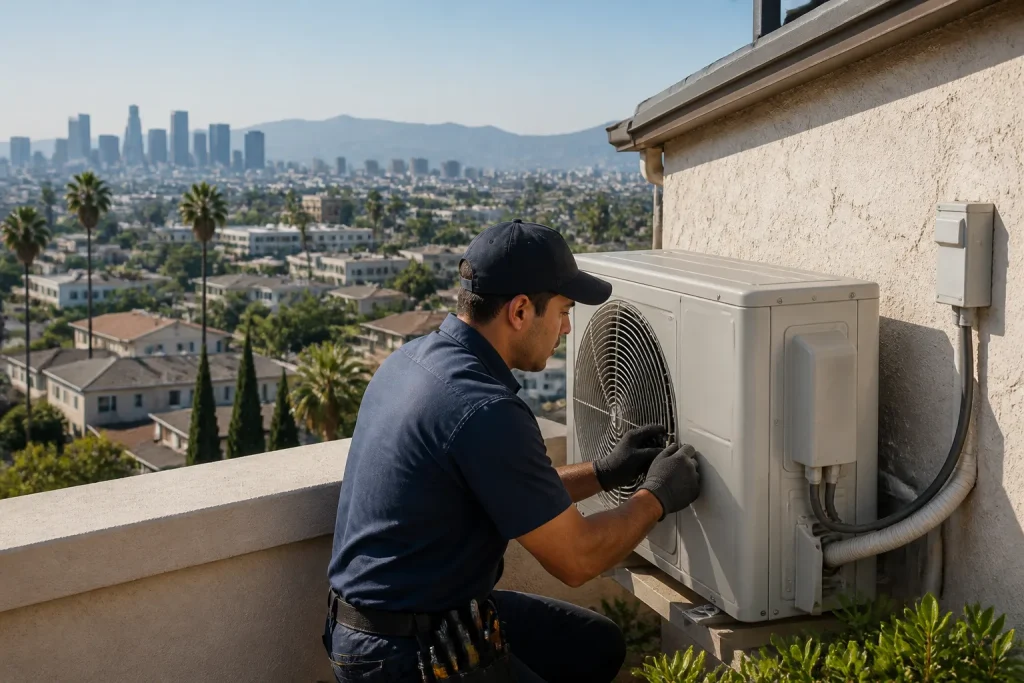
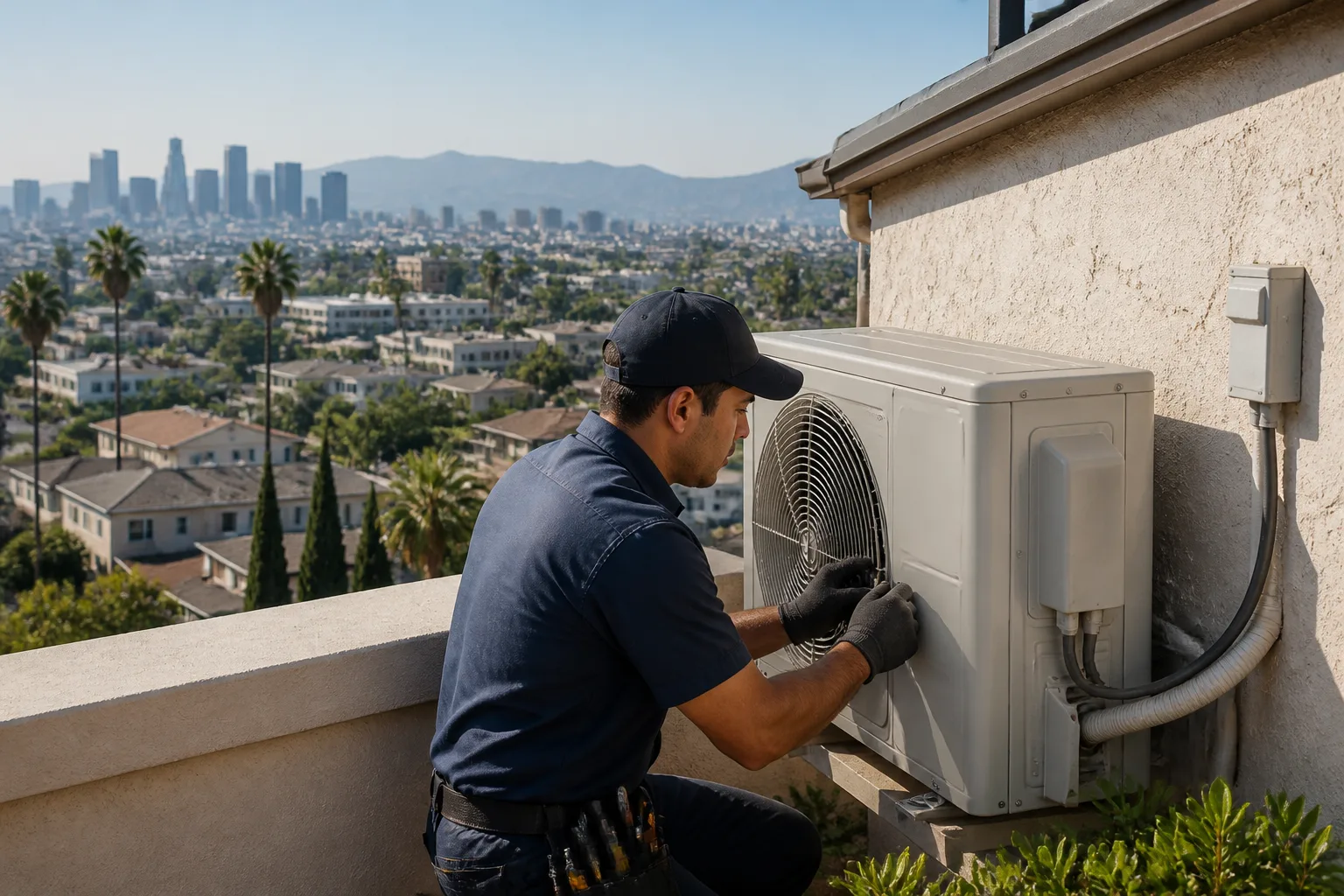
Daikin AC Repair in Los Angeles: A Homeowner’s Guide
Daikin AC repair in Los Angeles usually runs between $180 and $650 for common fixes like sensor failures, refrigerant leaks, and inverter board diagnostics. The real challenge isn’t finding someone to work on the unit; it’s finding a technician who understands how Daikin’s variable-speed inverter system actually talks to itself. If you’d rather skip the reading and get someone out to look at your system today, call (817) 402-2972.
Daikin’s inverter compressor technology is one of the reasons their systems run so efficiently in LA heat. It’s also the reason a technician trained only on single-stage systems can misread the diagnostic data and replace a part that wasn’t the problem. We’ve seen it happen in neighborhoods from Sherman Oaks to South Pasadena: a perfectly good inverter board gets swapped out because the tech didn’t recognize a normal load-reading pattern, and the homeowner pays for a part that was never broken.
What Makes Daikin Different (And Why It Matters for Repair)
Most conventional AC systems work like a light switch. They’re either running at full blast or completely off. When the thermostat calls for cooling, the compressor slams on at 100 percent, cools the house, then shuts down. That cycle repeats all day. It works, but it’s hard on equipment and it spikes your energy use every time the system kicks on.
Daikin’s inverter-driven compressor works differently. Instead of on/off, it ramps up and down in small increments, like a car accelerator rather than a toggle switch. On a mild Los Angeles morning, the compressor might run at 30 percent capacity. At 2 p.m. in an August heat wave, it climbs toward full output. The system constantly adjusts to hold your indoor temperature steady.
That’s efficient. It’s also why Daikin-specific diagnosis matters. A technician who’s spent years reading single-stage systems expects to see the compressor either drawing full amps or none at all. When they see a Daikin compressor pulling variable amperage at partial load, some mistake that for a failing component. It’s not failing. It’s doing exactly what it was designed to do. We explain this to Los Angeles homeowners all the time: the test readings look “wrong” to someone who doesn’t know the platform, but they’re normal for an inverter drive.
Key takeaways about Daikin systems:
- Inverter compressors modulate output instead of cycling on and off.
- Partial-load amp draws are normal and should not trigger a compressor replacement.
- Diagnostics require reading live data from the inverter board, not just static voltage checks.
- A technician who primarily works on Bryant, York, or American Standard single-stage units may not recognize healthy Daikin readings.
Understanding Daikin Error Codes: What Your Unit Is Telling You
Daikin builds self-diagnostics into nearly every residential system produced in the last decade. When something goes wrong, the indoor unit or the remote controller displays a code. These codes are useful, but they’re not always self-explanatory, and they don’t always mean what an untrained eye might assume.
Here’s what Los Angeles homeowners should know about the most common Daikin codes:
- A5: A high-pressure control lockout or a freeze protection trigger. Often points to restricted airflow, a dirty coil, or a failing fan motor. Sometimes it’s a genuine refrigerant charge issue.
- E7: A fan motor fault, usually on the outdoor unit. In direct Los Angeles sun, this is one we see frequently: high ambient temperatures plus a fan failure can cook a compressor in a single afternoon.
- U4: A communication error between the indoor and outdoor units. On ductless mini-splits, this often traces to damaged wiring, a loose connector, or voltage drops during peak LA heat.
- L3 or L4: Electrical box or compressor overheat warnings. These are strongly correlated with units installed on west-facing walls or roofs with no shade.
- F3: Discharge pipe temperature too high. Refrigerant volume may be low, or the system may be overworking due to placement in direct sun.
Some codes point to a field repair, like a capacitor or a fan motor. Others indicate a possible warranty claim, like a compressor or an inverter board. The distinction matters because a warranty claim needs documented installation history and proper diagnostic records. We tell our Los Angeles customers: never let a technician clear a code and walk away without writing down what it was and what they tested. That record protects you if the warranty comes into play.
How Much Does Daikin AC Repair Cost in Los Angeles?
Los Angeles pricing runs slightly above the national average due to labor rates, permitting requirements in certain neighborhoods, and the cost of carrying Daikin-specific parts. Here’s a realistic breakdown based on what we quote and what we see from competitors across the city:
- Diagnostic visit: $79-$129, generally waived if you proceed with the repair the same day.
- Thermistor or sensor replacement: $150-$280, parts and labor included.
- Fan motor replacement (outdoor unit): $350-$650, depending on whether it’s a single-speed or variable-speed motor.
- Inverter board replacement: $450-$900. This is the part people misdiagnose most often; get a second opinion if it’s quoted without live-voltage testing.
- Refrigerant recharge: $200-$450, including leak check. A proper recharge means finding the leak, not just topping off the fluid.
- Compressor replacement: $1,800-$3,200. If the unit is outside warranty, this is the point where you compare repair cost against a new system.
Every Coldharbour Heating & Air repair is covered by the Done Right Promise. That means we hand you a written guarantee on paper before we leave. If the repair fails inside a year, we come back and fix it at no charge. No argument, no re-diagnosis fee, no fine print. In our twenty-plus years serving Los Angeles, that guarantee has been the single biggest reason homeowners choose us over a cheaper quote that doesn’t include one.
Daikin’s 12-Year Warranty: What Actually Activates It
Daikin offers some of the strongest residential warranties in the industry, but the coverage depends on one thing many Los Angeles homeowners miss: registered installation.
If the system was installed by a licensed contractor and registered with Daikin within 60 days of installation, most Daikin systems carry a 12-year parts warranty. Some premium lines extend to 12 years on the compressor, and Daikin’s top-tier installer programs can include labor coverage too. If the registration never happened, the warranty reverts to a base 5-year parts term. That’s a seven-year difference.
Here’s how to check your registration status:
- Find your unit’s model and serial number. It’s on a data plate on the side of the outdoor condenser.
- Call Daikin’s customer service line or visit their warranty portal.
- Ask the installer for a copy of the registration confirmation. If they can’t produce it, assume it wasn’t done.
One thing we see regularly: a homeowner buys a house with a Daikin system already installed, and nobody ever tells them the warranty is in the previous owner’s name or was never registered. Daikin does allow warranty transfer in some cases, but it requires paperwork and a fee. If you’re buying or just bought a home in Los Angeles with a Daikin system, it’s worth a 15-minute check. The difference between a covered compressor replacement and a $3,000 surprise is often just a registration form that was never mailed in.
A word on warranty service in Los Angeles: Daikin does not send their own technicians. You still need a local contractor to diagnose the issue and submit the claim. Coldharbour technicians work on Daikin systems daily, and we handle the warranty paperwork on your behalf. If any of our Daikin repairs are covered, the claim starts before we leave your driveway.
Ducted vs. Ductless Daikin: Different Systems, Different Repairs
Daikin makes two broad families of residential equipment: traditional ducted split systems (an outdoor condenser paired with an indoor air handler and ductwork) and ductless mini-splits (a slim outdoor unit connected to one or more wall-mounted or ceiling-mounted heads via refrigerant lines). Los Angeles has plenty of both, especially in older homes that were retrofitted with mini-splits rather than paying to run ducts through 1920s bungalow framing.
These are not the same repair job.
A ducted Daikin system behaves like a conventional central air setup, with inverter-driven efficiency. Repairs are straightforward for a technician who understands the refrigerant circuit and the variable-speed board, and parts are widely available in the Los Angeles supply chain.
Ductless mini-splits are different. Each indoor head has its own fan motor, coil, sensor set, and control board. A four-head system is essentially four small air conditioners sharing one outdoor unit. When one head stops cooling, the problem could be in that head, in the branch box, in the communication wiring, or in the outdoor inverter. Diagnosing it correctly takes someone who’s worked on mini-split architecture specifically, not just standard AC.
Questions to ask before you let a technician open up a Daikin ductless system:
- “How many Daikin mini-split systems have you diagnosed in the last year?”
- “Do you read live inverter data from the outdoor board, or just static voltage?”
- “If one head is warm and the others are cold, where do you start looking?”
The answer to that last question should mention the branch box or the individual head’s expansion valve. If you get a blank stare, call someone else.
Los Angeles Sun Exposure and Daikin Outdoor Units
Here’s a Los Angeles-specific problem most national guides never mention. Daikin outdoor units are engineered in Japan, where the residential cooling load and sun angles are different from what a stucco-walled San Fernando Valley backyard dishes out in July.
When a Daikin condenser sits in direct afternoon sun, especially on a west-facing wall or an unshaded roof, the ambient temperature around the unit can run 10 to 15 degrees hotter than the air in the shade. That makes the system work harder to reject heat from the refrigerant. Over time, that added stress shortens the life of fan motors, capacitors, and compressor windings. It also triggers overheat codes like L3 and L4 more often.
We pulled an outdoor unit out of a garage alcove in Sunland-Tujunga last August where the previous installer had boxed the condenser into a corner with a fence on two sides and the house wall on a third. The clearance was about a quarter of what Daikin specifies. The compressor had been cycling on thermal overload for weeks. The homeowner had already been quoted a full compressor replacement by another company. We repositioned the unit, added a louvered shade screen, and the compressor ran fine. That was two years ago. It’s still running today.
If your Los Angeles Daikin unit sits in hot direct sun with no shade, consider a simple louvered screen or a trellis planted with something drought-tolerant. Don’t box the unit in; Daikin requires minimum clearances for airflow. Shade the unit, don’t suffocate it. Your repair frequency will drop.
When to Call a Professional (And When Not To)
There are Daikin issues you can address yourself, and there are issues you absolutely should not touch. Here’s the honest breakdown.
Safe to check on your own: dirty air filters, blocked return vents, a tripped breaker, a closed supply register, a remote controller with dead batteries, or a line-set cover that’s come loose. These are the cause of maybe 20 percent of the “my Daikin isn’t cooling” calls we get in Los Angeles.
Not safe to touch: anything involving refrigerant, the inverter board wiring, compressor terminals, or the high-voltage side of the unit. Daikin mini-splits and ducted systems carry high DC voltage on the inverter circuit. A fully-shut-off system can still hold a charge in its capacitors. This is genuinely dangerous, and a homeowner should never open the electrical compartment on any inverter-driven AC unit.
If your Daikin is blowing warm air and you’ve checked the filter and the breaker, it’s time to call a professional. The diagnostic cost is cheaper than the repair you’ll cause by guessing. And in Los Angeles summer heat, a system out for a week will make your house unbearable. If you need help now, call (817) 402-2972 and a live person will answer.
Related services in Los Angeles: if your system is older than 12 years or the repair quote is creeping past $2,500, it’s worth looking at AC Installation in Los Angeles to compare your options. If your heating side is acting up too, see our Furnace Repair in Los Angeles page.
The Bottom Line
Daikin makes a genuinely efficient, well-engineered machine. The inverter technology that makes it efficient also makes it misunderstood by technicians who only work on conventional single-stage systems. If you’re in Los Angeles and your Daikin is acting up, the most important thing you can do is verify that whoever shows up has real experience reading Daikin inverter diagnostics, not just a generic AC background.
Coldharbour Heating & Air has been repairing Daikin systems in Los Angeles. We write down the price before any work starts. We put the guarantee on paper. And we show up when we say we will, with a technician who knows exactly how your inverter board should behave. If you’re in Los Angeles and need help, call (817) 402-2972 for a free estimate.
Frequently Asked Questions
Most Daikin repairs in Los Angeles run between $180 and $650 for common issues like sensors, fan motors, and refrigerant top-offs. More involved repairs like inverter boards or compressors can range from $450 to $3,200 depending on the part and warranty status. Your best move is to get a written quote before work starts, which is exactly how Coldharbour does it every time. Call (817) 402-2972 for a free estimate.
If your system was installed by a licensed contractor and registered with Daikin within 60 days of installation, you likely have a 12-year parts warranty. If it wasn’t registered, the coverage drops to 5 years. Check the serial number on your outdoor unit and contact Daikin directly to confirm registration status. If you need help with a warranty claim in Los Angeles, Coldharbour handles the paperwork for you.
L3 and L4 codes usually mean the compressor or electrical box is overheating, and in Los Angeles the most common cause is an outdoor unit sitting in direct afternoon sun with inadequate clearance. Check that the unit hasn’t been boxed in by fences, plants, or stored items. If the clearance looks fine and the code keeps returning, call a professional to test the fan motor and refrigerant charge.
If your Daikin is under 8 years old and the repair is under $800, repair almost always makes sense. If the compressor or inverter board is failing and the unit is outside its 12-year warranty, you’re looking at a bill that may come close to half the cost of a new system. In that case, it’s worth comparing your repair estimate against a new Daikin or another high-efficiency unit. We’re happy to give you honest numbers for both paths.
Written by the team at Coldharbour Heating & Air.
Need HVAC Help?
Call Coldharbour Heating & Air - licensed & insured, here with fast after-hours help in Los Angeles.
(817) 402-2972