
Preparing Your Home’s HVAC for Winter in Los Angeles
Preparing your HVAC for winter in Los Angeles comes down to about thirty minutes of work in late October or early November, focused mostly on the furnace, the filters, and the outdoor unit. Most LA homes skip this entirely because the winters feel mild, and then the first real cold snap hits and furnaces that sat idle for eight months refuse to start. If you’d rather not deal with it yourself, call Coldharbour Heating & Air home at (817) 402-2972 and we’ll handle the whole checklist for you.
Los Angeles averages only 35 days a year below 50°F, but those are the exact days your furnace runs hardest after sitting idle for months. A heat exchanger crack or a dirty flame sensor that sat unnoticed all spring will announce itself at 11 p.m. in January, when every HVAC company in the city is suddenly booked out for a week.
The LA-Specific Problem: Long Idle Periods, Then Sudden Heavy Use
Most winter-prep advice written for cold climates assumes your furnace has been running consistently since October. It tells you to change the filter monthly, check the condensate line, and schedule annual maintenance on a schedule that matches continuous operation. Los Angeles is different. Your furnace sits dormant from roughly March through November. Then the temperature drops into the 40s for three straight nights and the system has to fire up and run for hours on end, for the first time in eight months.
We have walked into homes in neighborhoods all over Los Angeles during the first cold week of December and heard the same sentence from homeowners: “It worked fine last winter.” That’s true, and it’s also the whole problem. Eight months of dust settling on the burners, a flame sensor with a thin oxide coating from the last heating cycle, a blower wheel carrying a summer’s worth of pet hair and dust. None of this matters while the furnace is off. All of it matters the night it has to work hard.
Here are the three furnace checks that actually fit LA’s climate pattern:
- Furnace fails to light, or lights then shuts off after a minute. This is almost always a dirty flame sensor. The sensor is a small metal rod that sits in the burner flame and tells the control board that the gas actually ignited. When it gets coated with residue, it stops sending that signal, and the system shuts down as a safety precaution. A technician can clean it in about ten minutes.
- Odd smell when the heat first comes on. A dusty or burning smell for the first hour or so is usually just the accumulated dust burning off the heat exchanger. If the smell persists beyond a day, especially if it smells like gas or exhaust, turn the system off and call a professional. A cracked heat exchanger can leak carbon monoxide into the home, and that is not something to wait on.
- Unexpectedly high gas bill in the first cold month. This often points to a burner that’s running inefficiently, a clogged filter making the blower work harder, or a heat exchanger that’s not transferring heat the way it should. It’s worth a look before the cold season really sets in.
If any of these sound familiar, this is the year to catch it early. A pre-season check in November costs less than an emergency call in January, and you get to pick the appointment time instead of taking whatever slot is left on the coldest night of the year. Our Furnace Repair in Los Angeles page covers what a typical repair visit looks like and what to expect on pricing.
Santa Ana Winds and Your Outdoor Condenser Unit
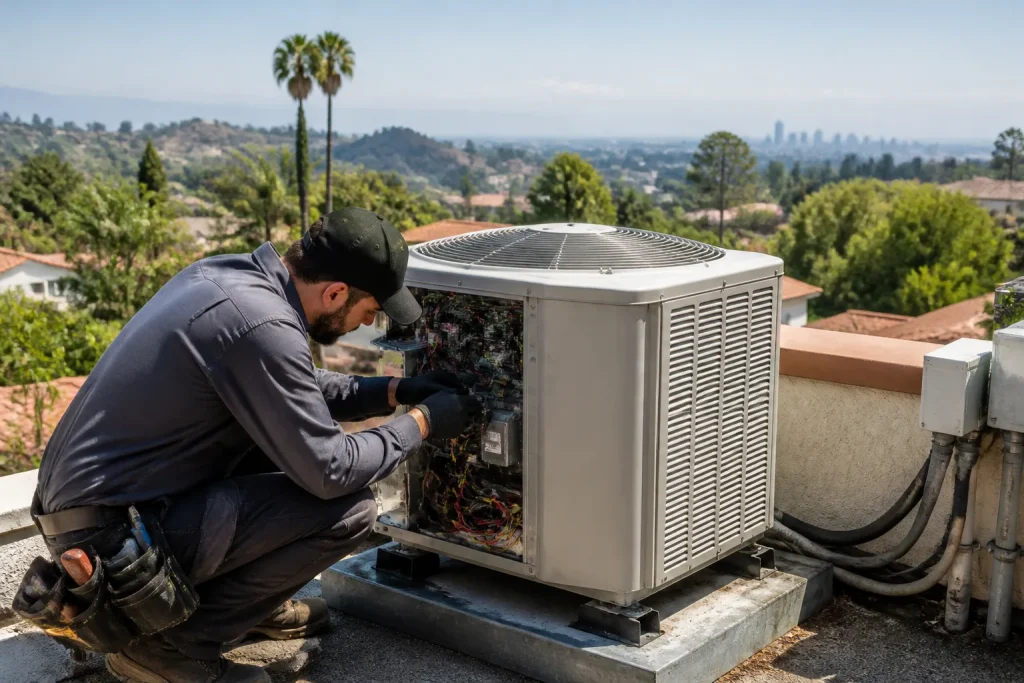
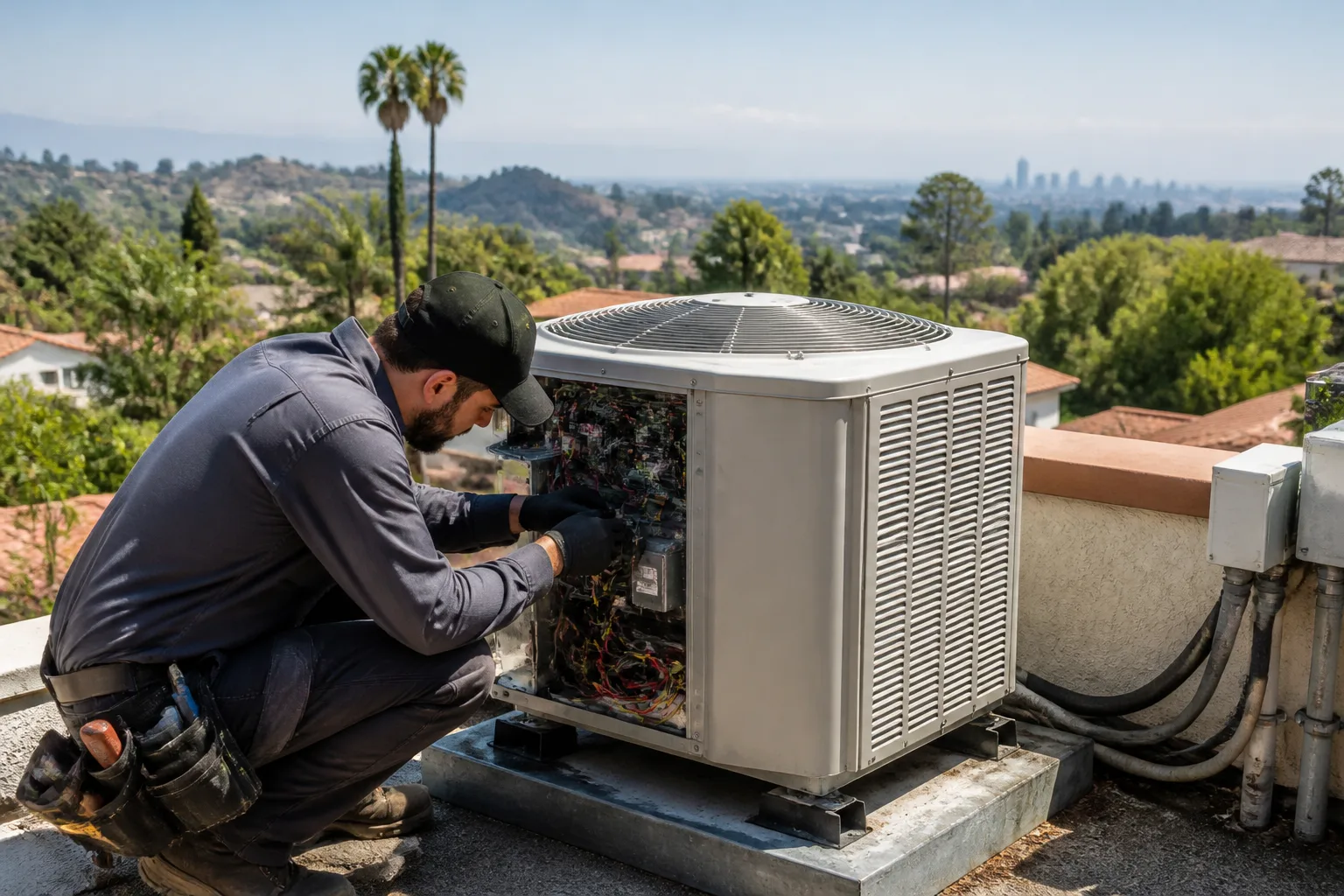
The Santa Ana wind season runs from October through March, and it overlaps almost perfectly with the time when most Los Angeles homeowners have stopped paying attention to their air conditioning. The outdoor condenser unit, the big metal box sitting next to the house, is built to sit outside, but it’s not built to be sandblasted by 60 mph gusts carrying dried leaves, palm fronds, and dust.
Before a major Santa Ana event, take three minutes and walk around the unit. Pull away any loose debris that has gathered against the coil fins. If there are larger branches or palm fronds leaning against it, move them. After the winds die down, check again. Debris wedged between the coil fins restricts airflow, and restricted airflow makes the system run hotter than it should, even in winter when it’s only running occasionally.
One thing we see every year in Los Angeles: a condenser that’s been wrapped in a “winter cover” or a tarp, trapping moisture and rotting the fan motor or corroding the coil. Don’t do that. Modern condensers are designed to sit out in the open year-round. A cover traps condensation and turns the inside of the unit into a humid little greenhouse. If you want to protect it from Santa Ana debris, a simple plywood-and-brick windbreak set a couple feet away does more good than any cover, and it doesn’t hold moisture against the metal.
Your furnace and your AC share the same blower and ductwork, which is why a condenser problem in winter matters. If the outdoor unit gets clogged or damaged and you don’t catch it, you’ll find out about it on the first 80-degree day in March, which in Los Angeles is basically next week.
The Filter Schedule That Actually Fits LA’s Heating Season
National filter guides usually say to change your filter every 90 days. That advice assumes a heating season that runs for five or six months of continuous use. In Los Angeles, your heating season is maybe eight to ten weeks spread across December through February, with most of the actual runtime compressed into three or four cold weeks.
Here’s what we recommend for most LA homes: check the filter every 30 days during November through February, and replace it whenever it looks dark gray or clogged, even if it hasn’t been a full 30 days. For homes in areas with heavy Santa Ana dust, or homes near construction, or homes with shedding pets, that might mean replacing it every three or four weeks during the worst of it. For the rest of the year, the every-90-days rule is fine.
On filter ratings: MERV 8 is the workhorse for most homes. It catches dust, pet dander, and pollen without restricting airflow. MERV 11 is a solid step up if anyone in the house has allergies or respiratory issues, and it handles LA’s smog-particulate load better than MERV 8. The thing to watch is MERV 13 and above. Those filters are dense enough that they can restrict airflow on older systems, which makes the blower work harder and can shorten the life of the motor. Unless your system was specifically designed for high-efficiency filtration, stick with MERV 8 or 11 during heating season and let the system breathe.
Testing Your Thermostat’s Heat Mode Before You Need It
Sometime in late October or early November, before the first genuinely cold night, walk over to your thermostat and switch it from COOL to HEAT. Set the temperature about five degrees above whatever the room currently reads. Then just stand there for a minute or two and listen.
You want to hear the system kick on, feel warm air coming from the vents, and confirm that the thermostat display shows the heat mode active. If the thermostat clicks but nothing happens, or if the fan runs but the air never warms up, you have found a problem at 2 p.m. on a Saturday in November instead of 11 p.m. on a Tuesday in January. That’s the entire point of testing early.
While you’re at it, this is the time to check the thermostat batteries if it has them. A thermostat with dying batteries causes exactly the kind of intermittent problem that drives homeowners crazy: the heat works one day, doesn’t the next, and the HVAC company can’t reproduce the issue when they arrive. Ten dollars in batteries in November prevents a service call in December.
If you have a programmable or smart thermostat, check the schedule. After a summer of cooling schedules, the transition to winter mode is when people discover their heat is set to hold at 62 degrees all night and the “problem” is actually just the schedule doing its job.
What a Pre-Season Furnace Tune-Up Should Include, and What It Should Cost
A legitimate pre-winter furnace tune-up in Los Angeles should run somewhere between $90 and $180, depending on the system and the company. If someone quotes you $49, they’re using the tune-up as a loss-leader to find things to upsell. If someone quotes you $400 for a “comprehensive winter system optimization,” they’re charging you for adjectives. The honest price lives in the middle.
Here’s what a real tune-up includes, and what to ask about:
- Flame sensor cleaning. Necessary. This is the single most common cause of winter no-heat calls in Los Angeles, and it takes ten minutes.
- Burner inspection and cleaning. Necessary. Dirty burners run inefficiently and can shorten the life of the heat exchanger.
- Heat exchanger visual inspection. Necessary on systems older than ten years. A cracked heat exchanger is a carbon monoxide risk, and visual inspection catches most of them.
- Blower wheel and motor check. Necessary if the system is noisy or if airflow feels weak.
- Capacitor and electrical connection check. Worth doing. Capacitors wear out with age and heat, and a weak capacitor is a $30 part that causes a $300 emergency call when it fails on the coldest night of the year.
- Duct cleaning add-on. Almost always unnecessary. Unless you’ve had a major renovation, a water leak, or a rodent problem, ducts don’t need to be cleaned as part of routine winter prep. If the tune-up tech immediately pushes a $600 duct cleaning, that’s an upsell, not a recommendation.
We pulled a blower wheel out of a unit in a home over in Sherman Oaks last November that had accumulated so much pet hair it looked like a small animal was living in the blower housing. The homeowner had been running the AC all summer with a clogged filter and never noticed the extra noise. By the time we got there in February, the motor had been straining for months. A forty-five minute tune-up in November would have caught it for the cost of a cleaning call, instead of a blower motor replacement in February.
When to call a pro: if your furnace makes a banging or rattling sound when it starts, if you smell gas, if the system short-cycles (turns on and off every few minutes), or if you have any reason to suspect a carbon monoxide issue. These are not DIY situations. A furnace burner and heat exchanger are gas-fired components, and a mistake there is a safety problem for the whole house. Call someone licensed, and if you’re in LA, our AC Repair in Los Angeles page covers what to expect from a service visit, from the written price to the arrival window.
Related services in Los Angeles: if you find during your winter prep that the AC side of things is on its last legs, or if your furnace is old enough that repair doesn’t make sense, we cover both. Our AC Installation in Los Angeles page walks through what a new system costs and how to think about the decision.
The Bottom Line
Winter prep in Los Angeles is a short list, but every item on it exists because LA’s specific climate pattern, long idle periods followed by sudden hard use, creates predictable failures. Clean the flame sensor or have it cleaned. Check the filter monthly during the heating months and don’t chase high MERV ratings on old systems. Walk around the condenser before and after Santa Ana events. Test your thermostat’s heat mode in daylight, in November, while the HVAC company is still answering the phone without a three-day wait.
None of this is expensive. Most of it is free and takes under an hour total. The expensive version is the emergency call at 11 p.m. on the first cold night of the year, when every furnace in Los Angeles fails at the same time and you’re one of two hundred people leaving voicemails.
If you’re in Los Angeles and want someone else to handle the checklist, Coldharbour Heating & Air offers a pre-season furnace tune-up with a written price before the work starts and a written guarantee on every repair. Call (817) 402-2972 for a free estimate, and a real person will answer, any time, day or night.
Frequently Asked Questions
Schedule it between mid-October and late November, before the first sustained cold nights. This gets your system checked while the technician can still run the furnace through a full cycle without the heat making the house uncomfortable, and it means any worn parts get replaced before the first real cold snap, when demand spikes and wait times stretch out. In Los Angeles, early November is the sweet spot.
Most legitimate furnace tune-ups in Los Angeles run between $90 and $180. The price should include flame sensor cleaning, burner inspection, a heat exchanger visual check, and basic electrical testing. Anything dramatically cheaper is a loss-leader designed to sell you add-ons, and anything dramatically more expensive should come with an itemized explanation. Call (817) 402-2972 for our exact current tune-up pricing, which we’ll put in writing before any work begins.
Yes, because those few weeks are when the system runs hardest and works longest per cycle, after sitting idle for most of the year. An unmaintained furnace in Los Angeles doesn’t fail in March when it’s off, it fails in January when the whole house depends on it, at the exact moment every HVAC company is at capacity. A $120 tune-up in November is insurance against a $400 emergency call in January.
You can skip the deeper inspection items, but even a furnace installed last year should have its filter checked and its heat mode tested before the first cold night. A new furnace can still have a dirty flame sensor, a thermostat setting that’s wrong after a summer of cooling, or a filter that’s been clogged since August. The dollar cost is zero, and the alternative is finding the problem at the worst possible moment.
Written by the team at Coldharbour Heating & Air.
Need HVAC Help?
Call Coldharbour Heating & Air - licensed & insured, here with fast after-hours help in Los Angeles.
(817) 402-2972