
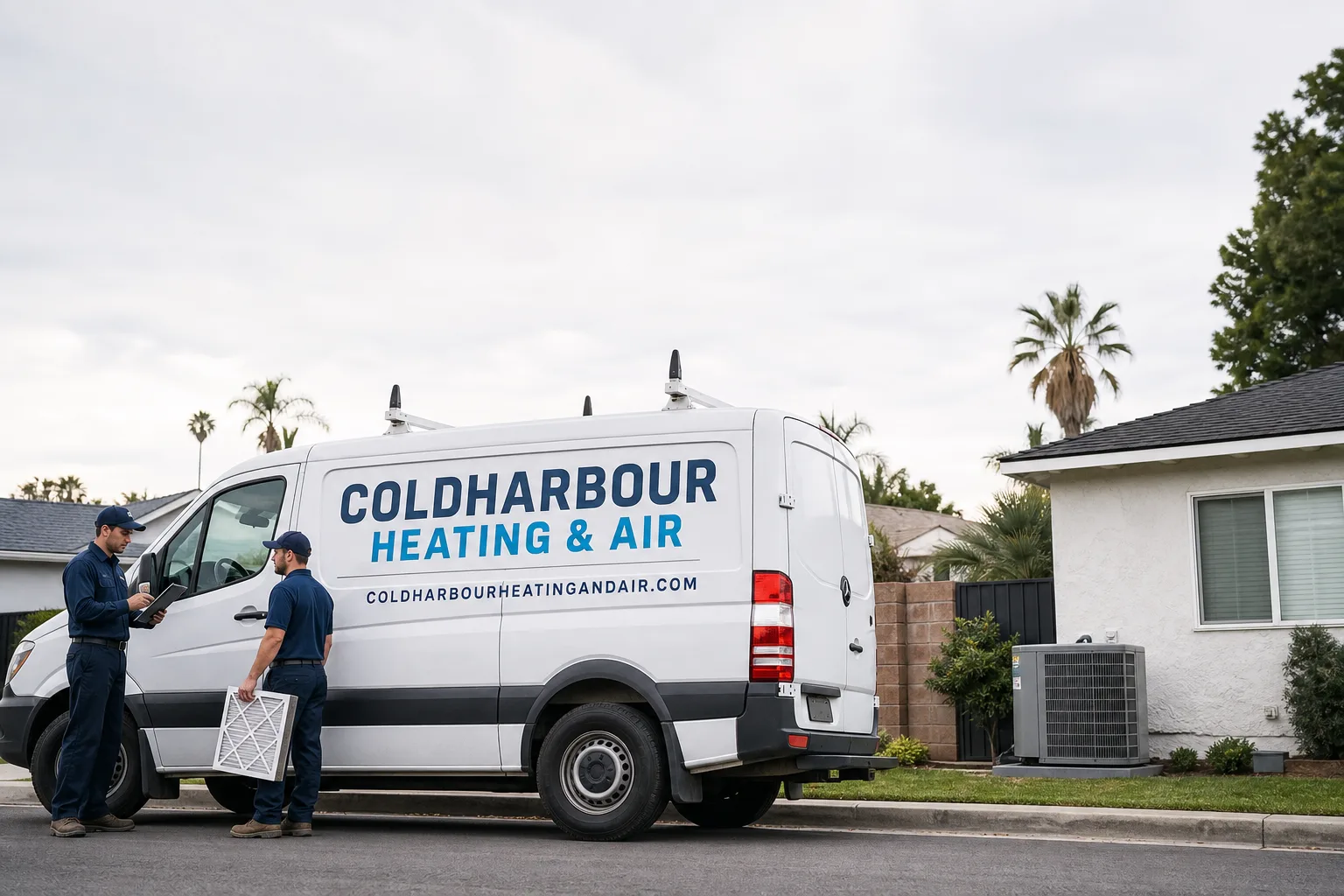
Seasonal tune-up and full diagnostic on your Carrier, Trane, or Goodman system - readings shown to you before any repair is proposed
Diagnosis first, numbers second - you approve the repair price before a single part goes in.







 Before
 After
After Before
 After
After Before
 After
AfterFurnace Installation Nationwide
A furnace that dies in January is not a problem you can put off until the weekend. If you are shopping for a replacement, or the old unit has finally quit, you need a straight answer on what to buy, what it costs, and when it will be running. That is what Coldharbour Heating & Air does. Since 2003, we have installed gas, electric, and high-efficiency furnaces in homes across the country, and every installation carries the 365-Day Done Right Promise: a written guarantee that if the work fails within a full year, we come back and fix it at no charge. A live person answers our phones 24 hours a day, seven days a week. Call (817) 402-2972 and you can book a free in-home estimate right then. Most furnace installations run between $3,800 and $9,500 including the unit, labor, and haul-away, and you will have the exact number in writing before any work starts.
Key Takeaways
- Furnace installation typically costs $3,800 to $9,500 depending on fuel type, efficiency rating, and the condition of your ductwork and venting.
- Every installation comes with the 365-Day Done Right Promise in writing, not just a verbal assurance.
- A live person answers the phone 24/7, including nights, weekends, and holidays.
- We install nine major brands including Carrier, Trane, Lennox, Goodman, Rheem, York, Daikin, Bryant, and American Standard.
- You get a written price before work starts, and that number does not change at the door.
When It Is Time to Replace Your Furnace
Most furnaces last 15 to 20 years, and the last few of those years are usually expensive. If your unit is older than 15 years and needs a repair that costs more than a third of a new system, replacement almost always makes more sense than another patch. Rising gas or electric bills with no change in how you heat the house are another clue, since an aging furnace loses efficiency every season. A cracked heat exchanger is the one problem that ends the conversation: it can leak carbon monoxide into the home, and it cannot be repaired safely. Our technicians will tell you honestly whether your furnace can be saved. If a fix makes sense, our heating repair team can handle it. If it does not, we will explain why and show you the numbers in writing.
Repair versus replace
We use a simple test. Multiply the repair cost by the furnace’s age in years. If the result is more than about $5,000, replacement is usually the better investment. A 17-year-old furnace needing a $400 part fails that test and a 6-year-old one needing the same part does not. We will walk through that math with you, and you decide.
Types of Furnaces We Install
The right furnace depends on the fuel available at your address, your climate, and how long you plan to stay in the home. We install all three common types and will help you pick, not push you toward the most expensive box on the truck.
Gas furnaces
Gas is the most common choice in cold-weather states because natural gas is usually the cheapest heat per unit of energy. A new gas furnace typically costs $3,800 to $8,500 installed. Single-stage models are the lowest price. Two-stage and modulating models run quieter and hold temperature more evenly, which many homeowners find worth the extra $800 to $1,800.
Electric furnaces
Electric furnaces cost less to buy, often $3,000 to $5,500 installed, and they need no gas line or flue. They are common in homes without gas service. The tradeoff is the monthly bill, since electric resistance heat costs more to run than gas in most regions. If you are weighing options for an all-electric home, ask us about a heat pump installation as well, because a heat pump can cut heating costs by half or more in milder climates.
Oil furnaces
Oil is still used in parts of the Northeast and some rural areas. We replace existing oil systems and can also advise on converting to gas where a line is available.
Choosing the Right Efficiency Rating
Furnace efficiency is measured by AFUE, which stands for annual fuel utilization efficiency. An 80 percent AFUE furnace turns 80 cents of every fuel dollar into heat and sends the rest up the flue. A 96 percent unit wastes only 4 cents. The minimum standard in many northern states is now 90 percent or higher, so check local code before you buy. In a cold climate with high winter fuel prices, a 95 to 98 percent furnace often pays back its higher price within six to ten years. In a mild climate where the furnace runs only a few weeks a year, the savings take much longer to add up and a mid-efficiency model can be the smarter buy. We will estimate your annual fuel use and show you the payback on each option so the decision comes down to numbers.
Single-stage, two-stage, and modulating
A single-stage furnace is either fully on or fully off. A two-stage furnace has a low setting for mild days and a high setting for cold ones. A modulating furnace adjusts its output in small steps to match what the house needs. More stages mean fewer temperature swings, less noise, and steadier airflow.
Sizing the Furnace Correctly
An oversized furnace is one of the most common installation mistakes in the country. It heats the house fast, shuts off, and repeats this short cycle all day. That wears out parts early, leaves cold spots, and wastes fuel. An undersized unit runs nonstop and still cannot keep up on the coldest nights. We size every furnace with a Manual J load calculation, the industry standard method that accounts for your home’s square footage, insulation, window area, air leakage, and local design temperature. We do not guess from the size of your old unit, because the old unit may have been wrong from day one. If your home has had insulation or window upgrades since the last furnace went in, the right size today may be a full step smaller than what you have now.
Ductwork, Venting, and Gas Lines
A new furnace is only as good as the system it connects to. Before we quote a price, the technician checks the ducts for leaks, crushed sections, and poor insulation in attics and crawl spaces. Leaky ducts can waste 20 to 30 percent of the heat you pay for. If we find problems, we put the repair cost on the written estimate as a separate line so you can see it and choose.
Venting and combustion air
Gas furnaces must vent exhaust gases safely outside. Older 80 percent units use a metal flue through the roof. High-efficiency models vent through PVC pipe and drain acidic condensate, so we run a condensate line to a floor drain or pump. We check clearances, draft, and combustion air supply on every job.
Gas line and electrical
We inspect the gas line size, shutoff valve, and connections, and we test every joint for leaks before the furnace is lit. Electrical work covers the dedicated circuit, disconnect, and thermostat wiring. Where a permit is required, we pull it and schedule the inspection.
Thermostats and Air Quality Add-Ons
A new furnace is a good moment to upgrade the parts around it. A programmable or smart thermostat costs $120 to $350 installed and can trim heating bills by 8 to 10 percent by lowering the temperature while you are out. A whole-home humidifier adds moisture in dry winter air and runs $350 to $700. A media air cleaner or upgraded filter cabinet catches more dust than a standard one-inch filter. None of this is required, and we will never add it to the estimate without asking. If you want it, we install it during the same visit so you pay for one trip.
Brands We Install
We install all major residential furnace brands. Carrier and Bryant share a design lineage and are popular for their quiet operation and long parts availability. Trane and American Standard are known for heavy-gauge cabinets and durable heat exchangers. Lennox offers some of the highest efficiency ratings on the market. Goodman is a value-focused line with a strong warranty, and Rheem, York, and Daikin round out the choices. We stock common parts for each brand, and the technician who installs your furnace will be trained on it. We will recommend based on your home and budget, and we are happy to quote two or three brands side by side.
Signs You Need a New Furnace Soon
- The furnace is 15 years old or more. Even a well-kept unit loses efficiency and reliability at this age. Planning a replacement in spring or fall costs less and stresses less than an emergency swap in a cold snap.
- Repair bills keep climbing. Two or more repairs in a single season usually mean the system is wearing out as a whole, not failing one part at a time.
- Uneven heat from room to room. Cold rooms can point to a failing blower, duct problems, or a furnace that is the wrong size for the house.
- Yellow or flickering burner flame. A healthy gas flame is steady and blue. A yellow flame can signal incomplete combustion, which produces carbon monoxide. Shut the furnace off and call us.
- Loud banging, squealing, or rattling. Delayed ignition, a failing blower bearing, or a cracked component can all make noise. These sounds get worse, not better, with time.
Our Installation Process, Step by Step
- 1
You call and a live person answers. We ask about your current system, your home, and what you want from a new one. You get a firm appointment window before the call ends.
- 2
A technician visits for a free in-home estimate. We measure the home, run the load calculation, inspect the ducts, venting, and gas line, and look at your existing equipment. You will know who is coming before they arrive.
- 3
You get a written price with options. The estimate covers equipment, labor, permits, and haul-away of the old furnace. We show good, better, and best choices so you can compare. That number is fixed.
- 4
We install on the agreed day. Most replacements are finished in one day, usually six to eight hours. We protect floors, disconnect and remove the old unit, set the new furnace, and connect gas, venting, electrical, and ducts.
- 5
We test, clean up, and hand you the guarantee. We check gas pressure, temperature rise, airflow, and carbon monoxide levels, then walk you through the thermostat. You receive the 365-Day Done Right Promise in writing before we leave.
How Much Does Furnace Installation Cost?
A mid-range gas furnace installation, 80 to 92 percent AFUE with standard venting, usually runs $3,800 to $6,200. A high-efficiency gas furnace at 95 to 98 percent AFUE typically costs $5,800 to $9,500 installed. Electric furnace installation falls between $3,000 and $5,500. Ductwork repairs, a new gas line, a chimney liner, or a thermostat upgrade are added as separate written lines, so you see exactly what each one costs.
Several factors move the final price. Home size and heat load decide the furnace capacity. Efficiency rating is the biggest swing, since condensing units cost more but use less fuel. Brand and warranty length matter, and so does how easy the old unit is to remove and the new one is to place. Attic and crawl space installs take more time than a basement or closet. Some utilities and states offer rebates on high-efficiency models, and we will point out any we know about. The best protection against overpaying is a company that puts the price in writing and guarantees the work in writing after. Call (817) 402-2972 and we will schedule your free estimate.
Where We Work
Coldharbour Heating & Air serves homeowners across the United States through local crews working to the same written standards. Whether you live in a city, a suburb, or a rural town, the job is run the same way: a price before the work starts, a firm arrival window, a clean job site, and a written 365-day guarantee. Heating and cooling you can count on, and we have been doing it since 2003. For cooling needs, see our AC repair page, or return to our home page to see everything we do.
Frequently Asked Questions About Furnace Installation
Most straight replacements are finished in one day, usually six to eight hours. Jobs that need new ductwork, a new gas line, or a switch from an 80 percent unit to a high-efficiency model with new PVC venting can take a second day. We give you a time estimate with your written price.
Most furnace installations fall between $3,800 and $9,500, depending on fuel type, efficiency rating, size, and what your ducts and venting need. Electric furnaces are on the lower end and high-efficiency gas models on the higher end. The estimate is free and in writing. Call (817) 402-2972 to schedule it.
Size is based on a Manual J load calculation, which looks at your home’s square footage, insulation, windows, air leakage, and local climate. We do not size by copying the old unit, because the old one may have been too big or too small. A properly sized furnace runs longer cycles, heats evenly, and lasts longer.
In cold climates with long heating seasons, usually yes. A 95 to 98 percent AFUE furnace often repays its higher price in six to ten years through lower fuel bills. In mild climates the payback is slower. We estimate your yearly fuel use and show the payback on each model before you decide.
Every installation includes the 365-Day Done Right Promise, a written guarantee on our labor and workmanship for a full year. If the installation fails during that window, we return and correct it at no charge. The furnace itself also carries the manufacturer’s parts warranty, which is often 10 years when registered.
Yes. Removal and disposal of the old furnace is included in the written price. We disconnect it, carry it out, and leave the area clean. Nothing is added to the bill at the door.
Schedule Your Furnace Installation Today
If your furnace is failing or you want to replace it before it does, call (817) 402-2972 now and a live person will answer, day or night. We will book a free in-home estimate and give you a written price with no pressure. Every installation includes the 365-Day Done Right Promise in writing. Homeowners across the country trust Coldharbour Heating & Air because we put it in writing, every time.
Written by Victor Mancini, Owner at Coldharbour Heating & Air, serving customers across the United States since 2003.