
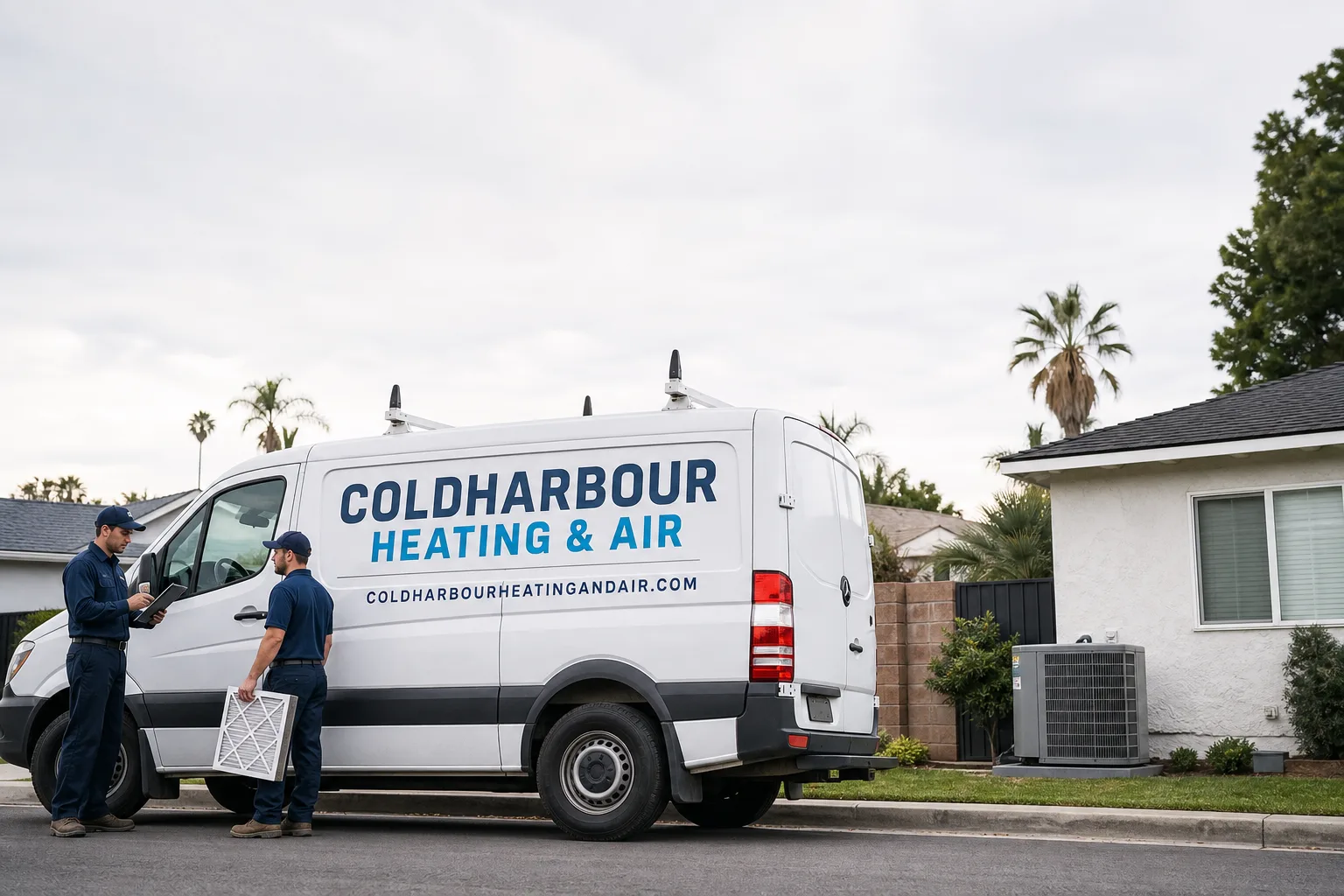
Seasonal tune-up and full diagnostic on your Carrier, Trane, or Goodman system - readings shown to you before any repair is proposed
Diagnosis first, numbers second - you approve the repair price before a single part goes in.







 Before
 After
After Before
 After
After Before
 After
AfterTrusted Heating Repair Nationwide
When the heat quits on a cold night, you don’t need a brochure. You need a person on the phone and a technician who knows what a failed igniter or a dead blower sounds like. That’s the problem Coldharbour Heating & Air solves. Since 2003, we’ve handled heating repair for homeowners across the country, and every job carries the 365-Day Done Right Promise: a written guarantee that if the repair fails within a full year, we come back and fix it at no charge. A live person answers our phones 24 hours a day, seven days a week, and we offer same-day service for most no-heat calls. Call (817) 402-2972 and you’ll talk to someone who can book your visit right then. Most heating repairs run between $120 and $700, and you get a written price before any work begins. No surprises at the door, and no exceptions to the guarantee.
Key Takeaways
- Heating repair typically costs $120 to $700 depending on the failed part and the type of system.
- Every repair comes with the 365-Day Done Right Promise in writing, not just a verbal assurance.
- A live person answers the phone 24/7, including nights, weekends, and holidays.
- We repair furnaces, heat pumps, and boilers from Carrier, Trane, Lennox, Goodman, Rheem, York, Daikin, Bryant, and American Standard.
- You get a written price before work starts, and that number does not change at the door.
Furnace Repair
Furnace repair is the work of finding the one part that stopped your heat and replacing or fixing it, without selling you a new system you don’t need. You need it when the furnace won’t start, starts and shuts off after a minute, or runs without warming the house. Coldharbour Heating & Air sends background-checked, uniformed technicians who arrive in the window we promised, test the furnace in sequence, and hand you a written price before any tool touches the unit. Most furnace repairs run $150 to $600. If a furnace is truly past saving, we’ll tell you plainly and point you to our furnace installation service with real numbers on the table.
Ignition and flame sensor problems
Gas furnaces light through a hot surface igniter or an electronic spark, then confirm the flame with a thin metal sensor. When that sensor gets coated with soot, the furnace lights, doesn’t “see” the flame, and shuts the gas off within seconds. Cleaning or replacing the sensor is a short job, often under an hour. A cracked igniter is just as common, and both parts are stocked on our trucks.
Blower motor and capacitor failure
The blower moves warm air through your ducts. When its motor or capacitor fails, the furnace can heat up but never push that heat into the house, and the heat exchanger may overheat and trip a safety limit. We test the motor windings and capacitor with a meter before replacing anything, so you pay only for what actually failed.
Heat Pump Repair
Heat pump repair covers the electrical and refrigerant faults that keep a heat pump from warming your home in winter. You need it when the outdoor unit is iced over, the air from the vents feels lukewarm, or the system leans on its backup heat strips all day and your electric bill jumps. Coldharbour Heating & Air diagnoses the reversing valve, the defrost board, the compressor, and the refrigerant charge, then gives you a written price. Heat pump repairs usually land between $180 and $700. If your system is beyond repair, our heat pump installation team can quote a replacement in writing.
Defrost and reversing valve faults
A heat pump builds a layer of frost on the outdoor coil in cold, damp weather and clears it with a defrost cycle. When the defrost board or sensor fails, the coil turns into a block of ice and heat output drops. A stuck reversing valve is a different problem: the system blows cool air in heating mode. We test both with gauges, not guesses.
Auxiliary heat strips
Electric backup strips kick in when the heat pump can’t keep up. If they run constantly, that points to a refrigerant or compressor problem upstream, and the strips are quietly burning through your power bill. We find the root cause instead of just resetting the system.
Boiler and Radiant Heat Repair
Boilers heat water instead of air, so their failures look different: radiators that stay cold, banging in the pipes, or a pressure gauge that drifts too high or too low. Coldharbour Heating & Air repairs circulator pumps, expansion tanks, pressure relief valves, zone valves, and ignition controls on residential boilers. Most boiler repairs fall between $200 and $700. A circulator pump replacement is the most common, and a zone valve swap is usually faster and cheaper than homeowners expect. Every boiler repair carries the same written 365-Day Done Right Promise as a furnace job.
Emergency Heating Repair
Emergency heating repair is what you need when the heat fails during freezing weather and waiting a day or two isn’t realistic. We treat a no-heat call as urgent when the house is dropping toward the 50s and someone at home is at risk: an infant, an older relative, or a person with a heart or breathing condition. Our phones are answered by a live person around the clock, and we dispatch same-day or next-morning coverage for emergency calls. Emergency pricing sits inside the same $120 to $700 range as standard repairs. We don’t charge overtime rates, and the written price you get before we start is the price you pay.
After-hours response
When the furnace dies at 11 p.m. in January, you shouldn’t have to wait until morning to tell someone. A live person takes your call, books the technician directly, and tells you when to expect us. No answering service that takes a message and hopes for the best.
Safety first on gas and carbon monoxide
If you smell gas, leave the house and call your gas utility or 911 before you call anyone else. If a carbon monoxide alarm goes off, get everyone outside and into fresh air. After the scene is safe, we’ll inspect the heat exchanger and venting so the problem doesn’t come back.
Furnace Not Heating
A furnace that runs but doesn’t heat is the most common winter call we take, and the list of usual causes is short: a dirty flame sensor, a failed igniter, a clogged filter that tripped the high-limit switch, a gas valve that isn’t opening, or a thermostat that isn’t sending the call for heat. This is a symptom, not a diagnosis, and the right move is a professional inspection rather than guessing at parts. We find the specific fault, show you the readings, and hand you a written price before any repair starts. Every one of these repairs carries the 365-Day Done Right Promise.
What to check before calling
Make sure the thermostat is set to heat and is a few degrees above room temperature, and replace the filter if it looks gray and matted. Check that the furnace switch near the unit is on and the breaker hasn’t tripped. If you reset the breaker and it trips again, stop. Repeated tripping points to an electrical fault, and High-voltage parts inside a furnace can cause serious injury, so leave the cover on.
Thermostat and Control Repair
Sometimes the heating equipment is fine and the control that tells it what to do is not. A failed thermostat, a loose low-voltage wire, or a bad control board can mimic a dead furnace. We test the thermostat output first because it’s the cheapest thing to rule out, then move to the control board and safety switches. Thermostat and control repairs typically run $120 to $350. If a smart thermostat is part of the problem, we’ll check that it’s wired and configured correctly for your system type, whether that’s a single-stage furnace, a variable-speed unit, or a heat pump.
Short Cycling and Noisy Systems
A furnace that turns on and off every few minutes is short cycling, and it wears out parts fast. The causes include a restricted filter, an oversized system, a failing flame sensor, and an overheating heat exchanger. Noises matter too. Banging at startup often means delayed ignition, squealing points to a blower belt or motor bearing, and a steady rattle can mean loose panels or a failing inducer motor. None of these go away by themselves, and each one gets more expensive the longer it runs. A diagnostic visit usually catches them while the repair is still a modest one.
Brands We Service
Our technicians work on all major residential heating brands. Carrier and Bryant share a platform, and we stock the igniters, flame sensors, and pressure switches for both. Trane and American Standard are built the same way, and our team knows their inducer assemblies and control boards well enough to diagnose them without swapping parts blindly.
Lennox furnaces often use proprietary communicating controls that trip up generalist techs, so our crews work through the diagnostic codes first. Whether you have a Goodman, Rheem, York, Daikin, or another make, the technician who arrives will know your system, not just heating in general.
Signs You Need a Pro Right Now
- The furnace runs but the house never warms up. Usually a failed igniter, a tripped limit switch, or a dead blower. The longer it runs like this, the more likely a small part becomes a large one.
- The breaker trips repeatedly. Reset it once. If it trips again, stop and call us. Repeated resets can damage the motor or start a fire.
- You smell something burning or see a yellow flame. A healthy gas flame is blue. A yellow or flickering flame can mean incomplete combustion and a carbon monoxide risk, so shut the system off and call.
- Your heating bill jumped without a rate change. A system that’s struggling uses more energy to produce less heat. A worn part, a dirty coil, or a failing heat pump is often the cause.
- Airflow from the vents is weak or uneven. A failing blower, a collapsed duct, or a clogged filter can all be to blame. If the system can’t move air, it can’t warm the house.
Our Process, Step by Step
- 1
You call and a live person answers. We’ll ask what the system is doing, how long it’s been happening, and whether anyone in the home is at risk from the cold. You’ll get a firm arrival window before the call ends, not a vague “sometime this afternoon.”
- 2
The technician arrives on schedule. A background-checked, uniformed technician shows up in the window we promised. We’ll confirm the symptoms with you, then start the diagnostic. You’ll know exactly who is coming through your door before they arrive.
- 3
We diagnose the system and show you the findings. Using meters, gauges, and manufacturer test procedures, we identify the failed component. We test before we replace, so you don’t pay for parts the system didn’t need. We explain the problem in plain English.
- 4
You get a written price before we turn a wrench. The estimate includes parts, labor, and supplies. That number is fixed. If we find something else during the repair, we stop, explain, and hand you a new written price before continuing.
- 5
We complete the work, clean up, and hand you the guarantee. After the repair, we run the system through a full heating cycle to confirm it’s warming correctly. We clean the work area, then hand you the 365-Day Done Right Promise in writing before we leave.
How Much Does Heating Repair Cost?
A flame sensor cleaning or replacement usually runs $120 to $250. A hot surface igniter replacement is typically $150 to $350, and a blower motor or capacitor replacement lands between $200 and $650 depending on the motor type. Heat pump repairs such as a defrost board or reversing valve run $250 to $700, and a boiler circulator pump replacement is generally $250 to $600. Where your job lands depends on what failed, and you’ll know that number in writing before we start.
Several factors affect the final price. The age of the system matters because older units need parts that are harder to find. The brand matters too, since proprietary parts from some manufacturers cost more than universal ones. Our pricing does not change with the weather or with demand. The best way to avoid overpaying is to work with a company that puts the price in writing before the work starts and guarantees the repair in writing after it’s done. That’s what we do on every job, and the estimate is free. If your system is also due for a tune-up, ask about seasonal maintenance so small issues get caught early. Call (817) 402-2972 and we’ll schedule a visit, diagnose the problem, and give you a fixed price before any work begins.
Where We Work
Coldharbour Heating & Air serves homeowners and businesses across the United States through local crews working to the same written standards. Whether you’re in a big city, a quiet suburb, or a rural town, the standard is the same: a price before the work starts, a firm arrival window, a clean job site, and a written 365-day guarantee on every repair. Comfort in any season is the job, and we’ve been doing it since 2003. You can also see everything we offer on our home page, including cooling work like AC repair.
Frequently Asked Questions About Heating Repair
Heating repair is the process of diagnosing and fixing a specific failure in your furnace, heat pump, or boiler, such as a bad igniter, a dead blower motor, or a stuck reversing valve. It’s different from replacement, which means installing a new system. Most repairs are finished in one visit and cost between $120 and $700 depending on the failed part.
Most common repairs, including flame sensor cleaning, igniter replacement, and capacitor replacement, are done in under two hours on site. Larger jobs like a blower motor swap, a control board replacement, or a reversing valve repair can take three to five hours. We give you a time estimate with your written price.
Most heating repairs fall between $120 and $700. A flame sensor service is usually $120 to $250, an igniter replacement $150 to $350, and a motor replacement $200 to $650. Every job includes a written price before work begins and the written 365-Day Done Right Promise after it’s done. Call (817) 402-2972 for a free estimate.
As a rule of thumb, if the furnace is under 12 years old and the repair costs less than a third of a new system, repair makes sense. A cracked heat exchanger or a system that needs repeated repairs in one season usually points to replacement. We’ll give you a straight, written comparison so you decide with real numbers.
Yes. A live person answers our phones 24 hours a day, seven days a week, including holidays. For no-heat calls in freezing weather we dispatch same-day or next-morning coverage, and we prioritize homes with older residents, young children, or anyone with a cold-sensitive medical condition. There is no overtime charge for after-hours work.
Every repair includes the 365-Day Done Right Promise, a written guarantee valid for a full year from the date of service. If the repair fails during that window, we return and correct the work at no additional charge. You get it in writing before we leave.
Schedule Your Heating Repair Service Today
If your heat isn’t working, call (817) 402-2972 now and a live person will answer, day or night. We’ll schedule a visit, diagnose the problem, and hand you a written price before any work begins. Every repair includes the 365-Day Done Right Promise in writing. Homeowners across the country rely on Coldharbour Heating & Air because we put it in writing, every time.
Written by Victor Mancini, Owner at Coldharbour Heating & Air, serving customers across the United States since 2003.