
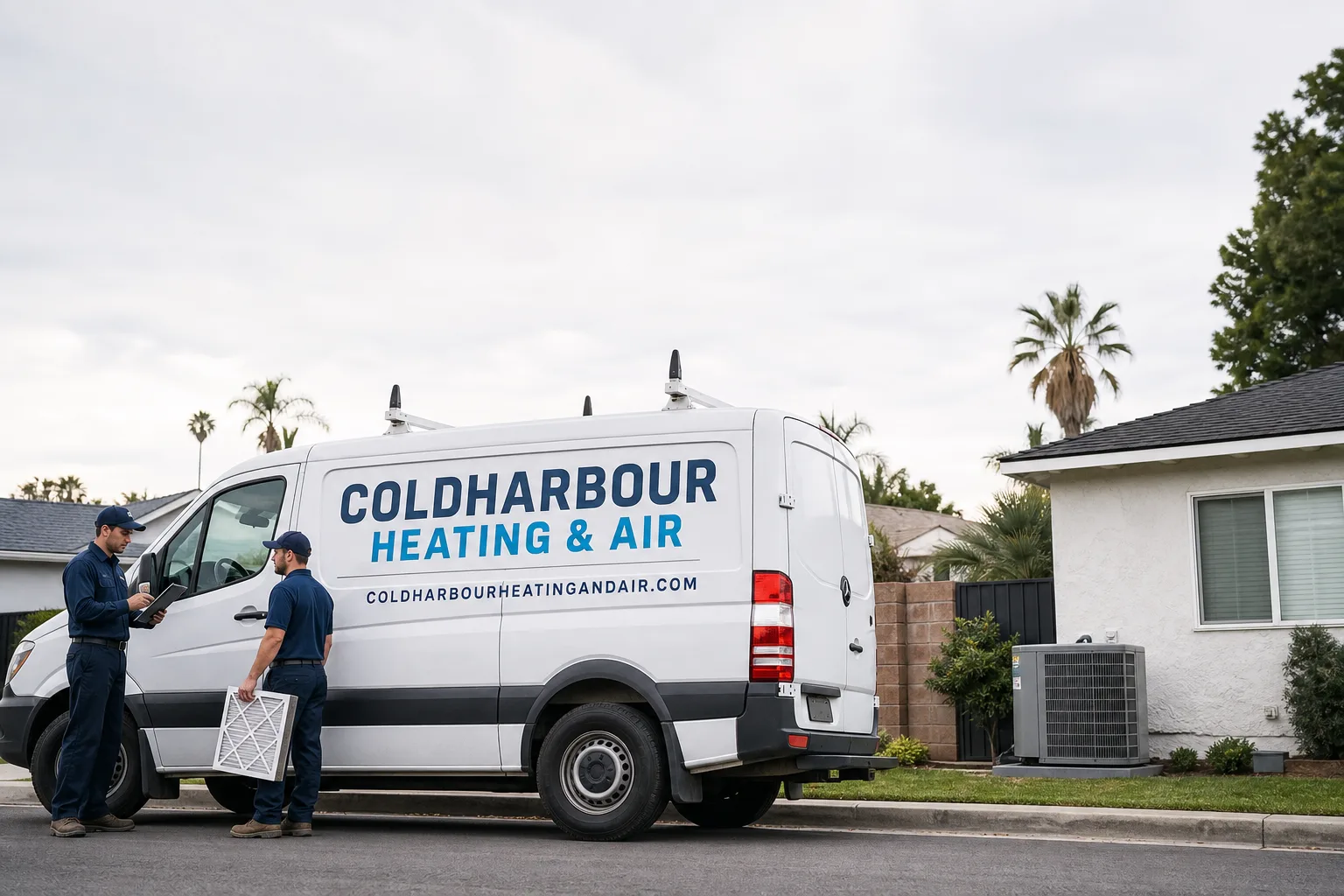
Seasonal tune-up and full diagnostic on your Carrier, Trane, or Goodman system - readings shown to you before any repair is proposed
Diagnosis first, numbers second - you approve the repair price before a single part goes in.







 Before
 After
After Before
 After
After Before
 After
AfterA/C Blowing Warm Air
What’s Happening
When your air conditioner is running but pushing warm air through the vents, the system is almost always either losing refrigerant, working with a dirty filter or coil that’s starving airflow, or dealing with a failed component – a capacitor, contactor, or compressor – that has taken the cooling function offline. The fix depends on which one it is, and a trained technician can usually pinpoint it within the first 20 minutes on site.
The frustrating part is that the blower fan keeps running no matter what. So the house fills with air that feels like it came off a parking lot, and you know something is wrong but the system sounds like it’s doing its job. That gap – between “it’s running” and “it’s actually cooling” – is exactly where most of these faults live. A refrigerant circuit can be low, a coil can be frozen solid, or an electrical component can fail in a way that keeps the fan moving while the compressor sits idle. None of these fix themselves. Most of them are diagnosable and repairable the same day a technician arrives.
Why It Happens
Low or Lost Refrigerant
Refrigerant is the substance that actually absorbs heat from your indoor air and moves it outside. When the refrigerant level drops – almost always because of a leak somewhere in the copper lines or coil – the system can no longer pull heat out of your home efficiently. You’ll often notice the air coming from the vents is slightly cool but never cold, or that the outdoor unit runs continuously without ever catching up. Frost forming on the copper line that connects to your outdoor unit is another strong indicator. Refrigerant does not “wear out” – if it’s low, there is a leak, and that leak needs to be found and repaired before the refrigerant is replaced.
Frozen Evaporator Coil
The evaporator coil sits inside your air handler and is responsible for cooling the air before it reaches your vents. If airflow across it is restricted – most commonly by a clogged air filter, blocked return vents, or dirt buildup on the coil itself – the coil’s surface temperature drops below freezing and ice forms on it. Once it’s iced over, cold air cannot pass through at all, so the vents push warm air or almost nothing. A telltale sign is visible ice on the indoor unit or the refrigerant line, and the unit may drip water as it partially thaws. This one sometimes looks like a refrigerant problem and sometimes is both – a technician sorts it out by checking pressures and airflow together.
Failed Capacitor or Contactor
Capacitors and contactors are electrical components inside the outdoor unit that start and run the compressor. They are also among the most common failure points in a residential AC system, particularly after a hot stretch or a power fluctuation. When a capacitor fails, the compressor may not start at all, leaving the fan running but the cooling completely dead. You might hear the outdoor unit humming without the deeper sound of the compressor kicking in, or the unit might attempt to start, shudder, and quit. These are relatively straightforward repairs when a technician has the right parts on the truck – which is why it matters that the tech arriving at your door is trained on your specific equipment brand.
Thermostat or Wiring Issue
Sometimes the problem is upstream of the equipment entirely. A thermostat set to “fan only” instead of “cool” will push unconditioned air all day long, and it’s worth ruling that out first. But wiring faults – corroded terminals, a tripped secondary disconnect, or a control board fault – can also mimic a cooling failure while the equipment itself is fine. If the thermostat is set correctly, the filters are clean, and the outdoor unit appears to not be running at all while the indoor fan runs freely, a wiring or control issue is worth suspecting. Leave the electrical diagnosis to the technician; residential HVAC wiring carries voltages that can injure or kill.
What to Do Right Now
- Check the thermostat setting first. Confirm it is set to “Cool” and not “Fan Only.” Set the target temperature at least four degrees below the current room temperature and wait five minutes to see if the outdoor unit starts. It sounds basic, but it resolves the problem more often than you’d expect.
- Check your air filter. Pull it out and hold it up to light. If you can’t see light through it, replace it before calling. A blocked filter is one of the most common causes of a frozen coil and warm-air output, and a clean filter rules out the cheapest fix immediately.
- Look at the outdoor unit. Is it running? Is there ice on the copper line coming out of it? Is there frost on the indoor air handler? If the outdoor unit is not running at all, or if you see ice, turn the system off at the thermostat and let it sit. Do not try to open or adjust anything on the outdoor unit – the capacitors inside hold an electrical charge that is genuinely dangerous even after the unit is powered off.
- Check the circuit breakers. Your electrical panel may have a dedicated breaker for the air handler and a separate one for the outdoor condenser unit. If either has tripped, reset it once. If it trips again immediately, stop – a breaker that keeps tripping is protecting you from something, and it should not be forced. Call us.
- Take a photo of what you see. A photo of the frozen line, the thermostat display, or the tripped breaker gives the technician useful context before the truck is even in your driveway. It costs nothing and sometimes cuts diagnostic time significantly.
How We Fix It
When your local Coldharbour Heating & Air technician arrives, the first thing that happens is a written price – your price, for your job, handed to you before a single tool comes out. That is The Kingswell Way, and it does not change at the door.
Diagnosis starts at the thermostat and works outward: airflow, electrical, refrigerant circuit. The technician will measure refrigerant pressures, check capacitor readings, test the contactor, and inspect the coil condition. On most warm-air calls, the fault is identified within the first visit. If it’s a refrigerant leak, the leak is located, repaired, and the system is recharged to the manufacturer’s specification – not just topped off. If it’s an electrical component, the part is typically on the truck for the most common failure points on the brands we service, including Carrier, Trane, Lennox, Goodman, Rheem, York, Daikin, Bryant, and American Standard. Most repairs are completed the same visit.
Every repair is covered by the 365-Day Done Right Promise. That guarantee is written down before the technician leaves – not verbal, not conditional. If the repair fails within that 365-day window, your local Coldharbour team comes back and corrects it at no charge.
The relevant services for this symptom are AC Repair and, where the equipment is too far gone to repair cost-effectively, AC Installation – though that conversation only happens when the numbers genuinely support it, and the written estimate makes the comparison clear either way.
Frequently Asked Questions
Running a system that is low on refrigerant or has a frozen coil can damage the compressor – the most expensive single component in a residential AC system. The safest move is to turn the system off at the thermostat and call as soon as you can. Your local Coldharbour Heating & Air team answers the phone around the clock, every day, with a live person on the line – not a voicemail box. Call (817) 402-2972 and we’ll get someone moving toward your home.
In mild weather, a broken AC is uncomfortable but not immediately dangerous for most households. In extreme heat, that changes – particularly for elderly family members, young children, or anyone with a heart or respiratory condition. If the indoor temperature is climbing and you’re in a vulnerable household, treat it as urgent. Call (817) 402-2972 right now – someone answers every time, day or night.
Your local Coldharbour Heating & Air team takes same-day calls and the phones are answered by a live person 24 hours a day, 7 days a week – no after-hours voicemail, no waiting until morning. Call (817) 402-2972 to find out the earliest available window in your area. We’ll give you a real arrival window and we show up in it.
The cost depends entirely on what the technician finds – a failed capacitor is a very different repair from a refrigerant leak with coil damage, and we won’t know until the system is diagnosed. What we can tell you is that your written price is delivered before any work begins, and it does not change once the job starts. There are no surprise line items at the end. Call (817) 402-2972 to schedule – the estimate is free, and the price you see on paper is the price you pay.
Get It Fixed
Your local Coldharbour Heating & Air team is ready. Call (817) 402-2972 – a live person answers around the clock, every day of the year. You can also book online. We’ll give you a real arrival window, a written price before any work starts, and a repair backed by the 365-Day Done Right Promise.
Written by Victor Mancini, Owner and Lead HVAC Technician at Coldharbour Heating & Air, a member of the Kingswell network of independently owned and operated HVAC businesses, founded in 2003.
What Our Customers Say
"Furnace wouldn't light the first cold morning. The guy walked me through what he was checking so I actually understood it. Replaced the igniter, wrote up the warranty, and it's been warm since."
- Alicia Romero"AC died overnight with a newborn in the house. They bumped us up the list and had it running by noon. I about hugged the guy. Fair price even on a rush call."
- Celeste Ngo"The repair was done well and quickly. Scheduling over the phone was a little clunky and I got transferred twice, but the tech himself was great and on time."
- Brett Haygood