
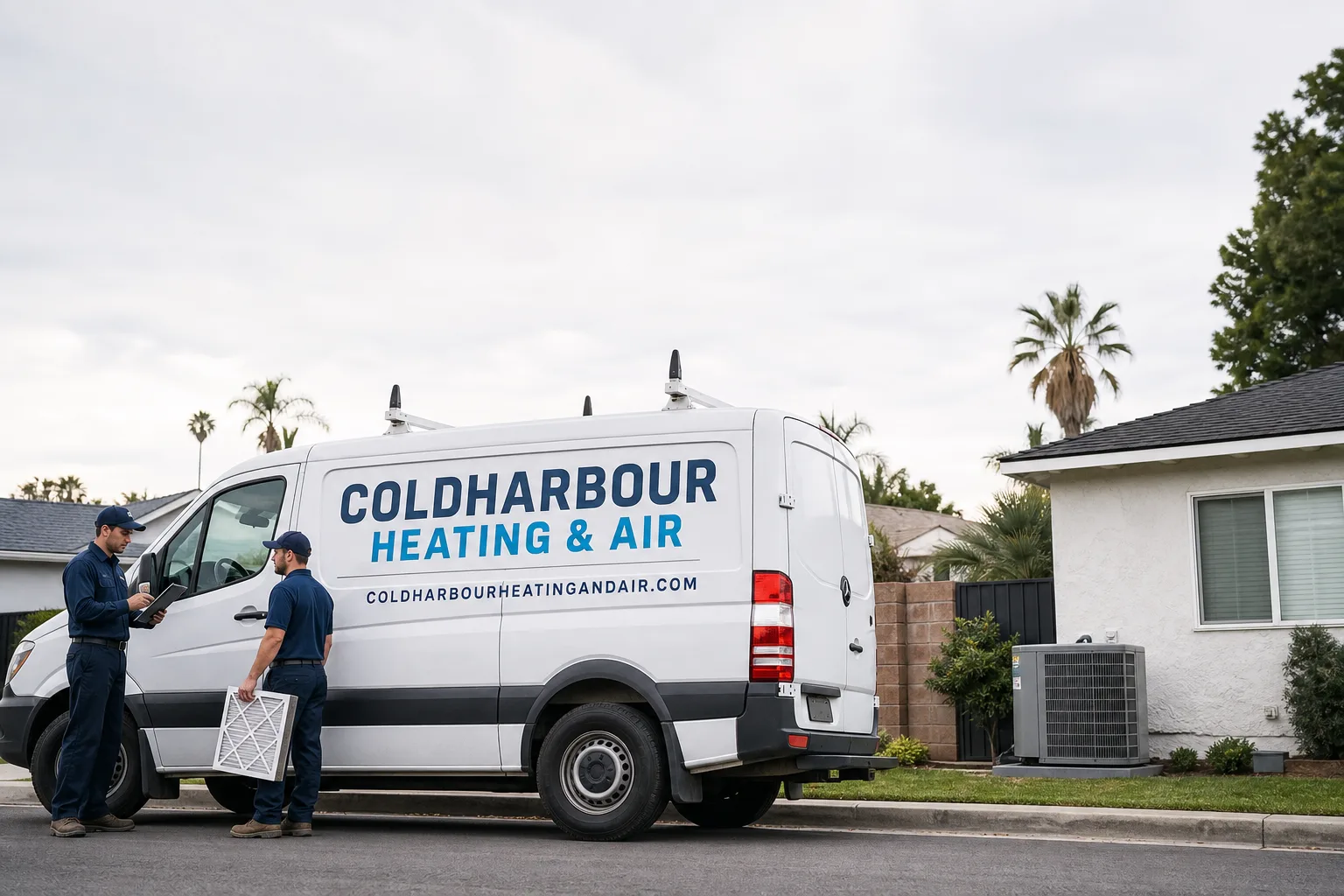
Seasonal tune-up and full diagnostic on your Carrier, Trane, or Goodman system - readings shown to you before any repair is proposed
Diagnosis first, numbers second - you approve the repair price before a single part goes in.







 Before
 After
After Before
 After
After Before
 After
AfterFast, Reliable AC Installation Across Newtown
Most central air installations in Newtown run $3,500-$7,500 for a complete split-system replacement, and every job starts with a written, fixed-price quote before any equipment gets ordered. Our AC Installation team dispatches from our Philadelphia office and carries the full Kingswell standard to every home in Newtown, from the stone colonials of the historic borough to the center-hall colonials in Newtown Grant and Chancellor Park. Call (817) 402-2972 for a free estimate and a firm install date.
We’ve been handling Newtown’s split personality since 2003. One zip code, two completely different HVAC worlds. The borough’s 18th- and 19th-century rubble-stone homes demand creative solutions, ductless retrofits, and a respectful hand with historic fabric. The township’s 1990s-2000s planned communities need straight talk about 20-to-35-year-old builder-grade systems that are quitting in waves. We know both sides cold.
Why Coldharbour Heating & Air Is Newtown’s Preferred AC Installation Company
We’re independently owned and operated under the Kingswell network, which means we answer to our neighbors, not a corporate office. That matters in Newtown, where a bad install in a stone colonial can mean plaster damage you can’t undo, and where a sloppy replacement in Newtown Grant wastes money on oversized equipment that short-cycles through humid July nights.
Our technicians are background-checked, uniformed, and trained on nine major brands: Carrier, Trane, Lennox, Goodman, Rheem, York, Daikin, Bryant, and American Standard. We don’t send a trainee to figure out your system on your dime. We send someone who’s done this exact job before.
Phones get answered by a live person 24 hours a day, 7 days a week. No voicemail trees. No “call back during business hours” when your compressor quits on a Saturday night in August and the dew point won’t drop below 65°F.
Every repair carries our 365-Day Done Right Promise in writing. If it fails, we come back and fix it at no charge. The guarantee goes on paper before the technician leaves. That’s The Kingswell Way: say the price before the work, show up in the window given, leave the place cleaner than found, put the guarantee in writing, come back if it fails.
Ductless Mini Split Installation in Newtown
Ductless Mini Split Installation in Newtown solves the problem that stone-and-plaster walls created two centuries before air conditioning existed. In the borough’s historic district, there’s no basement chase, no attic plenum, no stud cavity wide enough for conventional ductwork. A mini-split runs a slim refrigerant line set through a 3-inch exterior penetration, then mounts the evaporator high on a wall or recessed in a ceiling. No gutted rooms. No compromised plaster.
A typical ductless installation in Newtown runs $3,500-$7,500 depending on the number of indoor heads and the complexity of the line-run. Single-zone systems for a carriage-house conversion or summer kitchen start at the lower end. Multi-zone whole-home solutions in larger borough homes climb toward the upper range.
Historic District Solutions
We work with Newtown Borough’s historic commission requirements on façade-visible installations. That means hiding line sets behind downspouts, running them through existing chimney voids, or using slim-duct cassettes that recess into period-appropriate soffits. We’ve learned which blocks have strict review and which don’t. Saves everyone a permit headache.
Township Additions and Conversions
In Newtown Township, mini-splits often serve finished basements, attic offices, or garage workshops that the original builder-grade system never reached. The main house keeps its central air; the new space gets independent zoning without fighting the existing duct layout.
AC Replacement in Newtown
AC Replacement in Newtown is accelerating as the township’s 1990s-2005 construction wave hits simultaneous system failure. Those original Goodman, Rheem, or York builder-grade units were sized for cheap electricity and loose construction standards. They’re failing now, and square-footage rule-of-thumb sizing guarantees a replacement that’s wrong for the home.
A proper replacement starts with a room-by-room Manual J load calculation. In Newtown Township’s 2,500-4,500 sq ft center-hall colonials, that means accounting for the upgraded windows, added insulation, and finished basements that changed the original heat gain. In Newtown Borough’s stone walls and plaster interiors, it means recognizing that 18-inch rubble construction doesn’t behave like standard framing. Oversized tonnage short-cycles, wastes electricity, and never pulls the mid-60s dew-point humidity out of the air.
Load Calculation First
We measure every room, check insulation levels, count windows and their orientation, and account for internal heat loads. The calculation takes about 90 minutes. The right-sized system runs longer cycles at lower speed, dehumidifies properly, and lasts years longer than a brute-force oversized unit.
Written Fixed Price Before Ordering
Once we size the system, we give you a written price that includes equipment, labor, permits, and disposal of the old unit. That price doesn’t change when the crew arrives. We order to the spec, schedule a firm install date, and handle any rebate or financing paperwork you need.
Trusted Brands We Service in Newtown
We install and service Goodman, Rheem, York, and Daikin systems regularly in Newtown, and we maintain local parts inventory for fast turnaround when a compressor or coil fails in peak season. Goodman offers solid value for straightforward township replacements. Rheem and York bring proven reliability in the humid Delaware valley climate. Daikin’s inverter-driven heat pumps handle both cooling and heating efficiently, which matters when winter nights drop into the teens and summer dew points cling for weeks. Our technicians train factory-direct on all nine brands we cover, so the person who shows up knows your equipment, not just the theory.
Common AC Installation Problems We See in Newtown Homes
- Flooded condensers in the borough’s low-lying historic blocks. Units sitting below grade on rubble-stone foundations take on water that township pad-level installs never see. Restarting without electrical isolation, refrigerant-charge verification, and compressor winding tests risks instant catastrophic failure.
- Oversized replacement systems in stone-and-plaster homes. Contractors who size by square footage alone install tonnage that blasts cold air, shuts off fast, and leaves the walls sweating with trapped humidity. The valley’s mid-60s°F dew points make this a comfort and mold issue, not just an efficiency problem.
- Missing surge protection on new installs. A post-outage power surge through a builder-grade panel can destroy a new blower motor and scramble thermostat calibration the same week it’s installed. We see this after every major storm.
- Generator incompatibility on high-efficiency variable-speed systems. Not every portable generator produces clean enough power for modern inverter-driven compressors. We specify interlock requirements before install so your backup plan actually works.
Pricing for AC Installation in Newtown, PA
Here’s what we charge for the work homeowners in Newtown actually need:
| Service | Price Range |
|---|---|
| AC Installation (standard split system) | $3,500-$7,500 |
| AC Repair (post-flood diagnostic and restart) | $150-$650 |
| Tune-Up (pre-season capacitor and refrigerant-charge check) | $80-$200 |
What moves the number? System size, efficiency rating, ductwork condition, electrical panel capacity, and whether we’re running new line sets through historic plaster or dropping into an open township basement. We don’t guess. We inspect, calculate, and hand you a written price before you decide. Estimates are free. Financing and rebate paperwork are handled in-house.
In Newtown Borough’s historic district, a flooded outdoor condenser on a rubble-stone foundation can’t simply be dried and restarted. The unit often sits below the grade of the original 18th-century cellars, so a post-flood restart means full electrical isolation, a refrigerant-charge check, and a compressor winding test before the breaker goes back on. That same flooded condenser in Newtown Township’s open-basement homes is usually just a pad-level rinse-and-dry. Knowing which Newtown you’re in saves time, money, and equipment.
After a summer storm flooded a carriage-house conversion off South State Street in Newtown Borough, our tech pulled the disconnect on a waterlogged Bryant condenser, tested the capacitor and compressor windings, and found a shorted run capacitor that would have fried the compressor on restart. We flushed the condenser coil, recharged the refrigerant, and added a surge protector at the disconnect. The homeowner now has a working system and a plan for the next outage.
We Also Serve Cities Near Newtown
Our crews work AC Installation in Newtown regularly and also handle calls across Bucks County in Richboro, Langhorne, New Hope, and Morrisville. Same Kingswell standards, same written guarantees, same live-answer phones. Dispatch and scheduling run from our Philadelphia office; local technicians serve each community from stocked vans.
Serving Newtown, PA - Our Local Coverage Area
We’re based in the Newtown area and know this community well. Use the map below to see our service coverage - if you’re nearby, we can almost certainly help.
FAQs About AC Installation in Newtown
No. In Newtown Grant and similar township developments, pad-level flooding usually means water in the electrical compartment, and closing the breaker with a wet capacitor or contactor creates a dead short that can destroy the compressor. Pull the disconnect, let it dry, and have a technician test the capacitor, contactor, and compressor windings before restart. Call (817) 402-2972 for a same-day flood diagnostic.
Thick rubble-stone walls and plaster interiors in the borough have no duct chases and different thermal mass, so conventional forced-air installation requires either high-velocity small-duct systems or ductless mini-splits with careful line-set routing. Township homes from the 1990s-2000s have open basements, standard framing, and existing ductwork that supports straightforward split-system replacement. The sizing calculation differs too; stone mass delays heat gain, which changes the load profile.
We recommend both. The Delaware valley’s summer storms produce frequent outages and post-restore surges that damage modern control boards and inverter drives. A surge protector at the disconnect costs far less than one emergency compressor replacement. If you run a portable generator, we specify compatible interlock hardware during install so your backup power doesn’t fry the variable-speed blower we just put in.
Minimum federal SEER2 is 13.4, but we typically specify 15-17 SEER2 for Newtown homes because the extended cooling season and high dew points reward longer, lower-speed cycles. Higher SEER2 units with variable-capacity compressors dehumidify better, which matters when July humidity lingers for weeks. We’ll match the efficiency tier to your budget and calculate the payback on your actual electric rate.
Three signs: repeated refrigerant leaks (especially at the outdoor coil), compressor hard-starting or tripping the breaker, and repair estimates exceeding 30% of replacement cost. Most township systems installed during the 1990s-2005 boom use R-22 refrigerant, which is now prohibitively expensive and no longer manufactured. A failed compressor on an R-22 system is almost always a replacement trigger. We give honest assessments; our techs aren’t paid on what they sell.
Call (817) 402-2972 for your free estimate. We’ll size the system for your actual home, give you a written price that doesn’t change, and schedule a firm install date that works.
Written by Victor Mancini, Owner at Coldharbour Heating & Air, serving Newtown since 2003.