
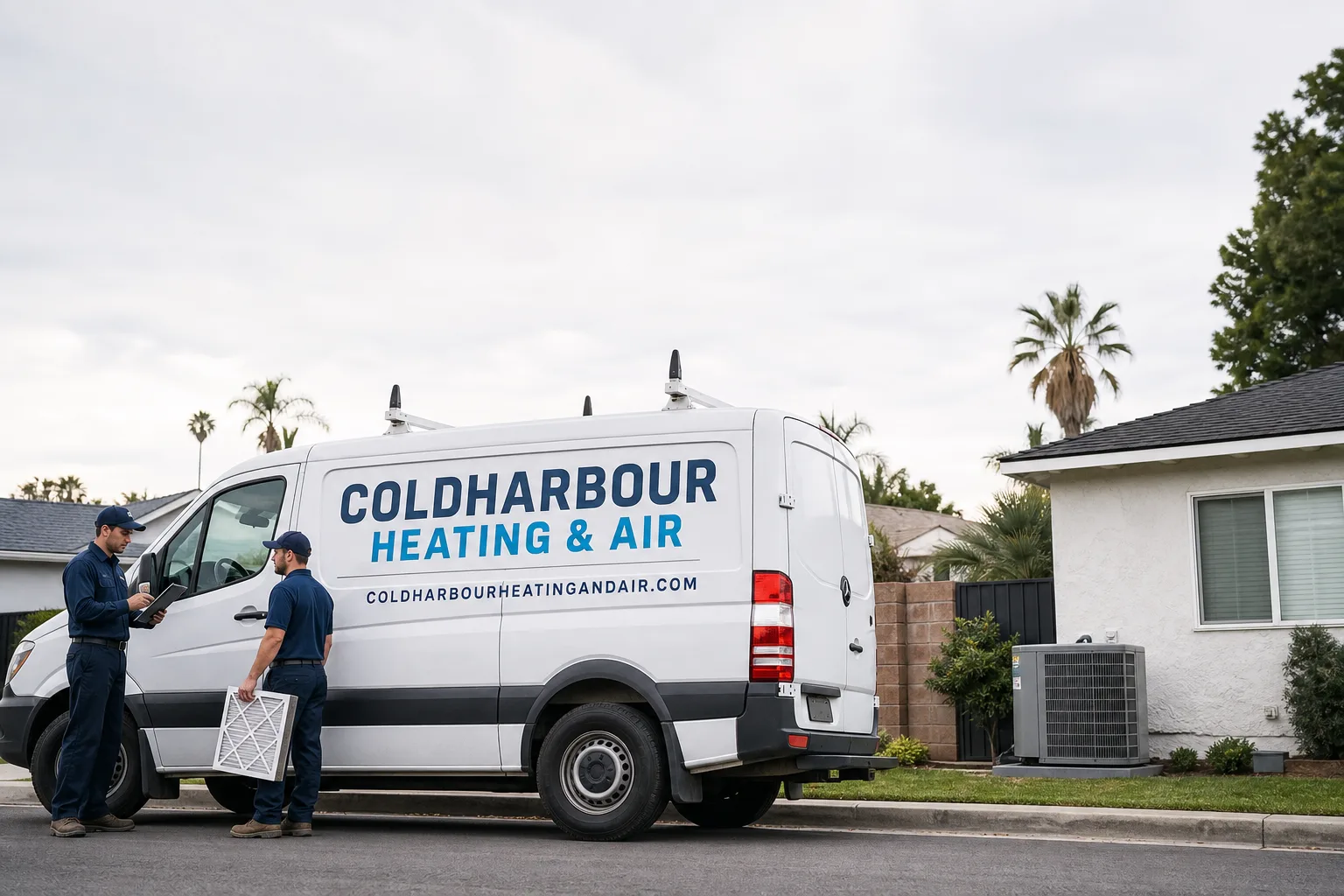
Seasonal tune-up and full diagnostic on your Carrier, Trane, or Goodman system - readings shown to you before any repair is proposed
Diagnosis first, numbers second - you approve the repair price before a single part goes in.







 Before
 After
After Before
 After
After Before
 After
AfterFast, Reliable AC Installation Across Progress Village
AC Installation in Progress Village typically costs $3,500-$7,500 for a standard split system, and most jobs are scheduled within a few days after your free estimate. We’re Coldharbour Heating & Air, and our AC Installation team works these 1959-era CBS block homes week in and week out. We know the low-pitched attics, the retrofitted ductwork, and the summer storms that flood condensers along Progress Village Drive. If you’re ready to replace a window-unit holdover or a failed retrofit, call us at (817) 402-2972. We’ll send a written price before any work starts, and we answer the phone live, 24 hours a day.
Why Coldharbour Heating & Air Is Progress Village’s Preferred AC Installation Company
We’ve been serving Hillsborough County since 2003 as an independently owned and operated member of the Kingswell network, and Progress Village is one of our most frequent stops. Our technicians are background-checked, uniformed, and trained on nine major residential HVAC brands, including Rheem, York, and Daikin, so whatever system you’re moving away from, we can size and install the right replacement.
Our dispatch and scheduling are coordinated from our Miami office, with crews rolling to Progress Village daily. We don’t give you a four-hour window and show up late. We give a firm arrival time, and we stick to it. That’s The Kingswell Way: say the price before the work, show up in the window given, leave the place cleaner than found, put the guarantee in writing, and come back if it fails.
Every AC Installation we complete carries our 365-Day Done Right Promise. The guarantee is written, not verbal. If anything we installed fails within a full year, we return and correct it at no charge.
Ductless Mini Split Installation in Progress Village
Ductless Mini Split Installation in Progress Village is often the smartest path for homeowners whose 1960s CBS block homes were never built for central ductwork. These systems use a compact outdoor condenser paired with one or more wall-mounted indoor air handlers, connected by a small refrigerant line set that runs through a 3-inch hole in the exterior wall. No attic ductwork. No fighting the 140°F heat gain of an unconditioned low-pitched roof cavity. For a typical Progress Village home of 900-1,400 square feet, a single-zone or multi-zone mini split runs in the same $3,500-$7,500 range as a conventional split system, but without the hidden costs of duct fabrication, sealing, and thermal jacketing in a space that was never engineered for it.
When the Attic Can’t Take Another Retrofit
We’ve opened too many Progress Village attics to find two generations of abandoned ductwork crammed alongside active flex runs, none of it sealed, all of it baking. A ductless mini split bypasses that mess entirely. The indoor unit mounts high on a living room or bedroom wall, pulls return air from the same room, and delivers conditioned air exactly where you stand.
Zoning for Multi-Generation Households
Many Progress Village homes house extended family across a modest footprint. A multi-zone mini split lets the front bedroom run at 74°F while the back room stays at 70°F, each with its own thermostat. No more closing vents and overworking a single central blower.
AC Replacement in Progress Village
AC Replacement in Progress Village is rarely a simple swap. The existing system you’re replacing was likely retrofitted into a home built for window units, and the ductwork, electrical, and pad placement all need honest evaluation before we quote. A straight equipment swap without addressing the underlying infrastructure is how homeowners end up with a new 16-SEER2 condenser performing like a 12-SEER2 because it’s breathing through kinked flex and leaking returns. Our AC Replacement jobs start at $3,500 and run to $7,500 depending on tonnage, electrical upgrades, and how much duct remediation the attic requires.
The Load Calculation Comes First
We never size replacement equipment off the old unit’s nameplate. We run a room-by-room Manual J load calculation, accounting for Progress Village’s concrete block construction, single-pane windows common to the era, and the internal heat gain from unshaded west walls. The 1960s low-pitched attic often can’t support the static pressure a modern air handler demands, so we verify duct capacity before we spec any equipment.
Electrical and Pad Inspection
Original Progress Village electrical panels were sized for window units and basic appliances. A modern heat pump or high-efficiency AC may need a dedicated 30-amp circuit or panel upgrade. We check this during the estimate, not on install day. The concrete pad beneath your old condenser may also be cracked or pitched toward the house; if so, we pour a new level pad so drainage runs away from the foundation.
Trusted Brands We Service in Progress Village
Our technicians are trained to install and service nine major residential HVAC brands: Carrier, Trane, Lennox, Goodman, Rheem, York, Daikin, Bryant, and American Standard. For Progress Village homeowners, that means we stock common parts locally and can source equipment quickly without waiting on regional distribution. We’ve installed Daikin heat pumps in the original core near Progress Village Drive, Rheem systems in the infill blocks closer to Riverview, and Bryant condensers throughout the neighborhood. Because we work these brands daily, we know which models hold up best to Progress Village’s combination of salt-air corrosion, summer thunderstorm flooding, and the heavy dehumidification load that runs from April through October. Fast turnaround, local parts inventory, and no guessing about what works here.
Common AC Installation Problems We See in Progress Village Homes
- Flooded condensers after summer storms. Progress Village sits low in unincorporated Hillsborough County, and afternoon convective thunderstorms routinely leave condenser pads underwater. Re-energizing a flooded unit without drying and testing the capacitor, contactor, and compressor windings will short the system. We Megger the compressor and verify insulation resistance before any power is applied.
- Two-generation patchwork ductwork. Open an attic in the 1962 core and you’ll often find an abandoned sheet-metal plenum from the first retrofit, plus an active flex system from the second, neither sealed. We remove the abandoned infrastructure, seal every joint in the active system with mastic, and add thermal jacketing so your new equipment’s efficiency rating actually shows up on the bill.
- Undersized returns choking the blower. Window-unit homes were never designed for central return air pathways. We regularly find 14-inch returns on 3-ton systems that need 18 inches minimum. The blower motor over-amps, the evaporator coil freezes, and the homeowner blames the new equipment. We size returns to the equipment specs, not to the existing wall opening.
- Attic heat gain destroying duct efficiency. Unconditioned Progress Village attics exceed 140°F for months. Flex duct laid directly on top of insulation sweats, sags, and loses capacity. We suspend ductwork off the deck, seal every connection, and install radiant barrier jacketing where the geometry allows.
Pricing for AC Installation in Progress Village, FL
We give you a written price before any work begins. No verbal estimates, no surprises at the door. Here’s what AC Installation and related services cost in the Progress Village market:
| Service | Price Range in Progress Village |
|---|---|
| AC Installation (standard split system) | $3,500-$7,500 |
| AC Repair (post-storm or post-surge diagnosis) | $150-$650 |
| Tune-Up (pre-season capacitor test and refrigerant charge check) | $80-$200 |
What moves you within that range? Tonnage, obviously. A 1.5-ton system for a 900-square-foot CBS home sits at the lower end; a 3.5-ton heat pump with duct remediation for a 1,400-square-foot house with multiple additions pushes toward the top. Electrical panel upgrades, new concrete pads, and extensive duct replacement are quoted separately and listed line-by-line on your written estimate. We also handle rebate and financing paperwork if you’re moving to a high-efficiency heat pump. Call (817) 402-2972 for your free estimate; we’ll survey the home, run the load calculation, and hand you a fixed price before we leave.
Protecting Your New System from Progress Village Storms and Outages
This is the part a generic AC Installation page won’t tell you. Progress Village’s geography and housing stock create specific risks that change how your system must be sized, protected, and restarted after severe weather.
Because Progress Village’s homes were built from 1959 as one of Florida’s first planned Black homeownership communities, nearly every house is a 1959-1975 CBS block home originally cooled by window units - so AC Installation here almost always means retrofitting a central system and ductwork into a low-pitched-roof attic that was never designed to carry conditioned air, a block-by-block consistency you won’t find in the more varied vintage mix of Brandon or Riverview. That attic environment, combined with the neighborhood’s exposure to Tampa Bay’s daily summer thunderstorms and ground-level moisture retention, means we approach every job with storm resilience and humidity control as co-equal priorities to temperature setpoint.
On a 1962 CBS block home in the original Progress Village core, we were installing a 3-ton Carrier heat pump after the family’s second window-unit-era retrofit and the attic showed two different duct systems - one abandoned and one active - with neither sealed, plus a kinked flex run and a return so undersized it was choking the blower motor. We sized the new equipment off a room-by-room load calculation, replaced the unsealed returns, jacketed the attic runs against the 140°F attic heat, and set the refrigerant charge and thermostat calibration; the homeowner’s summer bills dropped despite going to a larger, correctly matched system.
After a storm floods your condenser pad, never simply flip the breaker to test it. The capacitor, contactor, and compressor windings are wet. Applying power to moisture-saturated electrical components shorts the unit, often destroying a repairable compressor. Our protocol: disconnect power, remove and dry the electrical compartment, test capacitance and contactor resistance, and Megger the compressor windings for ground faults. Only then do we re-energize. This is standard on every post-storm call we take in Progress Village.
We also recommend whole-home surge protection for new installations here. Tampa Bay’s lightning density is among the highest in North America, and a single strike on nearby Progress Village Drive can induce voltage spikes that fry control boards in modern variable-speed systems. A surge protector at the disconnect guards the investment you just made.
For extended outages, we consult on generator sizing sufficient to run your new heat pump or AC, not just lights and refrigerators. A 3-ton system needs roughly 7,200 starting watts; many portable generators can’t deliver that. We can specify the right standby or portable unit and coordinate the transfer switch installation with your electrician.
We Also Serve Cities Near Progress Village
Our crews roll throughout Hillsborough County and beyond. If you’re looking for AC Installation in Progress Village or nearby, we also install and replace systems in Tampa, Orlando, Miami, and Jacksonville with the same written pricing, firm arrival windows, and 365-Day Done Right Promise.
Serving Progress Village, FL - Our Local Coverage Area
We’re based in the Progress Village area and know this community well. Use the map below to see our service coverage - if you’re nearby, we can almost certainly help.
FAQs About AC Installation in Progress Village
No. Re-energizing a flooded condenser without testing will likely short the capacitor, contactor, or compressor windings and turn a recoverable system into a total replacement. We disconnect power, dry the electrical compartment, test all components, and Megger the compressor for ground faults before any power is applied. Call (817) 402-2972 and we’ll walk you through the immediate shutdown steps; if water reached the control board, we’ll schedule a same-day assessment.
Your home was built for window units, not central air. The attic was never engineered for ductwork, the electrical panel may need upgrading, and we almost always find abandoned duct systems from previous retrofits that must be removed and sealed. A newer house gets a straight equipment swap; your Progress Village home gets a full infrastructure evaluation, load calculation, and duct remediation to make the new system perform to its rated efficiency. The written estimate breaks out every line item so you see exactly where the difference lies.
We strongly recommend both. Tampa Bay’s lightning density and Progress Village’s exposure to daily summer thunderstorms make surge damage a real risk for modern control boards. A whole-home surge protector at the AC disconnect runs a few hundred dollars and protects your multi-thousand-dollar investment. For generators, a 3-ton heat pump needs roughly 7,200 starting watts; we can specify the right unit and coordinate with your electrician on the transfer switch. Ask about both during your free estimate.
Often, yes. A ductless mini split avoids the attic entirely, running refrigerant lines through a small exterior wall penetration instead of forcing conditioned air through a 140°F space in a duct system that was never properly designed. For homes with multiple additions or extended-family occupancy, multi-zone mini splits also solve the single-thermostat problem common to these modest footprints. The installed cost falls in the same $3,500-$7,500 range as conventional equipment, but without the hidden ductwork costs.
If your system is over 12 years old, uses R-22 refrigerant that’s no longer manufactured, or has required two major repairs in three years, replacement usually makes better financial sense. We also flag replacement when the existing system was clearly oversized or undersized by a previous installer, which is common in Progress Village’s patchwork retrofit history. We’ll give you an honest assessment and a written price for both repair and replacement options; there’s no pressure, and the estimate is free. Call (817) 402-2972 to schedule.
Ready to get your Progress Village home cooled right? Call Coldharbour Heating & Air at (817) 402-2972 for your free, written estimate. We’ll show up in the window we promise, leave your home cleaner than we found it, and back every installation with our 365-Day Done Right Promise in writing.
Written by Victor Mancini, Owner at Coldharbour Heating & Air, serving Progress Village since 2003.