
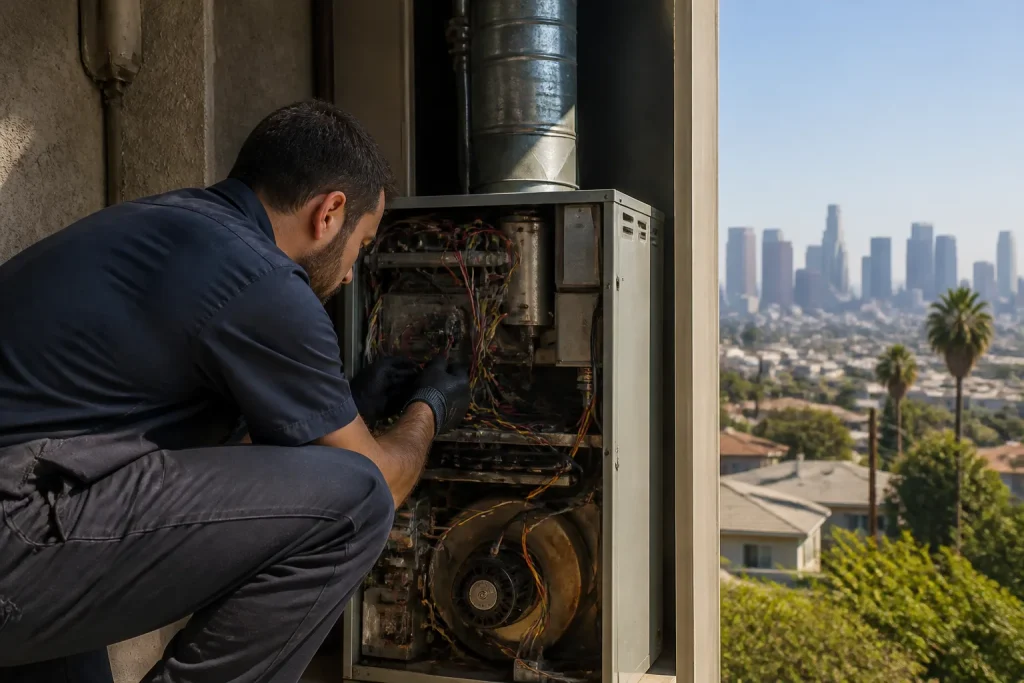
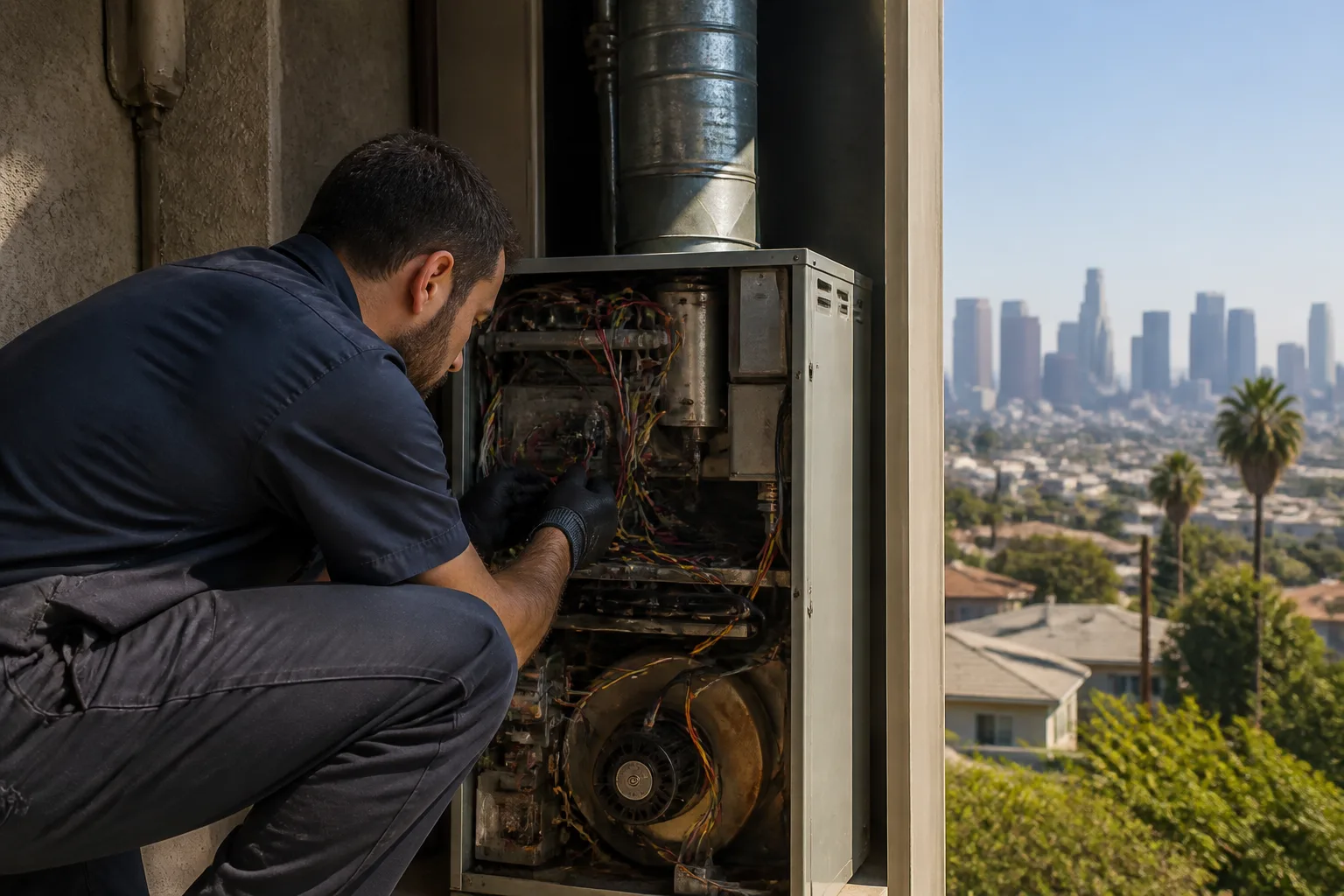
5 Mistakes to Avoid With Furnace Repair
Most furnace repair mistakes aren’t made during the repair itself. They happen in the ten minutes before the technician arrives, when a homeowner does something that seems smart but either wipes out the diagnostic evidence a tech needs or creates a safety hazard that wasn’t there before. Resetting your furnace’s circuit breaker before a technician visits seems logical, but it can clear a fault code that would have pointed directly to the failed component, turning a 30-minute diagnosis into a two-hour one. If you’d rather skip the guesswork entirely, call us at (817) 402-2972 and we’ll walk you through what to do before we get there.
We’ve been fixing furnaces in Los Angeles, and we’ve watched well-meaning homeowners turn small repairs into big ones by doing the wrong thing before we even rang the doorbell. Here are the five mistakes we see most often, and what to do instead.
Key Takeaways
- Don’t reset the breaker or thermostat before a technician arrives. You can erase the fault codes that point to the exact failed part.
- Never run a furnace that smells like it’s burning just to show the technician. That smell can signal a cracked heat exchanger or melting wiring, and running it can cause secondary damage and safety risks.
- Get a written price before any work begins. A verbal quote is nearly impossible to dispute when the invoice lands higher than expected.
- Skip the DIY flame sensor cleaning. Done wrong, it can void your manufacturer warranty and leave you paying for a part the warranty would have covered.
- Ask whether the company guarantees the specific part being replaced. “We guarantee our work” can mean nothing without the part name and the guarantee window in writing.
Mistake #1: Resetting the Breaker or Thermostat Before Diagnosis
This is the one that costs homeowners the most money, and it’s completely understandable why people do it. Your furnace quits in the middle of a cold Los Angeles night. You flip the breaker, you pull the thermostat off the wall and put it back, you press the reset button on the unit. Nothing works, so you call us. But here’s the thing: modern furnace control boards store fault codes when a component fails. Those codes tell a technician exactly what went wrong, from a flame sensor that stopped reading to a pressure switch that stuck open. When you reset power, you frequently clear that code, and now the technician has to recreate the failure from scratch.
We pulled into a house in West Hills last winter where the homeowner had reset the breaker four times trying to get the heat back on. The furnace had a failing inducer motor, and the control board had logged a specific fault code for it. By the time we arrived, that code was gone. What should have been a straightforward diagnosis took an extra hour of cycling the system to make the failure repeat itself. If your furnace won’t start, leave the power alone and call us at (817) 402-2972. If it’s 2 a.m., a live person still answers.
Mistake #2: Running a Burning-Smell Furnace “Just to Show the Tech”
If your furnace smells like something is burning, the absolute worst thing you can do is turn it back on so the technician can see it. We know the impulse, you think you’re being helpful by demonstrating the problem. Please don’t.
That burning smell means one of a few things, and none of them get better with more run time. Dust burning off the heat exchanger after months of sitting idle is the most common cause, and that one is harmless. But the same smell can come from melting wire insulation near a failing blower motor, or from a cracked heat exchanger allowing combustion gases to circulate into your home. A cracked heat exchanger is a carbon monoxide risk, and running a furnace with one is dangerous. Running a furnace with melting wiring risks a fire. If the smell is acrid, sharp, or smells like plastic rather than dusty air, shut the system down at the thermostat, leave the breaker alone, and call us. Describe the smell over the phone. We’ll tell you whether it’s safe to run it at all before we arrive.
Mistake #3: Accepting a Verbal Quote Before Work Begins
Here’s a situation we hear about all the time in Los Angeles. A homeowner gets a call or a visit from a furnace repair company. The technician says the repair will run “about $350.” The homeowner says go ahead. The invoice comes back at $680 because the “about” didn’t include some part or some charge that nobody mentioned up front. When there’s no written quote, there’s nothing to dispute. It’s your word against theirs, and you’re the one holding the invoice.
We do it differently, and we do it differently because it’s written down. Before a single tool comes out, you get a price on paper. That price doesn’t change at the door. If the repair requires something we didn’t anticipate, we stop, we explain it, and we get your sign-off before we proceed. This is a core part of Coldharbour Heating & Air home standards, what we call The Kingswell Way: say the price before the work, show up in the window we gave you, leave the place cleaner than we found it, put the guarantee in writing, and come back if the repair fails. A verbal quote protects the company. A written one protects you.
Mistake #4: DIY Flame Sensor Cleaning That Voids the Warranty
We understand the appeal. Flame sensor cleaning looks simple on YouTube. You pull the sensor out, rub it with steel wool or emery cloth, slide it back in, and your furnace stops short-cycling. The problem is that flame sensors are more delicate than they look, and modern furnaces with Carrier, Trane, Lennox, or American Standard controls are more particular than the units from twenty years ago. If you sand the sensor too aggressively, or you bend the mounting bracket even slightly, or you reinstall it at the wrong angle, the furnace can fail to sense the flame at all. And here’s the kicker: if the sensor is still under manufacturer warranty and you damage it doing a DIY cleaning, the warranty is void. You’ve just converted a covered repair into an out-of-pocket one.
What we see in Los Angeles homes is that flame sensor issues usually need about 20 minutes of work and a cleaning with the right material, not whatever is sitting in your garage. If the sensor is too far gone, we replace it. The repair is covered by our Done Right Promise: if it fails within a year, we come back and fix it at no charge. No warranty voiding, no guesswork, no sandpaper.
Mistake #5: Not Asking Whether the Specific Part Is Guaranteed
“We guarantee our work” is a phrase that means almost nothing unless you know what the work included and how long the guarantee lasts. We’ve had Los Angeles homeowners tell us a previous company guaranteed a repair, only to find out later that the guarantee applied to labor but not parts, or to the original diagnosis but not the replacement component, or that it expired after 30 days. A furnace repair can involve a dozen different parts, and “the work” can mean whatever the company wants it to mean.
Here’s what to ask before you authorize any furnace repair: What specific part is being replaced, and is that part covered by the guarantee? How long does the guarantee last? Will you give me both of those things in writing? At Coldharbour Heating & Air, every repair includes a written guarantee that names the part and the repair, and it’s valid for a full 365 days. If that part fails inside that year, we return and correct it at no charge. Not a reduced charge, not a diagnostic fee, no charge. We put that in writing before our technician leaves, every single time. If a company won’t write down what they promised, the promise isn’t worth much.
When to Call a Pro
Some furnace issues are genuinely quick fixes. A dirty filter, a tripped condensate float switch, a thermostat with dying batteries, those are things any homeowner can handle. But if your furnace is short-cycling, making grinding or screeching noises, blowing cold air, or putting out a burning smell, that’s a trained technician’s job. Furnace repair involves high-voltage electrical connections, gas lines, and combustion components. A mistake with any of those carries real risk to your home and your family. We’d rather walk you through safe checks over the phone than have you open up a furnace cabinet yourself.
If you’re in Los Angeles and your furnace is acting up, we offer free estimates and a live person answers the phone 24 hours a day. Our technicians are background-checked, uniformed, and trained to service all major residential brands including Carrier, Trane, Lennox, Goodman, Rheem, York, Daikin, Bryant, and American Standard. That means whoever comes to your door can work on whatever system is already in your home.
The Bottom Line
Furnace repair mistakes fall into two categories: things you do before the technician arrives that make the diagnosis harder, and things you accept from the repair company that make the bill bigger or the guarantee worthless. Leave the breaker alone. Don’t run a burning-smell furnace. Get the price it written before work starts. Skip the DIY flame sensor adventure. And ask what specific part is guaranteed, and for how long, and get it on paper.
We named ourselves after a cold harbour, the roadside shelter where travelers waited out the weather. Comfort in any season is the job. If you’re in Los Angeles and you need help with your furnace, call Furnace Repair in Los Angeles at (817) 402-2972. Estimates are free, the price is in writing, and the guarantee is on paper before we leave.
Frequently Asked Questions
No. Resetting the breaker, thermostat, or reset button can clear fault codes that modern furnace control boards store, which erases the diagnostic evidence a technician needs to find the failed component quickly. If your furnace has quit, leave the power alone and call us. We’ll walk you through what to check over the phone before we arrive.
It can be. Burning dust after a long idle period is usually harmless, but a sharp, acrid, or plastic-like burning smell can signal melting wiring or a cracked heat exchanger, which carries a carbon monoxide risk. Shut the system down at the thermostat and don’t run it again until a technician has looked at it. Call (817) 402-2972 day or night.
It depends on the failed part. A flame sensor cleanup typically runs $120 to $200. An igniter replacement usually runs $150 to $280, parts and labor included. A blower motor can run $400 to $900 depending on the furnace model. More involved jobs cost more. Whatever the repair, you’ll get a written price before a single tool comes out, and that number doesn’t change at the door.
A real guarantee names the specific part that was replaced, states the length of the guarantee, and covers both parts and labor. Ours runs 365 days and is written down before our technician leaves. If the repair fails inside that year, we come back and fix it at no charge. If a company won’t put their guarantee in writing, ask yourself why.
Written by the team at Coldharbour Heating & Air.
Need HVAC Help?
Call Coldharbour Heating & Air - licensed & insured, here with fast after-hours help in Los Angeles.
(817) 402-2972