
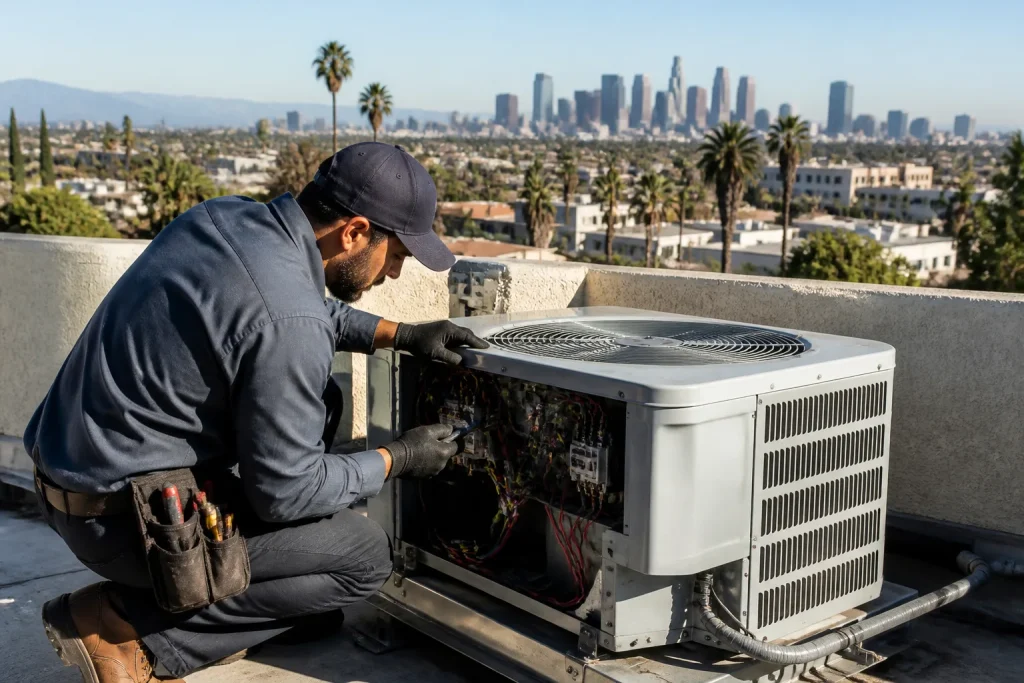
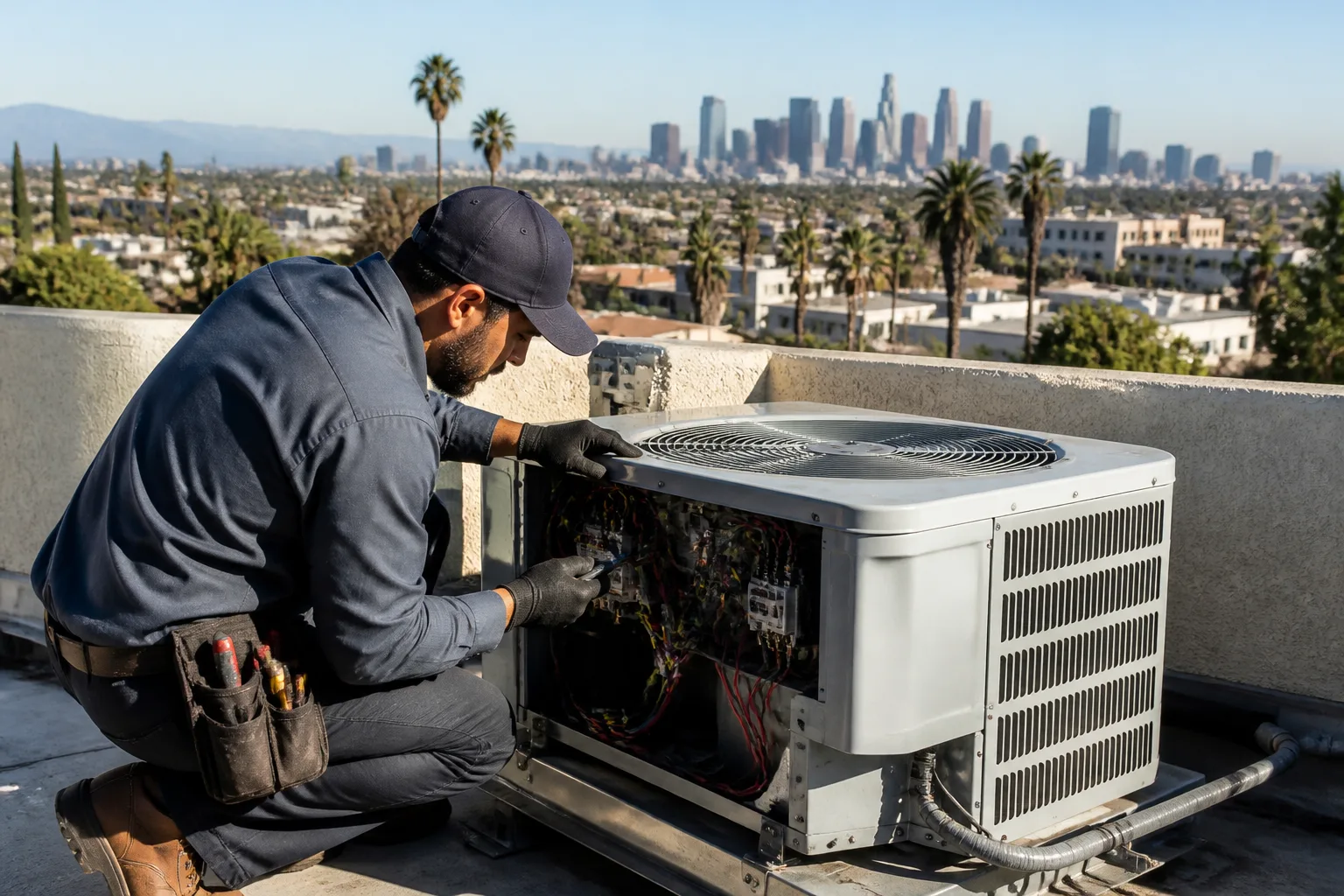
Carrier AC Repair in Los Angeles: A Homeowner’s Guide
Carrier AC repair in Los Angeles typically runs between $160 and $1,200 depending on the failure, with capacitors and contactors on the low end and compressors or TXVs on the high end. Most repairs take a technician 1 to 2 hours once the part is in hand, and many can be completed same-day if diagnosed by noon. If you’d rather not wrestle with a fault code at 9 p.m. on a July night, call (817) 402-2972 and a real person will answer.
Carrier’s Infinity series can run 15-20 years in moderate climates, but Los Angeles’s year-round cooling demand compresses that lifespan. Most Carrier units here hit their first major repair need two to four years earlier than the national average. The reason is simple math: a system in Sherman Oaks or Woodland Hills cycles on 2,800 to 3,400 hours per year, roughly double what the same unit would see in Portland or Seattle. If you own a Carrier in Los Angeles, you’re not doing anything wrong. Your unit is just working twice as hard as the engineering team assumed.
That brings us to the blind spot Victor sees most often. Carrier owners tend to hang onto equipment longer than owners of other brands, trusting the nameplate more than the repair math. The brand deserves that reputation, mostly. But reliability is not the same thing as immortality, and we have pulled more than a few Carrier condensers out of Westside backyards where the repair bill had quietly exceeded $2,500, one service call at a time. This guide is here to help you know the difference between a Carrier that’s still paying you back and one that’s just costing you.
Key Takeaways
- Most Carrier AC repair jobs in Los Angeles fall between $160 and $1,200, with capacitors and contactors being the cheapest and most common failures.
- Fault codes E4, 31, and 33 show up constantly here, and each points to a different system: the control board, pressure switches, or high-limit safety circuits.
- Carrier’s communicating Infinity systems are picky about parts. A mismatched replacement can trigger error loops and void your remaining factory warranty.
- The 10-year parts warranty only applies if you registered the unit within 90 days of installation. Many Los Angeles homeowners never do, which cuts the warranty in half.
- Know the repair cost threshold. Once a Carrier compressor fails after year 10, replacement often beats repair on a dollar-per-year basis. We’ll show you the math below.
How Much Does Carrier AC Repair Cost in Los Angeles?
Here’s a straight answer: most homeowners we serve in Los Angeles pay between $160 and $1,200 for a Carrier repair, depending on what failed. Diagnostic visits run $80 to $120 and are credited toward the repair if you proceed. The cheapest jobs are usually capacitors, which run around $160 to $250 installed. The most expensive residential repair we regularly see is a compressor replacement at $1,200 to $2,400, parts and labor.
To give you a real benchmark, here’s what the four most common Carrier failures in LA actually cost to fix:
| Component | Typical Repair Cost (LA) | What It Does | Average Time to Fix |
|---|---|---|---|
| Capacitor | $160-$280 | Gives the compressor and fan motor their starting jolt | 30-45 minutes |
| Contactor | $180-$320 | Switches 240V power to the outdoor unit | 30-60 minutes |
| TXV (expansion valve) | $520-$950 | Meters refrigerant into the evaporator coil | 2-3 hours |
| Compressor | $1,200-$2,400 | Pumps refrigerant through the whole system | 4-6 hours |
Sanity-check any quote against this table. If someone wants $500 to replace a capacitor, that’s not Los Angeles pricing, that’s highway robbery. If someone quotes you $900 for a compressor, they’re either installing a salvage part or they’ll be back in June with bad news. We hand every customer a written price before any tool comes out of the truck, and that price doesn’t change at the door. That is not a special policy. That’s The Kingswell Way, which Victor and every technician at Coldharbour Heating & Air home follows on every job, no exceptions.
The Three Carrier Fault Codes Los Angeles Homeowners See Most
Carrier Infinity systems are smart enough to tell you what’s wrong, but the error codes read like alphabet soup. You do not need a technical background to understand them. You just need to know which three to look for and what they mean.
Code 31: High-Pressure Switch Trip
This is the most common Carrier fault we see in Los Angeles, and the cause is usually boring: a dirty condenser coil. The coil sits in your outdoor unit and sheds heat. After two or three years of Los Angeles dust, construction grit, and the occasional Santa Ana wind storm, the coil is insulated and the refrigerant pressure climbs until the safety switch trips. The fix is a professional coil cleaning, which runs $180 to $350 at most homes in Burbank or Glendale. Sometimes code 31 points to a failing condenser fan motor instead, which runs $290 to $550.
Code E4: Communication Loss
The E4 code means the Infinity wall controller has lost contact with the outdoor unit. This one is uniquely Carrier because Infinity systems use a communicating thermostat that sends data over a four-wire connection, not the old dumb contact-closure wiring of traditional systems. Think of it as your AC having a LAN cable instead of a light switch. E4 usually shows up after power surges, lightning strikes, or service work where someone pulled a connector loose. Repairs run $160 to $400 depending on whether we’re replacing a damaged wire segment or a control board.
Code 33: High-Limit Lockout
Code 33 means the furnace board has locked out the system because it detected airflow that is dangerously low. In heating season it shuts off the burners. In cooling season it can keep the blower from running at all. The usual suspect in Los Angeles homes is a clogged air filter that has been ignored since last summer, layered over with pet hair and attic dust. Replacing the filter often clears it. If the code persists, the blower motor or the limit switch itself needs attention, which runs $220 to $680.
We have a diagnostic routine we run on every no-cool call that starts with pulling the fault log from the Infinity controller. The controller stores the last 15 events, so even if the system is running again when we arrive, the code history tells us what happened at 3 a.m. That is a small thing, but it’s the difference between fixing what’s actually wrong and guessing.
The Warranty Trap: Carrier’s 10-Year Parts Warranty Is Not Automatic
Here is the thing almost nobody tells you: you do not automatically get the full 10-year Carrier parts warranty. You get 5 years. The full 10-year coverage only activates if the original owner registered the equipment on Carrier’s website within 90 days of installation. If the previous homeowner forgot, or a contractor never mentioned it, your “10-year warranty” ends at year 5.
In Los Angeles, where homes change hands frequently and flippers often replace equipment during escrow, unregistered units are common. We check warranty status on every single repair, because it changes the repair math completely. A $900 TXV replacement becomes a $350 labor-only job if the part is still under warranty. A $2,100 compressor becomes $1,000. You can check your own status on Carrier’s product registration page using the model and serial numbers from the data plate on your outdoor unit. If you bought the house and never did this, take two minutes today. You might have thousands of dollars of coverage sitting there unused.
One more thing, and it matters for Los Angeles specifically: if a prior repair used a non-Carrier part on a communicating Infinity system, the factory can deny warranty coverage on related components. We have seen this happen. A homeowner in Studio City had a third-party blower motor installed by a general handyman. Eight months later the inverter board failed. Carrier’s warranty department flagged the non-approved motor and denied the claim. The repair cost $1,100 out of pocket. On a communicating system, the parts talk to each other. If the replacement part does not speak Carrier’s language, the system notices and the manufacturer can walk. Details like this are exactly why trained, brand-matched service matters more on Carrier than on almost any other residential system.
Is Your Technician Actually Familiar with the Infinity Controller? One Question Tells You.
Carrier’s Infinity controller is not a regular thermostat. It is the brain of a communicating system, and a technician who has never seen one will either fumble through or fake it badly. Before you let anyone touch your system, ask one diagnostic question: “What’s the installed CFM and static pressure on the last cycle?”
A technician who knows Infinity systems will know exactly where to find that data in the service menu and will answer without hesitation. A technician who has only worked on non-communicating Rheem or Goodman systems will blink. That single question takes 10 seconds to ask and separates someone who actually understands your Carrier from someone who is about to learn on your dime. We train our people on nine major residential brands, including Carrier, Trane, Lennox, and American Standard, but Carrier communicating systems get extra attention because the controllers are genuinely different. The question costs you nothing. The confidence it buys you is worth a lot.
Repair or Replace: The Los Angeles-Specific Math
Every Los Angeles homeowner with an aging Carrier eventually faces the same decision: sink another $800 into it, or start over with a new system. The rule of thumb we give people is blunt: if the repair costs more than 40% of the system’s remaining useful life value, replace it. And in Los Angeles, where cooling demand runs 8 to 10 months a year, “remaining useful life” is shorter than the national numbers suggest.
Here’s a concrete example. A 14-year-old Carrier Infinity in Van Nuys needs a $1,700 compressor. That unit, even in perfect working order, might have 3 to 5 years left. Spending $1,700 to buy 3 to 5 more years means you’re paying $340 to $570 per year, with no efficiency gain and a warranty that’s already expired. A new AC installation in Los Angeles costs more upfront but delivers 10 years of parts warranty, higher SEER2 efficiency, and a system sized for your home, not for whoever lived there in 2009. The math is uncomfortable, but ignoring it just means you pay the same money in $500 installments for the next three years and then replace it anyway.
If the compressor fails after year 10 and the unit is not under warranty, we tell people straight: you’re at the decision point. We’ll still fix it if that’s what you want. We’ll write the quote, do the work, and back it with the 365-Day Done Right Promise. But we’ll also tell you the honest per-year math and let you decide. That is how we think a company should operate, and it’s the same approach we take on furnace repair in Los Angeles when a 20-year-old heat exchanger gives up.
For what it’s worth, we see the same blind spot on every brand, not just Carrier. A Goodman owner in Northridge will nurse a 16-year-old unit along for the same reason a Carrier owner in Rancho Park will. Brand loyalty feels like financial prudence. Usually it’s just deferred spending.
When to Call a Pro
If you see code E4, 31, or 33 flashing on your Infinity controller and you don’t know what you’re looking at, call us. If you hear a hard buzzing from the outdoor unit that lasts more than 5 seconds, that is a contactor or capacitor failing under load, and it will not heal itself. If your system runs but won’t cool below 80 on a Los Angeles summer day, low refrigerant or a failing compressor is the likely cause, and both need a licensed technician with proper recovery equipment. If you smell burning plastic near the air handler or condenser, shut the system off at the breaker and call immediately.
Here is a real example from last August. We got a call from a homeowner in Silver Lake whose Infinity system was throwing code 31 every afternoon at 3 p.m. She had already paid a different company $240 to “fix” it, and the code came back four days later. What they had done was clear the code without cleaning the coil. We spent an hour removing two seasons of accumulated dust, pollen, and exhaust film from the condenser coil, verified the subcooling, and the code never returned. Her system has run clean for 11 months since. The problem was not exotic. It was just dirty, and nobody had actually fixed it.
That is the kind of experience that makes Los Angeles homeowners gun-shy, and we get it. It’s also why the AC repair in Los Angeles work we do comes with a written guarantee before we leave the driveway. Not a verbal promise. Paper. If the repair fails within 365 days, we come back and fix it at no additional charge. You’ll find related services on that page if you need more detail about our same-day repair availability across Los Angeles and the San Fernando Valley.
The Bottom Line
Your Carrier is a good machine. That is true. But a good machine in Los Angeles still runs twice the annual hours of the national average, still accumulates dust and grime, still ages, and still fails. The smart play is not to trust the brand name and hope. It is to know your fault codes, check your warranty registration, ask the right question before a technician touches the system, and do the repair-versus-replace math with real numbers. Most Carrier failures in Los Angeles are mechanical and routine: capacitors, contactors, dirty coils. Repair those with confidence and move on. But if you’re looking at a compressor or a TXV on a system past year 10, stop and think hard before you spend.
If you’re in Los Angeles and you want an honest diagnosis from people who work on Carrier systems every day, Coldharbour Heating & Air offers free estimates and written pricing before any work begins. Call (817) 402-2972. A live person answers, even at midnight, because that’s the way we’ve run this company since 2003.
Frequently Asked Questions
Capacitor replacement for a Carrier in Los Angeles typically runs $160 to $280, parts and labor included. The capacitor is a small cylinder inside the outdoor unit that provides the electrical jolt to start the compressor and fan motor, and it is the single most common failure we repair in LA, especially after heat waves. It is a quick fix, usually done in under an hour. Call (817) 402-2972 for a written quote and we’ll tell you the exact price before any work starts.
Code 31 means the high-pressure switch has tripped because refrigerant pressure exceeded safe limits. In Los Angeles, the most common cause is a coil clogged with dust, pollen, and road grime, which stops the outdoor unit from shedding heat and drives up pressure. A professional coil cleaning typically resolves it for $180 to $350. Call (817) 402-2972 and we’ll pull the full fault log from your Infinity controller to confirm the cause before we touch anything.
Look up your outdoor unit’s model and serial number on Carrier’s product registration site. If the original owner registered within 90 days of installation, you have 10 years of parts coverage. If not, the warranty ended after 5 years. We check warranty status on every repair we do in Los Angeles, because a covered part can turn a $900 job into a $350 job. If you can’t find the numbers, call (817) 402-2972 and we’ll help you read the data plate over the phone.
The short answer depends on the repair: capacitors, contactors, and coil cleanings are worth doing on almost any system. But if the compressor or TXV has failed and your Carrier is out of warranty, replacement often makes more financial sense in Los Angeles, where cooling demand ages equipment faster than anywhere else on the West Coast. A 12-year-old system with a $1,700 compressor repair is buying you maybe 3 to 4 more years at $425 to $565 per year, with no warranty safety net. Call (817) 402-2972 and we’ll walk you through the specific numbers for your home, your model, and your actual usage, no pressure.
Written by Victor Mancini, Owner at Coldharbour Heating & Air, serving Los Angeles since 2003.
Need HVAC Help?
Call Coldharbour Heating & Air - licensed & insured, here with fast after-hours help in Los Angeles.
(817) 402-2972