
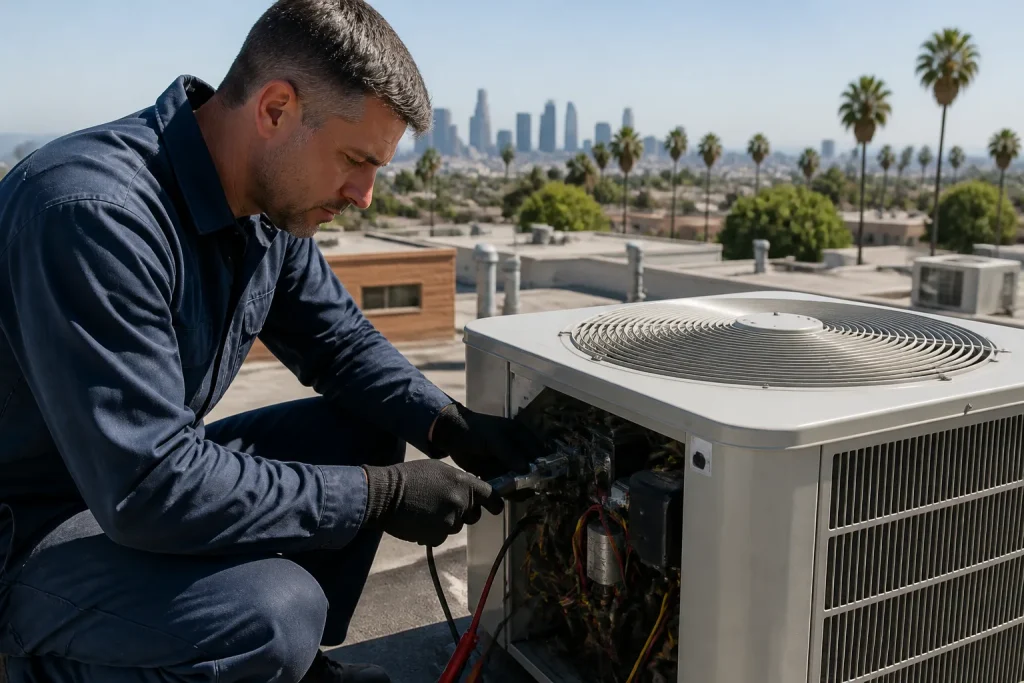
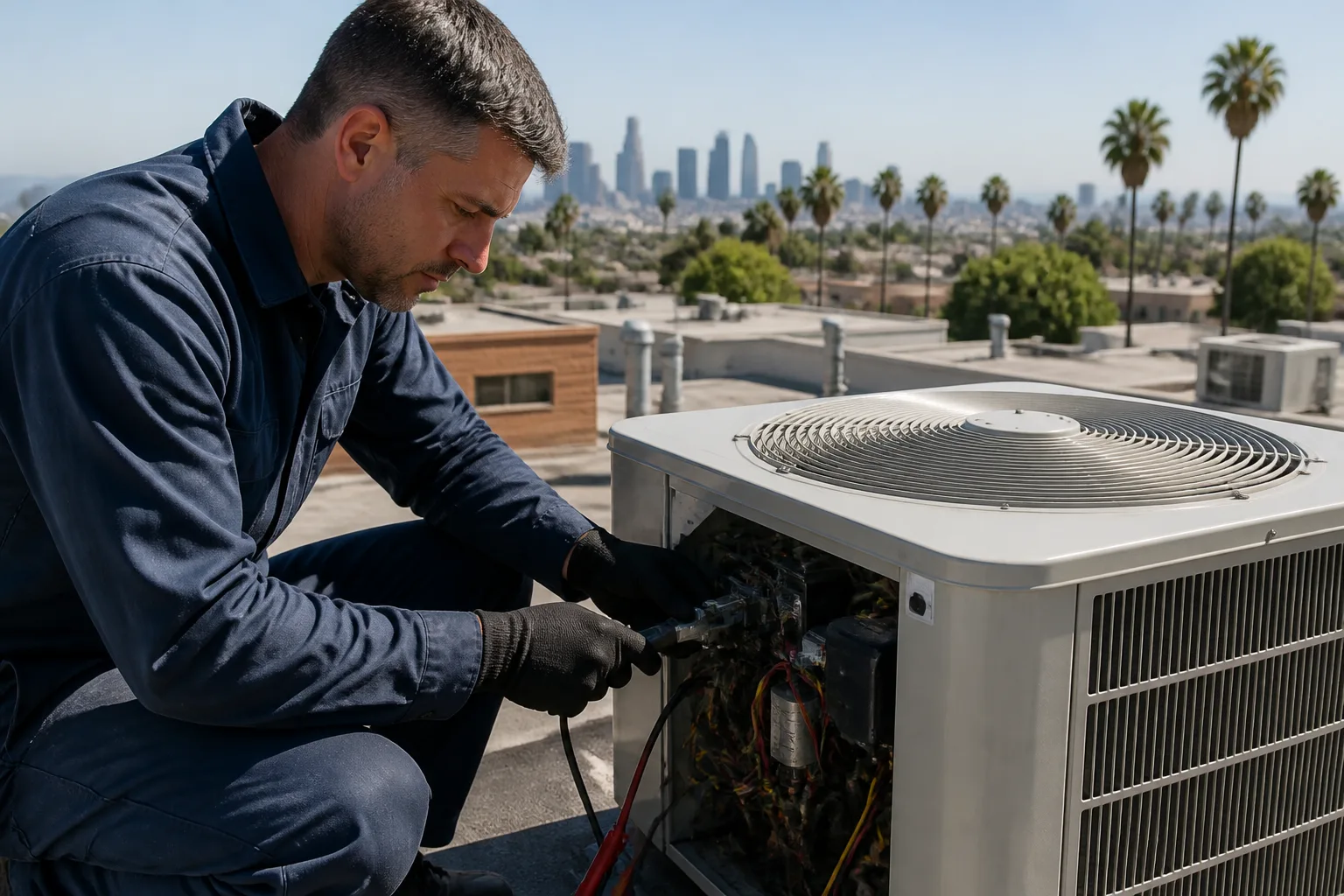
Emergency AC Repair Near Me: What Los Angeles Homeowners Should Do First
If your air conditioner quit on a 96-degree Los Angeles afternoon, start with the breaker panel and the filter before you spend a dime on a service call. Nearly one in three “emergency” AC calls in Los Angeles turns out to be a tripped breaker or a clogged filter, problems you can fix in under five minutes for free. If you’d rather not troubleshoot in a hot house, call (817) 402-2972 and a live person will answer, day or night.
We’ve been answering those calls across Los Angeles since 2003, and we’d rather tell you the truth than sell you a repair you don’t need. Here’s the exact order we walk our own neighbors through when the AC dies.
The 20 Minutes That Can Save You $300
Before you dial anyone, run these four checks in order. Each one takes less than five minutes, and together they eliminate the most common no-repair-needed failures we see in Los Angeles homes every summer. You’ll know within twenty minutes whether you need a technician or just a new filter.
- Check the breaker. Walk to your electrical panel and look for a tripped breaker, usually flipped halfway between ON and OFF. In older Los Angeles homes, AC circuits get overloaded when the whole block runs cooling at once. Flip it fully OFF, then fully ON. If it trips again within the hour, stop resetting it and call a professional. Repeated tripping means a short or a failing compressor, not a fluke.
- Check the thermostat. Confirm it’s set to COOL, not just switched on. Check the setpoint is at least five degrees below room temperature. Weak batteries cause half the “dead AC” calls in our experience. If the display is blank, change the batteries before anything else.
- Check the filter. Pull it out and hold it up to a light. If you can’t see light through it, that filter is starving your system of airflow. A badly clogged filter in Los Angeles dust can ice over the indoor coil and shut the system down entirely. Replace it and wait thirty minutes for ice to melt before restarting.
- Check the condensate drain. Most Los Angeles AC units have a float switch that kills power when the drain line clogs with dust and algae. If the drain pan under the indoor unit is full of water, that’s your culprit. A wet/dry shop vac on the drain line’s outdoor exit often clears it. If you’re not sure where the drain exits, skip this one and call us.
We pulled a float-switch clog out of a system in Sherman Oaks last week where the homeowner had already been quoted $900 for a new compressor by another company. The compressor was fine. The drain was full of sludge. Ten minutes and the system was running. That’s the difference twenty minutes of triage makes.
What to Have Ready When You Call
When you do call for emergency AC repair in Los Angeles, thirty seconds of preparation can save you hours of waiting. Dispatchers send parts and people; give them the right information and the technician arrives ready to work instead of ready to diagnose and drive back for a part. Here’s what speeds up the visit:
- Model number and brand. Find the data plate on the outdoor condenser or indoor air handler. It usually has a model number that starts with a letter. Brands like Rheem, York, Daikin, and Bryant each have specific parts. Knowing the model means we load the right capacitor or control board before the truck leaves.
- Symptom timeline. When did it stop cooling? Was it sudden or gradual? Any strange noises before it died? Did it trip the breaker more than once? A compressor that hums but won’t start is a different repair than one that’s completely silent.
- Last service date. If it’s been years since the system was touched, the problem might be broader than one failed part. If it was serviced last month, the diagnosis narrows considerably.
- Indoor temperature right now. Tell the dispatcher exactly what the thermostat reads. If you have elderly family, a newborn, or pets in the home, say so plainly. It matters for prioritization.
At Coldharbour Heating & Air, a live person answers the phone 24 hours a day, 7 days a week. No voicemail tree, no “we’ll call you back after sunrise.” You’ll speak to someone who can tell you whether it’s safe to wait until morning or whether we need to send a technician now.
How to Read an “Emergency Rate” Before You Agree
Emergency AC repair pricing in Los Angeles varies wildly, and the variance isn’t about quality. It’s about how a company structures its after-hours fee. Some charge a flat emergency dispatch fee, typically $150 to $300 on top of the repair. Others charge time-and-a-half or double-time labor for every hour the technician is on site. Still others charge a “diagnostic” fee that gets waived if you approve the repair.
Ask these three questions before you say yes to anyone:
- Is the emergency fee flat or hourly? Flat means you know the number before the truck moves. Hourly means the final bill climbs the longer the job takes, which is bad for you and fine for the company taking their time.
- Does the diagnostic fee apply to the repair? Some companies charge you to show up, then charge you again to fix. Others roll the diagnostic into the repair price. You want the second kind.
- Will I get a written price before any work begins? If the answer is anything but “yes,” hang up. In Los Angeles, where summer heat pushes people to desperation, the companies that won’t put a number on paper before the work starts are the ones banking on your discomfort.
Coldharbour operates under The Kingswell Way, a set of written standards our network was founded on. Say the price before the work, show up in the window given, leave the place cleaner than found, put the guarantee in writing, come back if it fails. That means the emergency fee is a flat number disclosed before the technician gets in the truck, and the written price for the actual repair is in your hand before a tool comes out of the bag. No surprises at the door, ever.
When the Temperature Becomes a Health Issue
There’s a difference between “uncomfortable” and “dangerous,” and in Los Angeles summers, the line moves fast. For healthy adults, an indoor temperature above 90°F is unpleasant but survivable for a few hours with fans and cold water. For elderly residents, infants, or anyone with a heart or respiratory condition, that same temperature becomes a medical risk within two to four hours.
The concrete benchmark we tell Los Angeles families: if the indoor temperature hits 92°F and anyone in the home is over 70, under 2, or managing a chronic health condition, call for emergency service immediately and consider relocating to a cooler space while you wait. Heat stress in vulnerable people doesn’t announce itself. It builds until it’s serious.
For pets, the danger point is lower than most people think. Dogs and cats can’t sweat efficiently, and breeds with short snouts like bulldogs and Persian cats overheat even faster. If the indoor temperature passes 85°F and your pet is panting heavily or listless, treat that as an emergency.
If you’re in Los Angeles and the heat has crossed that line, call (817) 402-2972 now. We tell you over the phone whether we can get a technician to you fast enough or whether you should move your family somewhere cool first. We’d rather be honest than make a promise the traffic on the 405 won’t let us keep.
Written Arrival Windows vs. “We’ll Be There Today”
Most Los Angeles AC companies promise “sometime today.” That means you’re stuck at home from 7 a.m. to 9 p.m., unable to run errands or leave for work, waiting for a truck that may or may not show. A written arrival window is different. It’s a two-hour block, agreed to before the technician leaves the shop, and the company risks losing your business if they miss it.
Why does this matter so much in Los Angeles specifically? Because traffic is unpredictable, which means companies use it as an excuse for missed windows. A company that gives you a real window plans a route, not a hope. Ask for the window in writing, by text or email, so you have proof of what was promised.
When you call Coldharbour Heating & Air, the dispatcher gives you a two-hour window before the technician heads your way. If traffic blows the window, you get a call before the window closes, not after you’ve already waited four hours wondering. That’s part of The Kingswell Way: show up in the window given.
When to Call a Pro
Some problems are not worth attempting to fix yourself. If the breaker trips repeatedly, if you hear grinding, hissing, or a loud buzz from the outdoor unit, or if you notice warm air blowing from the registers with ice visible on the copper lines at the indoor unit, stop troubleshooting and call. These are signs of a failing compressor, a refrigerant leak, or an electrical short. All of them get worse with time, and some are genuinely dangerous to poke at.
Refrigerant work requires an EPA certification and specialized tools, and compressor work involves high-voltage electrical components and pressurized lines. This is the moment where the cost of a service call is the cheapest money you’ll spend all summer. A trained technician with the right gauge set and multimeter can diagnose in minutes what would take you an afternoon and a burned hand to misdiagnose.
Coldharbour technicians work on nine major residential brands, including Carrier, Trane, Lennox, Goodman, Rheem, York, Daikin, Bryant, and American Standard. If your Los Angeles home has an older Rheem condenser or a York heat pump, the technician who shows up has seen it before and carries parts that fit.
Related services in Los Angeles: AC Repair in Los Angeles, Furnace Repair in Los Angeles, and AC Installation in Los Angeles. If you’re weighing repair against replacement, our team can walk you through the numbers honestly.
The Bottom Line
Los Angeles emergency AC calls often turn out to be simple problems disguised as disasters. Check the breaker, the thermostat, the filter, and the drain pan before you call anyone. If those checks don’t solve the problem, have your model number, symptom timeline, and last service date ready when you make the call. Ask whether the emergency fee is flat or hourly, and insist on a written price before any work begins. And if the indoor temperature passes 92°F with vulnerable people in the home, treat it as the emergency it is.
If you’re in Los Angeles and need help, Coldharbour Heating & Air home offers free estimates and written pricing before any work begins. Every repair we make is covered by the 365-Day Done Right Promise, which means if the repair fails within a full year, we come back and fix it at no charge, in writing. Call (817) 402-2972 and a live person will answer, day or night. We’ll tell you straight whether you need us or whether you can wait.
Frequently Asked Questions
We dispatch technicians across Los Angeles with written two-hour arrival windows, not vague “sometime today” promises. When you call (817) 402-2972, a live person answers and gives you a real window before the truck rolls. Call (817) 402-2972 to check current availability in your neighborhood.
Yes. A written price is handed to you before any work begins, and that price does not change at the door. The Kingswell Way requires it: say the price before the work, on paper, every time. Call (817) 402-2972 for a free estimate on your specific system.
Every repair we make is covered by the 365-Day Done Right Promise. If the repair fails within a full year, Coldharbour Heating & Air returns and corrects the work at no charge. The guarantee is written down and handed to you before the technician leaves. Call (817) 402-2972 if you need service under the warranty.
Our technicians are trained to service nine major residential HVAC brands, including Carrier, Trane, Lennox, Goodman, Rheem, York, Daikin, Bryant, and American Standard. If you have a Rheem, York, Daikin, or Bryant system in your Los Angeles home, the technician who shows up has worked on it before. Call (817) 402-2972 and tell the dispatcher your model number so we load the right parts.
Written by Victor Mancini, Owner at Coldharbour Heating & Air, serving Los Angeles since 2003.
Need HVAC Help?
Call Coldharbour Heating & Air - licensed & insured, here with fast after-hours help in Los Angeles.
(817) 402-2972