
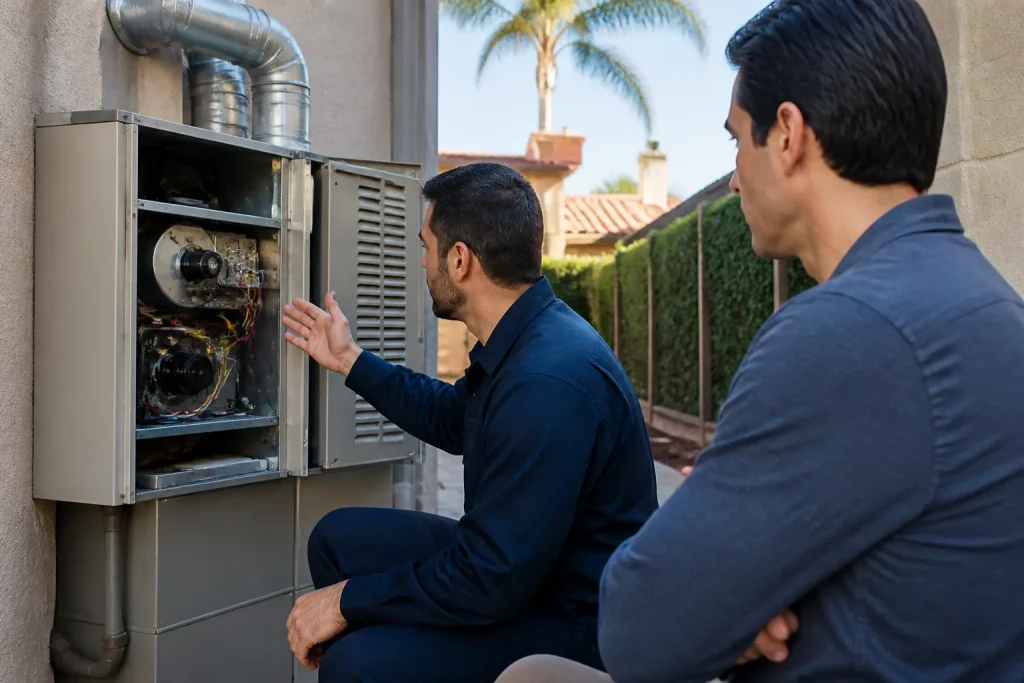
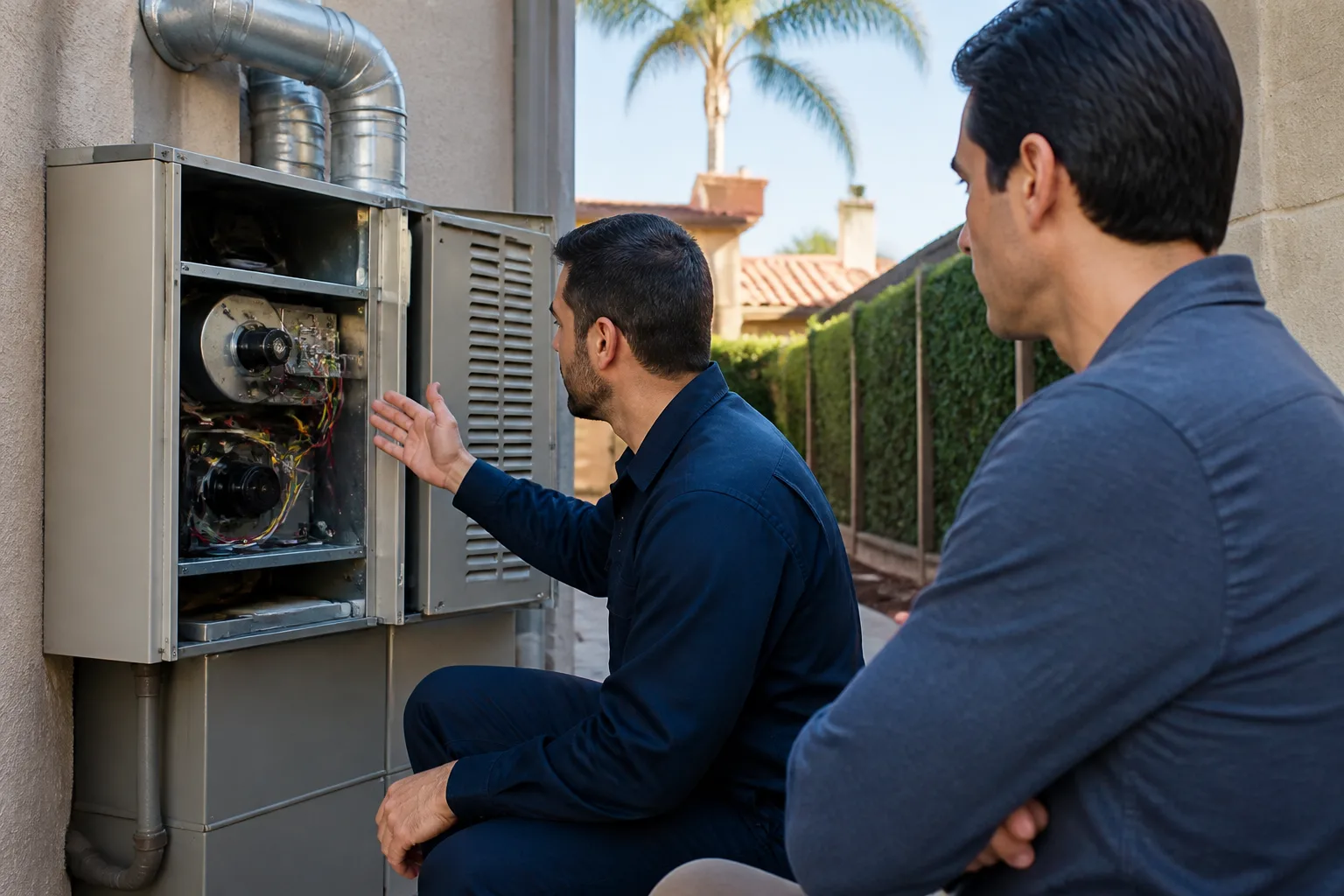
Furnace Repair: Repair or Replace? How Los Angeles Homeowners Decide
In Los Angeles, the repair-or-replace decision works differently than anywhere else in the country. The old “replace at 15 years” rule assumes a furnace runs 1,200 or more hours per heating season, but a typical LA furnace chugs along for maybe 350 hours a year. That means mechanical parts age slowly here, while the heat exchanger ages on calendar time, not run time. If you’re weighing a furnace repair in Los Angeles against a new unit, you need a framework built for this climate, not a national average. And if you’d rather skip the analysis and get a straight answer, call (817) 402-2972 and we’ll take a look.
Why the 15-Year Rule Fails in Los Angeles
The standard guidance you’ll find online says furnaces last 15 to 20 years, then replacement makes more sense than repair. That number comes from heating-heavy regions like Chicago, Minneapolis, or Denver, where a furnace might burn for 1,500 hours every winter. Wear accumulates in the blower motor, the gas valve, the control board, the inducer motor, all the moving parts that cycle every time the system kicks on.
A furnace in Los Angeles doesn’t accumulate those cycles. If your system runs 350 hours a season, in 15 years it has logged roughly 5,250 hours. A Denver furnace hits that same number in about four years. Mechanically speaking, a 20-year-old Los Angeles furnace can be in better shape than a 12-year-old Denver unit. We pulled a 22-year-old Goodman out of a house in Eagle Rock last month that was still running its original blower motor. It failed only because the heat exchanger finally cracked, and that failure had everything to do with age and corrosion, not hours of operation.
So when a technician tells you your 18-year-old LA furnace is “at the end of its life,” ask a better question: which parts are wearing out, and is the heat exchanger still sound? Those are two different timelines, and only one of them cares how much you actually run the heat.
The Heat Exchanger Is the Real Clock
Here’s the distinction most Los Angeles homeowners never hear: low run hours extend the life of motors, valves, and switches, but they don’t extend the life of the heat exchanger. The heat exchanger is the metal chamber that contains the burner flames and lets heat pass into the air your ducts carry through the house. It expands when it heats and contracts when it cools. Every one of those cycles, even a short one, stresses the metal. On top of that, Southern California’s coastal air carries moisture, and moisture plus metal means corrosion over decades, regardless of how often the furnace actually fires.
A cracked heat exchanger is the one furnace diagnosis that justifies replacement on its own, no matter how young or low-hours the rest of the system is. The crack lets combustion gases, including carbon monoxide, escape into the air circulating through your home. The symptoms are easy to misread in Los Angeles because we heat our homes in short, irregular bursts. A slight headache on the first cold morning of December. A little nausea in the evening. A flu-like feeling that fades when you leave the house. People blame the season. We’ve had more than one customer in Sherman Oaks tell us they thought half the family had caught the same bug, when the actual cause was a hairline crack in a heat exchanger that had been spreading for years.
This is where the safety caveat matters: carbon monoxide exposure is genuinely dangerous, and diagnosing a cracked heat exchanger requires the right equipment and training. A trained professional uses a combustion analyzer and a visual inspection scope for this work. If you suspect a crack or your CO detector has alarmed at any point this winter, get a technician out immediately and keep the system off until it’s been checked.
What Furnace Repair Actually Costs in Los Angeles
You can’t make a smart repair-or-replace call without knowing the real numbers, and Los Angeles pricing runs slightly above the national average due to labor costs. Here’s what we see across the city in 2026:
- Igniter replacement: $150 to $280, parts and labor included
- Flame sensor cleaning or replacement: $95 to $180
- Capacitor replacement: $150 to $250
- Pressure switch replacement: $180 to $320
- Inducer motor replacement: $450 to $900, depending on brand
- Control board replacement: $350 to $750, plus labor
- Gas valve replacement: $300 to $650
- Blower motor replacement: $450 to $1,100
- Heat exchanger replacement (if available): $900 to $1,800, with labor
- Full furnace replacement in Los Angeles: $3,800 to $8,500, depending on size, brand, and efficiency tier
Those replacement figures also need a California note. State building code under Title 24 now sets minimum AFUE (Annual Fuel Utilization Efficiency) requirements for residential furnaces sold and installed here. AFUE is simply the percentage of fuel that becomes usable heat. New furnaces in Los Angeles generally need a minimum of 80 AFUE, but many homeowners choose 90-plus AFUE condensing units because the rebate math works better over time. We’ll cover that below.
The Repair Threshold Rule for Low-Hours Furnaces
Every repair-or-replace decision comes down to one simple comparison: how much is the repair, and how much is a new furnace? The rule that makes sense in Los Angeles, given our low annual run hours, is this:
If the repair costs less than 25% of a full replacement, repair it.
Here’s the logic. Let’s say your replacement quote comes in at $5,500. Twenty-five percent of that is $1,375. So if your repair is an igniter at $200, or a gas valve at $450, or even a control board at $700, repair is the obvious call. A low-hours furnace in Los Angeles that’s mechanically sound could run another seven to ten years with a small repair. Spending $450 to protect a $5,500 asset you’d otherwise replace is sound math.
If the repair exceeds 50% of replacement cost, replace the furnace.
At $5,500 replacement cost, a $2,800 repair puts you past the halfway mark. Even if the rest of the unit is in decent shape, at that dollar figure you’re better off directing the money into a new furnace with a fresh warranty, higher efficiency, and a known service history. Coldharbour Heating & Air writes our pricing down before any work begins, so you’ll see exactly where your repair lands relative to a replacement quote before you decide. That’s how the Kingswell Way works: say the price before the work, show the numbers on paper, and let the homeowner choose with clear eyes.
The One Repair That Rarely Makes Financial Sense
There’s an exception to every rule, and in Los Angeles the exception is the inducer motor on an older furnace. The inducer motor is the small blower that pulls combustion gases through the heat exchanger and pushes them out the flue. It fails on cycles, not on hours, so even a rarely used LA furnace can lose one.
The problem is what an inducer failure signals. On a unit over 18 years old, a failed inducer usually means the pressure switch is also original, the control board is original, and the gas valve is original. Each of those parts sits in the same tier of life expectancy. We’ve watched homeowners in Pasadena and Glendale pay $700 for an inducer motor on an 18-year-old Rheem, only to have the pressure switch quit eight months later for another $220, and then the control board two winters after that for another $500. Within two years they’re $1,400 into a furnace they could have replaced for $4,800, and they’re still nursing a unit with no warranty left on the heat exchanger.
Here’s the honest rule from our technicians: if your furnace is older than 18 years and the inducer motor has failed, get a replacement quote before you approve the repair. On a York or Daikin system that’s been well-maintained, that might change the math. But on a standard-efficiency unit of that age, the cascade is the rule, not the exception.
When Repair Is Still the Obvious Choice
None of this means you should rush to replace a furnace that’s having a routine problem. A flame sensor that needs cleaning, an igniter that has simply worn out, a capacitor that’s drifted out of spec, those are maintenance items, not structural failures. We repair those every week in Los Angeles, and we’ve written the Done Right Promise specifically for those jobs: if the repair fails inside a year, we come back and make it right at no charge. That guarantee is on paper before our technician leaves your driveway.
What we recommend for a low-hours furnace between 12 and 20 years old is a proper diagnostic first. Not a salesman’s walkthrough. A technician who puts a combustion analyzer on the flue, checks the temperature rise across the heat exchanger, inspects the burners for rust, and gives you a written report of what’s actually failing and what’s likely to fail next. That report is the foundation of the repair-or-replace decision. At Coldharbour Heating & Air, that means a written price before any tool comes out, and a plain-English explanation of every finding. We’re trained on nine major residential brands, including Lennox, Bryant, and American Standard, so the technician who shows up knows the system that’s already in your home.
Rebates, Title 24, and the Replacement Side of the Equation
If your furnace does need replacement, you’ll want to know about the California money available for it. The state’s Title 24 building efficiency standards mandate minimum AFUE levels for any new furnace installed in Los Angeles, and utility rebates through LADWP and SoCalGas often reward higher-efficiency units. A 90-plus AFUE condensing furnace costs more upfront, usually $1,200 to $2,000 more than a baseline 80 AFUE unit, but with rebates and the lower gas bill over the next decade, the net difference narrows considerably. Our AC Installation in Los Angeles team can walk you through the full rebate stack for any system we quote.
One practical note for Los Angeles homeowners: upgrading to a higher-efficiency furnace sometimes requires new venting. Condensing furnaces produce acidic condensate that can’t run through an old metal flue, so the installation may include a PVC vent line and a condensate drain. That’s a normal part of the job, but it means your old vent stack doesn’t necessarily carry over. A written fixed price from us includes all of that work, not just the furnace itself. No change orders at the door, no surprise line items.
Related Services in Los Angeles
If you’re already thinking about the furnace, this is a good time to look at the other half of your system. Our AC Repair in Los Angeles service covers the cooling side of the same ductwork, and many homeowners find it more economical to address both systems in a single visit. If the furnace diagnosis points toward replacement, see our Furnace Repair in Los Angeles page for how we handle the repair side, or start at the Coldharbour Heating & Air home page for the full picture.
What happens when you call
- 1
A real person answersNo phone trees - you reach a local pro.
- 2
You get an upfront price rangeHonest numbers before anyone is dispatched.
- 3
A background-checked tech heads outLicensed & insured, dispatched right away.
- 4
You approve before work beginsNothing starts until you say go.
The Bottom Line
Los Angeles homeowners should judge their furnace by two clocks. The mechanical clock runs slow here because we barely heat our homes, which means motors and valves can last well past the “national” replacement age. The heat exchanger clock runs on calendar years and corrosion, and when it cracks, replacement is the only safe call, no matter how little the furnace has run. Between those two clocks sits a simple rule: repair under 25% of replacement cost, replace over 50%, and treat an inducer failure on a furnace over 18 years old as a strong signal that the end is near.
If you’re in Los Angeles and you want a straight answer about your specific furnace, Coldharbour Heating & Air offers free estimates. Call (817) 402-2972 and we’ll send a background-checked, uniformed technician who will diagnose the problem, write down a fixed price before any work starts, and put every repair in writing with our Done Right Promise.
Frequently Asked Questions
If the heat exchanger is intact and the repair costs less than 25% of a replacement quote, repair makes sense, even at 20 years old. Los Angeles furnaces run so few hours per year that the mechanical parts often have significant life remaining. The decision hinges on a proper heat exchanger inspection, not the age on the nameplate. Call (817) 402-2972 for an honest assessment with a written price before any work begins.
A complete furnace replacement in Los Angeles typically runs $3,800 to $8,500, depending on size, brand, efficiency tier, and venting requirements. Higher-efficiency condensing units cost more upfront but may qualify for LADWP and SoCalGas rebates that narrow the gap. California’s Title 24 standards also set minimum AFUE requirements for new installations, which a reputable installer will explain before you sign anything.
The symptoms often look like the flu: headache, nausea, dizziness, or fatigue that appears when the furnace runs and fades when you leave the house. Los Angeles homeowners frequently misattribute these signs to seasonal illness because our heating season is short and intermittent. If your carbon monoxide detector alarms or these symptoms appear, shut the furnace off and call a professional immediately. This is a genuine safety risk, not a comfort issue.
Usually yes, if the repair is modest and the heat exchanger checks out. A low-hours furnace in Los Angeles can deliver many more years on a simple repair like an igniter or gas valve. The exception is an inducer motor failure on a unit over 18 years old, which often signals a cascade of other aging parts and makes replacement the better financial call. Our technicians write everything down so you can see the math before you decide.
Written by the team at Coldharbour Heating & Air.
Need HVAC Help?
Call Coldharbour Heating & Air - licensed & insured, here with fast after-hours help in Los Angeles.
(817) 402-2972