
Trane AC Repair in Los Angeles: A Homeowner’s Guide
Trane AC repair in Los Angeles typically costs between $180 and $450 for common issues like capacitor or thermistor replacement, while compressor work can run $1,800 to $3,200. Most Trane repairs are completed in one visit, but parts for less common components can take 3 to 7 days to arrive in Southern California. If your Trane is blowing warm air or making a sound you’ve never heard before, don’t wait, call us at (817) 402-2972 and we’ll diagnose it honestly.
We’re Coldharbour Heating & Air, and we’ve been repairing Trane systems across Los Angeles. We wrote this guide because Trane owners face a specific problem: the brand’s “It’s Hard to Stop a Trane” reputation is so baked in that homeowners often ignore early warning signs, assuming the unit will pull through. It usually will, Trane builds a genuinely tough machine, but durability is not the same thing as invincibility. And in Los Angeles, where a Trane can log 2,000 cooling hours a year, certain components hit their limits earlier than the marketing lets on.
Key Takeaways
- Common Trane repairs in Los Angeles: capacitors, drain pan cracks, and communicating thermostat failures.
- Trane XR and XV units have LED diagnostic blink codes you can read before calling a technician.
- Trane’s registered warranty may require a Trane Comfort Specialist for certain repairs.
- Whole-home surge protection is a worthwhile investment for Trane communicating systems in older LA neighborhoods.
- Parts availability in Southern California is generally good, but specialty components can take up to a week.
Which Trane Components Fail Most Often in Los Angeles?
In our experience, three parts show up on Trane service tickets in Los Angeles more than any others: capacitors, drain pans, and communicating thermostats. None of these are a reflection of poor build quality. They’re a reflection of the local climate.
Capacitors are the cylindrical components that give your compressor and fan motor the electrical jolt they need to start. Los Angeles heat accelerates their aging because the internal dielectric fluid degrades faster at sustained high temperatures. A Trane condenser sitting on a sun-baked roof in Sherman Oaks or an exposed side yard in Woodland Hills can see internal temperatures 30 to 40 degrees above ambient. We replace capacitors on Trane units that are only five or six years old, not because Trane uses cheap parts, but because the heat cycling in the San Fernando Valley is brutal on electrical components.
Drain pans are a quieter failure. Many Los Angeles homes have horizontal Trane air handlers installed in attics, where daytime temperatures can exceed 140 degrees in August. The plastic Trane uses in its drain pans is durable, but years of UV exposure through gable vents and thermal expansion cycles can cause hairline cracks. A cracked drain pan doesn’t announce itself with a bang. It drips. Slowly. Onto ceiling drywall. By the time you see the water stain, the secondary drain line may have been doing the real work for weeks. If your Trane is in the attic and you notice any discoloration on the ceiling below it, that’s a drain pan inspection, not a maybe.
Communicating thermostats, the touchscreen models that talk digitally to your Trane system, fail in a more frustrating way. They lose pairing after power surges. A brownout in Silver Lake, a transformer blow in Highland Park, even a lightning strike a mile away in the Hollywood Hills can scramble the digital handshake between the thermostat and the air handler. The thermostat will still light up and look functional, but the system won’t respond. That’s when knowing how to read your Trane’s error codes helps.
How to Read Trane LED Diagnostic Codes Before You Call
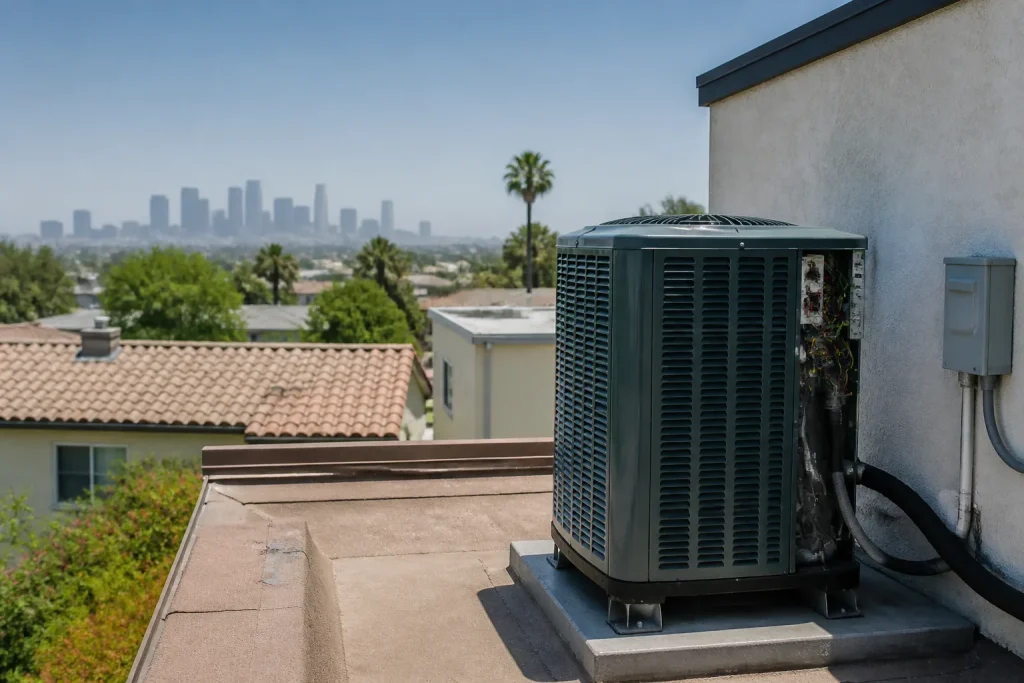
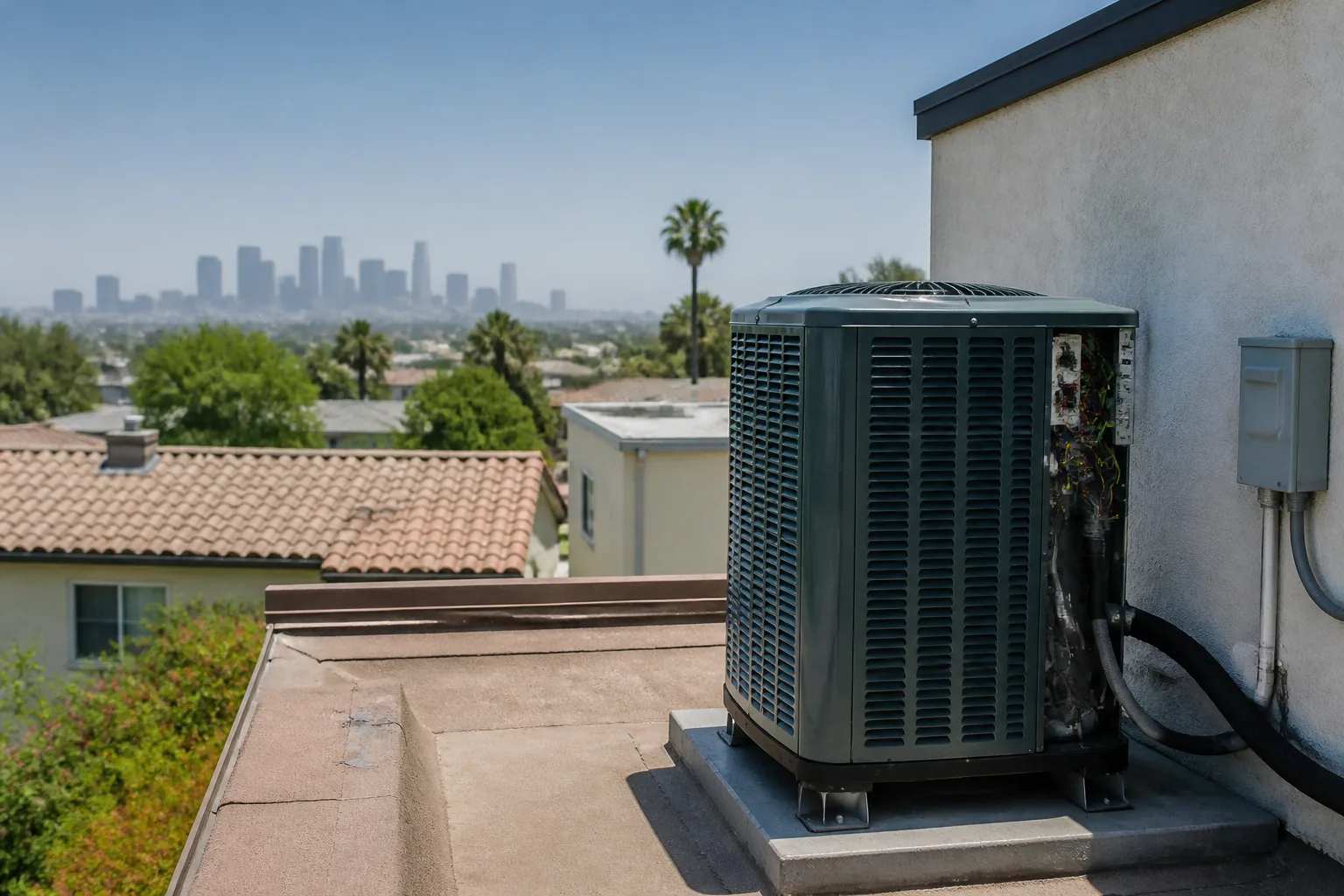
Trane XR and XV series outdoor units have a small LED light behind the access panel that blinks in patterns when something is wrong. You don’t need to be a technician to read these patterns, and knowing what they mean can save you a service call for something simple, or tell you when the problem is genuinely serious.
Here’s what the most common blink sequences mean in plain English:
- Steady ON: The unit has power and is running normally. No action needed.
- 1 blink: The system has locked out after too many failed start attempts. Reset the breaker, wait five minutes, and turn it back on. If it locks out again quickly, call a technician.
- 2 blinks: The outdoor fan motor or its circuit is sensing a problem. This often means a failing capacitor or a fan motor that’s drawing too much current.
- 3 blinks: Low pressure in the refrigerant circuit. This could be a leak or a failing pressure switch. Low refrigerant means reduced cooling and potential compressor damage if ignored.
- 4 blinks: High pressure, which usually means a dirty condenser coil, a blocked airflow, or an overcharged system. Try rinsing the outdoor coil gently with a hose first.
- 5 blinks: A temperature sensor has failed or is out of range. This requires a technician with a multimeter and a replacement sensor.
- 6 blinks: The compressor is drawing too much current or has a fault. This is serious. Don’t keep resetting the breaker, call a professional.
- 7 blinks: The system detects a fault in its communication with the indoor unit, common on communicating models. A power cycle sometimes clears it. A surge often caused it.
Reading these codes won’t make you a DIY repair hero, and honestly, opening a Trane cabinet when you don’t know what you’re doing can be genuinely dangerous because of the high-voltage capacitors inside. But knowing what the blinks mean helps you describe the problem accurately over the phone, which gets you a faster, more honest diagnosis.
Warning: Trane Communicating Systems Are Sensitive to Voltage Fluctuations
Here’s something you won’t see on Trane’s brochure. Trane’s two-stage and variable-speed models, particularly the XV18 and the high-efficiency modulating units, rely on a complex control board that manages the system’s speed and refrigerant flow. That board is sensitive. Not fragile, but sensitive, to the kind of voltage fluctuations that are common in older Los Angeles neighborhoods.
Think about it. A neighborhood like West Adams was wired in the 1920s. Pasadena’s bungalow belt was built for fuses, not 200-amp panels. When a heat wave hits in August and every house on the block is pulling full amperage for their AC, the grid voltage sags. When it recovers, it can spike briefly. A traditional single-stage Trane will shrug that off. A communicating Trane might not, because its control board is essentially a small computer, and computers don’t love turbulence.
We’ve pulled a fried Trane control board out of a house in Eagle Rock after an afternoon transformer issue that didn’t even knock out the lights. The homeowner kept resetting the breaker, the unit kept showing 7 blinks, and by the time we arrived, the board was gone. A whole-home surge protector, a $300 to $600 addition, would have absorbed that spike. For a Trane communicating system, it’s the cheapest insurance you can buy in Los Angeles.
Trane’s Warranty Rules Are Stricter Than Most People Realize
Trane’s warranty is good. It’s not unconditional. And in Los Angeles, where so many homes change hands, the warranty registration history can get murky.
Here’s the thing most Trane owners don’t know: Trane’s registered limited warranty, the one that extends compressor coverage to 12 years instead of 5, only transfers to a new owner under very specific conditions. If you bought a house with a Trane already installed, you may be looking at base warranty coverage, not the extended version. Additionally, Trane can require that certain complex repairs, particularly on communicating systems and variable-speed compressors, be performed by a Trane Comfort Specialist. If a non-certified technician opens up a warranty-covered part and replaces it incorrectly, Trane can deny the claim.
How do you verify a technician’s actual certification? Ask for the Comfort Specialist ID number. A real one exists, it’s verifiable, and the technician should be able to produce it without blinking. Our technicians at Coldharbour Heating & Air work on nine major residential brands, including Trane, Carrier, Lennox, Goodman, and American Standard, and we’ll always tell you before a repair whether your warranty will cover the work and what documentation you need to keep it valid.
One more note: keep your proof of installation and any service records in a file. Trane doesn’t chase you for documentation, but when a compressor fails at year six and your warranty claim hinges on showing that the coil was cleaned twice, you’ll be glad you kept the receipts.
Parts Availability in Southern California: What to Actually Expect
If you search “Trane parts Los Angeles,” you’ll find distributors in Commerce, Santa Fe Springs, and Burbank. That’s good news. Common parts, capacitors, contactors, thermistors, pressure switches, are almost always available same-day or next-day. Our techs routinely pick up a Trane run capacitor from a local supply house and have the system cooling again before lunch.
But less common parts are a different story. A Trane variable-speed control board for an XV18 isn’t sitting on a shelf in Commerce. It ships from Trane’s regional warehouse in Texas or sometimes from the factory. That’s a 3 to 7 day wait, depending on the time of year and the specific part. During a Los Angeles heat wave, expedited shipping helps, but you should still plan for a few days of getting by without the system if you own a high-end communicating Trane.
We always tell homeowners this before the repair is approved: if the part is in local stock, you’ll be cool today. If it’s not, here’s the realistic window, and here’s what we can do to make you comfortable in the meantime, like setting up a portable unit or prioritizing the repair for the moment the part lands.
When to Call a Professional
There’s a line between a homeowner who reads error codes and a homeowner who opens a compressor and gets hurt. That line is high voltage. Trane outdoor units contain capacitors that hold a charge even when the power is off. Touching the wrong terminal can kill you. We’re not saying that to scare you, we’re saying it because it’s true, and because someone’s brother-in-law always “knows a guy.”
Call a professional when you see compressor error codes (6 blinks), when you hear grinding or knocking sounds, when the system is tripping the breaker repeatedly, or when the thermostat is showing a communication error that doesn’t clear after a proper power cycle. These are not YouTube-able repairs. If you’re looking for broader help, we’ve covered AC Repair in Los Angeles in detail, and we also handle Furnace Repair in Los Angeles and AC Installation in Los Angeles when the time comes for a full replacement.
The Bottom Line
Trane builds a tough machine. The “Hard to Stop a Trane” slogan isn’t empty marketing, it reflects a genuinely durable compressor and a well-engineered cabinet. But Los Angeles punishes HVAC equipment in ways that a test lab in Tyler, Texas doesn’t fully replicate. Heat-cycled capacitors die early. Attic drain pans crack. Communicating boards get fried by voltage spikes that don’t even trip your breakers. And the Trane warranty, while strong, has fine print that can leave you uncovered if you don’t know the rules.
The smart Trane owner does three things: reads the blink codes, installs a whole-home surge protector if the system is communicating, and builds a relationship with a technician who actually knows Trane’s quirks before the heat wave hits. If you’re in Los Angeles and you’d rather not guess, give Victor a call. Coldharbour Heating & Air offers free estimates, firm arrival windows, and a written Done Right Promise on every repair, if it fails within a year, we’re back at no charge. Call (817) 402-2972 or reach out through our Coldharbour Heating & Air home page.
Frequently Asked Questions
Most Trane AC repairs in Los Angeles run between $180 and $450 for common issues like capacitors, contactors, and thermistor replacements. More involved work, like a compressor replacement, typically costs $1,800 to $3,200 depending on the model and whether it’s covered under warranty. Every Coldharbour repair includes a written price before work begins, so you’ll know the exact cost before a single tool comes out. Call (817) 402-2972 for a free estimate.
In the Los Angeles climate, where systems run hard from June through October, a well-maintained Trane typically lasts 12 to 18 years. The compressor is the strongest component and often outlives the rest of the machine, but capacitors, fan motors, and control boards may need replacement well before the unit itself reaches the end of its life. Annual maintenance extends the lifespan meaningfully, especially in Valley neighborhoods where summer temperatures push systems harder.
Yes, for most common failures, our Trane repair in Los Angeles is available with same-day service. Capacitors, contactors, pressure switches, and drain pan issues can usually be diagnosed and fixed in a single visit because the parts are stocked locally in Southern California. Specialty components, like a variable-speed control board, may take 3 to 7 days. We’ll tell you exactly what to expect before you approve any repair.
If your Trane is running but not cooling, the most likely culprits are a failed capacitor, a refrigerant leak, or a dirty condenser coil that can’t reject heat. In Los Angeles, where dust and wildfire ash accumulate on outdoor coils, airflow restriction is a common and often overlooked cause. Check the LED blink codes on your outdoor unit first, clean the coil with a gentle hose rinse, and if it’s still not cooling, call a technician to check refrigerant pressures.
The general rule we use: if the repair costs more than 30% of what a new system would cost, and the unit is over 12 years old, replacement is usually the smarter financial move. A compressor replacement on a 14-year-old Trane is a big investment in a machine that may need a new fan motor or control board next. We’ll always give you an honest comparison between repair and replacement, with written pricing for both, so you can make the call without pressure.
Written by the team at Coldharbour Heating & Air.
Need HVAC Help?
Call Coldharbour Heating & Air - licensed & insured, here with fast after-hours help in Los Angeles.
(817) 402-2972