
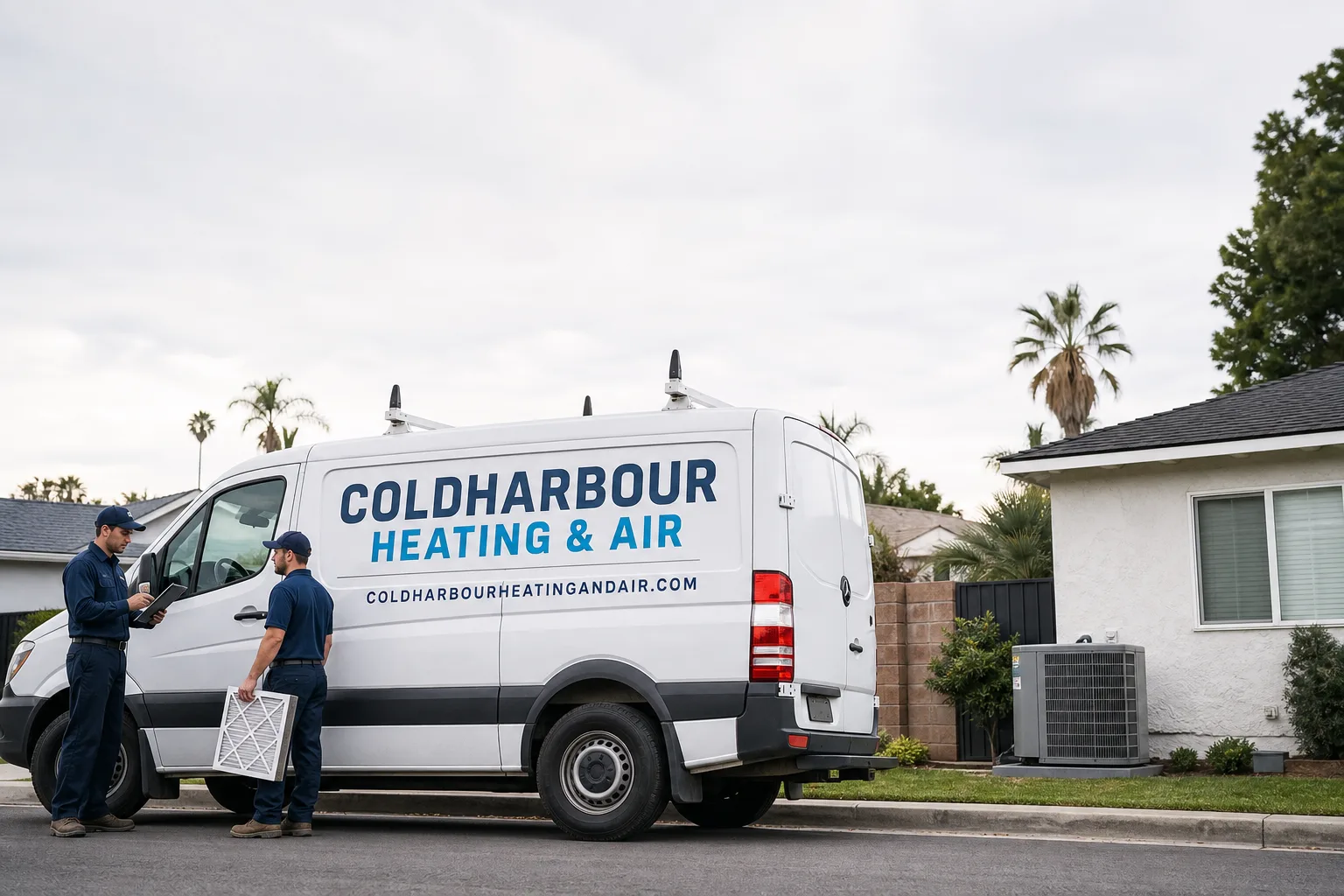
Seasonal tune-up and full diagnostic on your Carrier, Trane, or Goodman system - readings shown to you before any repair is proposed
Diagnosis first, numbers second - you approve the repair price before a single part goes in.







 Before
 After
After Before
 After
After Before
 After
AfterFast, Reliable Furnace Repair Across Bangor Base
Furnace repair in Bangor Base typically costs $150-$700, and most calls are completed in a single visit once access authorization is cleared. We’re Coldharbour Heating & Air, and our Furnace Repair team serves the base family housing areas and support facilities on Naval Base Kitsap-Bangor. Dispatch and scheduling are coordinated from our Seattle office, but the crews that roll through the gate are the same technicians who know these standardized units inside and out. If your furnace is short-cycling, blowing cold, or not running at all, call (817) 402-2972. A live person answers around the clock, and we’ll walk you through the base access process so nothing gets held up at the security checkpoint.
Why Coldharbour Heating & Air Is Bangor Base’s Preferred Furnace Repair Company
We’ve been working the Kitsap Peninsula since 2003, and over the years we’ve learned that Furnace Repair in Bangor Base isn’t like furnace repair anywhere else. The access requirements, the UFC compliance paperwork, the clustered failures across identical housing units, these aren’t things you pick up from a manual. Our technicians are background-checked, uniformed, and trained on nine major residential brands including Goodman, Rheem, and York, so when we clear the gate, we arrive with the right parts and the right documentation already in hand.
Homeowners here, or more often the housing office dispatching on their behalf, tell us the same thing: previous contractors got turned away at the gate, showed up without NAVFAC-approved parts, or didn’t understand that a work order number isn’t optional. We don’t let that happen. Our written price is delivered before any tool comes out of the truck. Our arrival window is firm. And our 365-Day Done Right Promise, a written guarantee included on every repair, means if the fix fails within a full year, we come back and correct it at no charge. No argument, no additional invoice.
Phones are answered by a live person 24 hours a day, 7 days a week. No voicemail trees, no after-hours runaround.
Boiler Repair in Bangor Base
Boiler Repair in Bangor Base covers hydronic heating systems, the kind that circulate hot water or steam through baseboard radiators or in-floor tubing rather than forcing warm air through ducts. While gas furnaces dominate the base family housing stock, some older support buildings and a handful of original 1970s units still run boilers, and when they go down, the humid marine air here makes the problem worse, wet cold seeps in fast and pipe freeze risk is real even in our mild winters. Most boiler repairs in Bangor Base fall in that same $150-$700 range, though cast-iron section replacement or circulator pump swaps can push toward the higher end.
Diagnosing Circulator and Zone Valve Failures
Boilers in this climate suffer from circulator pumps that seize after seasons of disuse and zone valves that corrode from the persistent humidity off Hood Canal. We test flow rates, check expansion tank pressure, and verify that the aquastat, the temperature control that tells the boiler when to fire, is reading accurately. A boiler that short-cycles or runs constantly usually points to a control issue, not a heat exchanger problem.
Pressure Loss and Leak Detection
Closed-loop hydronic systems shouldn’t lose pressure. If yours drops repeatedly, we’re looking for a leak in the loop, a failing pressure relief valve, or a cracked heat exchanger allowing water into the combustion chamber. We pressure-test the system, inspect visible piping, and document findings to the same standard required for NAVFAC work orders.
Gas Furnace Repair in Bangor Base
Gas Furnace Repair in Bangor Base means working on the natural-gas-fired forced-air systems that heat the majority of base family housing, standardized units built in waves from the 1970s through the early 2000s and now managed under a military housing privatization program. These furnaces weren’t built to last forever, and because dozens of identical units were installed simultaneously, we see failure patterns that cluster across whole neighborhoods, weak capacitors in one court, cracked heat exchangers in another, all within the same construction vintage. Repair costs run $150-$700 for most calls, with ignitor replacements and blower motor repairs toward the lower middle of that range and heat exchanger work or gas valve replacement toward the top.
Ignitor and Flame Sensor Service
The hot surface ignitor, a ceramic element that glows white-hot to light the gas, is one of the most common failures we see in these aging systems. When it cracks or burns out, the furnace can’t light at all. The flame sensor, a small metal rod that confirms the burner actually ignited, gets coated with oxidation and soot and starts shutting the system down as a safety measure. Both are straightforward replacements, but the parts must match the housing manager’s approved spec sheet, not whatever the parts house has in stock.
Blower Motor and Capacitor Replacement
Blower motors draw high amps and run hot when they’re fighting undersized, leaky ductwork, which is the norm in these standardized units. We test amp draw against manufacturer spec, measure static pressure to see how hard the motor is working, and replace weak capacitors, the electrical components that give the motor its starting torque, before they take the motor itself with them. It’s cheaper to replace a $40 capacitor than a $400 blower assembly.
Trusted Brands We Service in Bangor Base
Our technicians train on Goodman, Rheem, York, Daikin, and five other major residential HVAC brands, so the person who shows up at your door can work on whatever system is already in the home. For Bangor Base specifically, we maintain relationships with suppliers who stock NAVFAC-preferred and housing manager-approved parts, because a generic replacement that works fine in Silverdale might not meet the Unified Facilities Criteria required here. That pre-approval step adds time to the ordering process, which is why we ask for model and serial numbers upfront when a work order comes through. The right part, the first time, documented to spec. That’s how we avoid a second trip through the gate.
Common Furnace Repair Problems We See in Bangor Base Homes
- Clustered capacitor and blower motor failures. Because base family housing was built in standardized waves, furnaces of the same age and model fail within months of each other. We replaced a weak capacitor in a 1980s-era unit last month, and two neighboring addresses built in the same wave called in with identical symptoms within the week. We now watch for these patterns and stock accordingly.
- High static pressure from original ductwork. The undersized, leaky return ducts in these units strangle airflow, overwork the blower motor, and can cause the heat exchanger to run hotter than designed. A like-for-like furnace swap without correcting the ductwork just repeats the problem on a new unit.
- Humidity-driven corrosion and mold. The persistent marine moisture off Hood Canal attacks electrical components inside air handlers and breeds mold in ductwork. We see corroded control boards, degraded wiring insulation, and blower wheels caked with microbial growth that restricts airflow and smells bad when the heat kicks on.
- Misapplied modern equipment retrofits. Dropping a high-efficiency variable-speed furnace into a system with an old electrical panel and restrictive ductwork creates more problems than it solves. The panel may not support the new control requirements, and without a load calculation and duct correction, the new furnace short-cycles, overheats, and fails early. UFC documentation requirements add another layer that civilian retrofits never face.
Pricing for Furnace Repair in Bangor Base, WA
Most furnace repairs in Bangor Base run between $150 and $700, with the final figure depending on which component failed and whether the repair requires NAVFAC-preferred parts with longer lead times. Here’s how typical calls break down:
| Service | Price Range |
|---|---|
| Furnace Repair (general) | $150-$700 |
| Furnace Tune-Up | $80-$200 |
An ignitor replacement usually lands in the $150-$280 range, parts and labor included. Blower motor repairs or replacements might run $300-$550 depending on whether it’s a direct-drive or modular assembly. Heat exchanger work, gas valve replacement, or control board swaps push toward the upper end of our range. We don’t guess at your price over the phone, we diagnose first, then hand you a written price before any work begins. That price doesn’t change at the door. Estimates are free, and there’s no charge for the call if you choose not to proceed.
We Also Serve Cities Near Bangor Base
Our service region extends across the Kitsap Peninsula and beyond. We regularly dispatch to Seattle, Spokane, Tacoma, and Vancouver for homeowners who need the same written guarantee and upfront pricing we bring to Bangor Base. Each city page has local specifics, but the Kingswell standards don’t change.
Serving Bangor Base, WA - Our Local Coverage Area
We’re based in the Bangor Base area and know this community well. Use the map below to see our service coverage - if you’re nearby, we can almost certainly help.
FAQs About Furnace Repair in Bangor Base
No. Contractors must obtain base access authorization, vehicle passes, and often coordinate through NAVFAC or the privatized housing manager before any work can begin. Unannounced contractor vehicles are turned away at the gate. Coldharbour handles this paperwork as part of our standard process for Bangor Base calls, so ask your housing office to include us on the work order and we’ll take it from there. Call (817) 402-2972 to get started.
Your neighbor’s furnace is probably failing too, just on a slightly different schedule. Base family housing consists of standardized units built in waves with identical equipment installed simultaneously, so components like capacitors, ignitors, and blower motors reach end-of-life across multiple homes within the same few months. We track these clusters and stock parts accordingly. If your unit is a 1980s or 1990s build and you’re seeing repeated failures, expect similar calls from your block.
Because the original ductwork is almost certainly undersized and leaky, and a new furnace pushing against that restriction will short-cycle, overheat, and fail early. Plus, replacement equipment must match the housing manager’s approved specifications and comply with Unified Facilities Criteria, not just Washington State residential code. We perform a load calculation, measure static pressure, and document everything to spec before any replacement is approved through the work-order system.
Yes. The persistent marine humidity causes corrosion of electrical components inside air handlers and promotes mold growth in ductwork and on blower wheels. We see more control board failures and microbial contamination here than in drier inland climates. During any repair, we inspect accessible ductwork and electrical compartments for moisture damage and document findings for the housing file.
No. Work on the installation must comply with Unified Facilities Criteria, federal standards that govern equipment specifications, refrigerant handling documentation, and inspection processes differently than civilian residential code. Our technicians understand these requirements and prepare documentation accordingly, which is why we ask for work order details and housing manager contact information before dispatching to the gate.
Written by Victor Mancini, Owner at Coldharbour Heating & Air, serving Bangor Base since 2003.